How to Eliminate Intercompany Stock Transfers Between a Central Warehouse Entity and Retail Store Subsidiaries
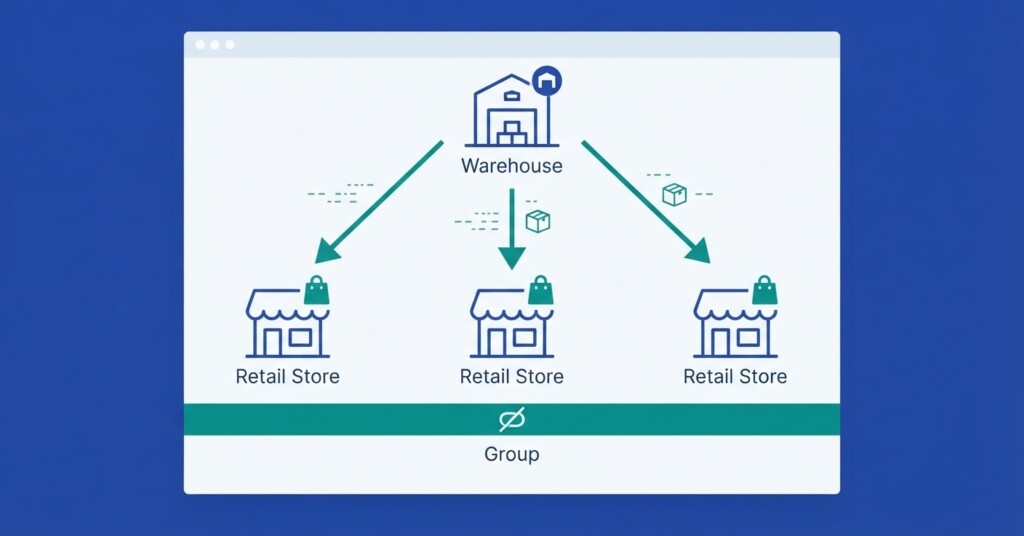
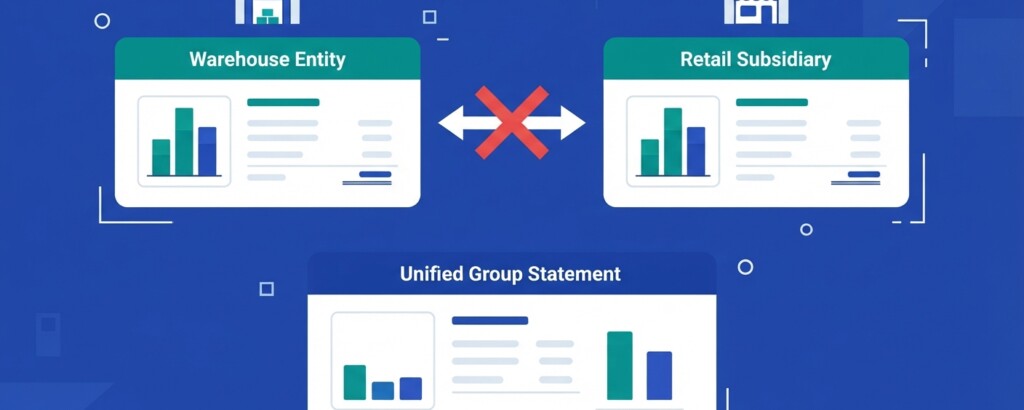
For retail groups operating through a central warehouse entity that distributes inventory to subsidiary store companies, intercompany stock transfers are one of the most common — and most mishandled — consolidation adjustments at month-end. When goods move from a warehouse entity to a retail subsidiary, both entities record transactions on their own books. Left uneliminated at group level, these transactions inflate both group revenue and group inventory, producing financial statements that simply do not represent the economic reality of the business as a single reporting unit.
This article walks through exactly how these eliminations work, why they matter, and where finance teams typically encounter problems — particularly when dealing with unrealised profit in closing stock, FX-denominated transfers, and timing differences between entities.
Why Intercompany Stock Transfers Create Consolidation Problems
Consider a common structure: a parent group operates a central warehouse entity — let us call it WarehouseCo — that purchases goods from third-party suppliers and sells them on to three retail subsidiaries: StoreA, StoreB, and StoreC. Each subsidiary is a separate legal entity. WarehouseCo records sales revenue when it transfers stock to the subsidiaries, and each subsidiary records a stock purchase.
Intercompany eliminations without the manual work.
BrizoConsol identifies and eliminates intercompany balances automatically at consolidation.
From a legal-entity perspective, this is entirely correct. But from a group consolidation perspective, no external sale has occurred. The goods have simply moved within the group. If those goods are still sitting in a retail subsidiary’s closing inventory at month-end, the group financial statements will contain two distortions: inflated revenue (from WarehouseCo’s internal ‘sales’) and inflated inventory (because the subsidiary holds stock at a marked-up transfer price rather than original cost to the group).
The core principle: consolidated financial statements should reflect transactions with parties outside the group only. Any profit or revenue generated purely between group entities must be eliminated before publishing group results.
Step One — Eliminating Intercompany Sales and Purchases
The first elimination is straightforward. If WarehouseCo sold £1,200,000 of stock to the three retail subsidiaries during the month, and those subsidiaries recorded purchases of £1,200,000 in their respective books, the group consolidation must eliminate the entire amount from both revenue and cost of sales (or purchases), regardless of whether the goods have been sold to external customers by month-end.
| Account | Dr | Cr |
|---|---|---|
| Intercompany Sales Revenue (WarehouseCo) | 1,200,000 | |
| Intercompany Cost of Purchases (Retail Subsidiaries) | 1,200,000 |
Elimination of intercompany stock transfers at transfer price — WarehouseCo sales to retail subsidiaries during the period. This entry nets to zero at group level and removes the internal trading loop from consolidated revenue and cost of goods sold.
After this entry, the group income statement shows only purchases made from external suppliers and only sales made to external customers. The internal mark-up that WarehouseCo applies when transferring stock is, however, a separate problem — one that requires an additional elimination step.
Step Two — Eliminating Unrealised Profit in Closing Inventory
Suppose WarehouseCo purchases goods from external suppliers at cost and then sells them internally to the retail subsidiaries at cost plus 20%. If a retail subsidiary holds £300,000 of that stock in closing inventory at month-end, that inventory is sitting on the subsidiary’s balance sheet at the transfer price — not at the group’s original cost.
The unrealised profit embedded in closing stock must be eliminated. Here is how to calculate it:
| Closing inventory at retail subsidiary (transfer price) | £300,000 |
| Mark-up percentage applied by WarehouseCo | 20% |
| Unrealised profit = £300,000 × (20 ÷ 120) | £50,000 |
| Inventory restated to group cost (£300,000 − £50,000) | £250,000 |
| Account | Dr | Cr |
|---|---|---|
| Cost of Sales (Group P&L) | 50,000 | |
| Inventory — Retail Subsidiaries (Group Balance Sheet) | 50,000 |
Elimination of unrealised profit in closing inventory. The group’s cost of sales increases by £50,000 (reducing group gross profit), and the consolidated inventory balance is reduced to the original cost to the group. This entry is reversed in the following period when the goods are sold externally or when opening stock eliminations are processed.
Do not forget opening stock eliminations. If closing inventory adjustments were made in the prior period, those adjustments must be reversed at the start of the new period (typically debiting opening retained earnings and crediting current-period cost of sales). Missing this step is one of the most common errors in manual consolidations and leads to cumulative distortions in group profit.
How Transfer Pricing Affects the Elimination Process
The elimination calculations above assume a consistent, known mark-up applied uniformly across all transfers. In practice, many retail groups use tiered or product-category-specific transfer prices, seasonal pricing adjustments, or even cost-plus arrangements that change quarterly. This makes the unrealised profit calculation significantly more complex.
Finance teams managing this manually in Excel typically maintain a transfer pricing schedule and attempt to apply weighted-average mark-up rates to closing stock by category. This works in principle but breaks down quickly when stock levels change rapidly, when there are multiple currency-denominated transfers, or when the subsidiary holds stock from multiple batch deliveries at different prices.
| Subsidiary | Closing Stock (Transfer Price) | Mark-up Applied | Unrealised Profit to Eliminate | Restated Group Cost |
|---|---|---|---|---|
| StoreA | £120,000 | 20% | £20,000 | £100,000 |
| StoreB | £96,000 | 20% | £16,000 | £80,000 |
| StoreC | £84,000 | 20% | £14,000 | £70,000 |
| Total | £300,000 | — | £50,000 | £250,000 |
Handling FX-Denominated Intercompany Stock Transfers
FX translation adds another layer of complexity. If WarehouseCo operates in GBP and one of its retail subsidiaries — say, StoreC — operates in EUR, the intercompany stock transfer will be invoiced in one currency and translated into another. When performing the elimination, both the revenue recorded by WarehouseCo in GBP and the purchase recorded by StoreC in EUR must be translated to the group presentation currency and then eliminated.
The practical issue is that exchange rates move between the invoice date and the balance sheet date. WarehouseCo may have recorded the sale at an invoice rate of 1.15, while StoreC translates its closing inventory at the period-end rate of 1.18. This mismatch creates a small residual balance that appears in the consolidation working papers — often described as a consolidation FX difference. This difference is not an error; it is a genuine currency translation effect that should be recognised in the group’s foreign currency translation reserve, not buried in cost of sales.
Finance teams using manual Excel-based consolidations frequently misclassify these residual FX differences, leading to out-of-balance eliminations that are then force-resolved by adjusting cost of sales. Automated consolidation tools that maintain entity-level trial balances in source currency and translate consistently to group currency handle this correctly and transparently.
Non-Controlling Interests and the Elimination
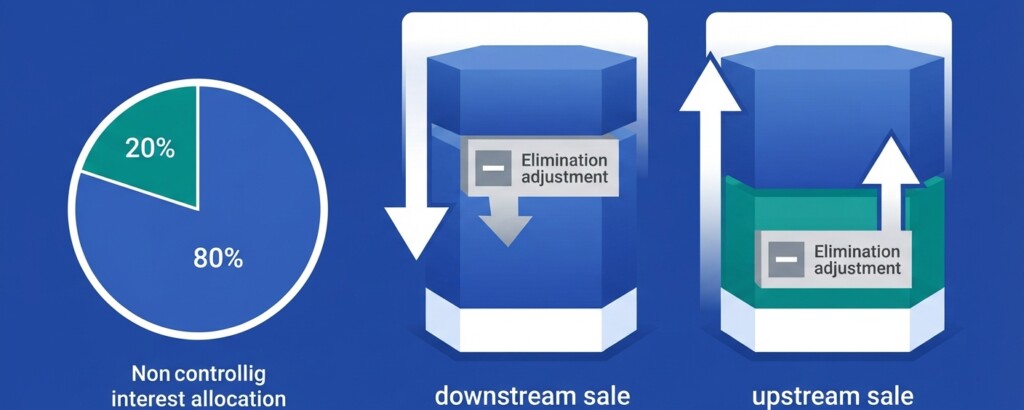
Where the parent does not own 100% of an entity involved in the transfer, finance teams must carefully determine how the unrealised profit elimination interacts with non-controlling interest (NCI) calculations. Consider a scenario where StoreB is 80% owned by the group and 20% owned by an external minority shareholder.
When WarehouseCo (a wholly owned group entity) sells stock downstream to StoreB and that stock remains unsold at month-end, the unrealised profit was recorded entirely in WarehouseCo’s standalone books, not StoreB’s. Because WarehouseCo is wholly owned by the parent, 100% of the unrealised profit elimination is attributed to parent equity. StoreB’s standalone profit and the 20% NCI are completely unaffected.
Under IFRS 10 and other major consolidation frameworks, NCI is only adjusted when the selling entity has non-controlling shareholders — such as in an upstream sale where StoreB sells goods back to WarehouseCo or to another group entity at a mark-up. In that upstream scenario, the unrealised profit was recognised on StoreB’s books, so eliminating it reduces StoreB’s profit and is shared proportionately between the group (80%) and NCI (20%). A frequent error among finance teams is mistakenly deducting unrealised profit from NCI on downstream sales from a wholly owned warehouse, which understates NCI and overstates group equity deductions.
Building the Intercompany Reconciliation Process
A robust group reporting process for retail structures with a central warehouse entity requires the following disciplines to be in place before consolidation can be performed cleanly:
- Maintain a consistent intercompany transaction register: every stock transfer from WarehouseCo to a retail subsidiary should be recorded in a shared ledger or intercompany module with matching reference numbers.
- Agree intercompany balances before close: each entity’s finance function should confirm the intercompany payable or receivable balance before month-end. Discrepancies from timing differences or currency translation should be identified and categorised — not simply written off.
- Classify all intercompany transfers correctly: distinguish between stock transfers (which require unrealised profit calculations), service recharges (management fees, shared services), and financing transactions (intercompany loans). Each category has different elimination rules.
- Document the transfer pricing policy: the mark-up applied by WarehouseCo should be formally documented, consistently applied, and available to the consolidation team. Last-minute changes to transfer prices after ledgers are closed make elimination calculations unreliable.
- Apply eliminations in a structured consolidation layer: never make elimination journals directly in an entity’s own ledger. Consolidation eliminations belong in a separate group consolidation working paper or consolidation module, so the entity’s statutory accounts remain unaffected.
- Test for completeness each period: compare WarehouseCo’s intercompany sales ledger total to the sum of intercompany purchases across all retail subsidiaries. Any gap indicates a missing transaction, a cut-off issue, or a classification error that must be resolved.
Where Manual Processes Break Down — and What to Do About It
Finance teams managing four or more entities often find that intercompany eliminations become the longest part of the month-end process. A central warehouse supplying five retail subsidiaries can generate dozens of individual stock transfer transactions each month. Calculating unrealised profit by entity, by product category, and by FX rate — all in a single Excel model — is time-consuming, error-prone, and difficult to review.
Common failure points in manual consolidations include: elimination journals that do not balance due to rounding; FX residuals that are misclassified; opening stock reversals that are missed or duplicated; and incorrectly allocating downstream profit eliminations to NCI (or failing to allocate upstream eliminations to NCI). Each of these errors is individually small but cumulatively they can materially distort group gross margin and group net assets.
Consolidation software that ingests entity trial balances, maintains a persistent intercompany matching layer, and calculates unrealised profit eliminations automatically based on defined mark-up rules reduces both the volume and the risk of manual work. The output is a set of auditable consolidation journals — equivalent to what is described above — produced consistently each period without rebuilding the model from scratch.
Practical Takeaways for Finance Teams
Intercompany stock transfer eliminations between a central warehouse entity and retail subsidiaries follow a clear logical sequence: eliminate the trading transaction first, then calculate and eliminate unrealised profit in closing inventory, handle FX residuals correctly, and properly attribute eliminations between group equity and NCI based on the direction of the sale. The mechanics are not conceptually difficult, but they become operationally challenging at scale — particularly where transfer prices vary, currencies differ, and entities close on slightly different timelines.
Getting these eliminations right is not just a technical accounting exercise. Group gross margin, group inventory valuation, and NCI balances all depend on them being performed accurately. For CFOs and controllers reviewing consolidated management accounts, unexplained movements in group gross margin month-on-month are frequently traceable to inconsistent intercompany elimination treatment rather than genuine trading performance changes.
Building a disciplined, documented, and repeatable process for intercompany eliminations — whether in a well-structured Excel model or a dedicated consolidation tool — is one of the highest-value investments a growing multi-entity finance team can make.
Automate Intercompany Eliminations Across Your Group
BrizoConsol is built for multi-entity finance teams managing consolidations, intercompany eliminations, FX translation, and group reporting. See how it handles the workflows described in this article.