Acquisitions and Disposals in the Consolidated Cash Flow Statement
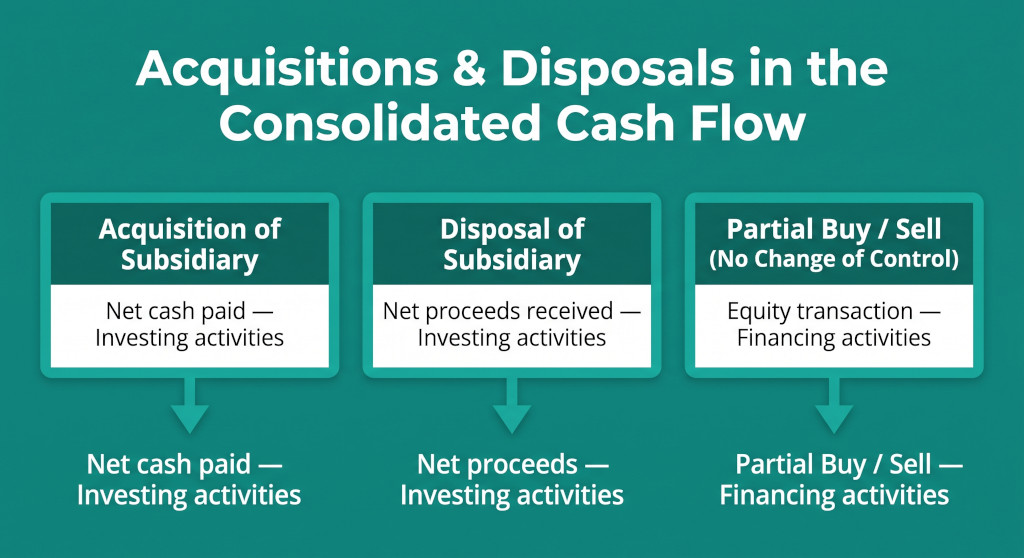
Daniel’s group had a busy year. In March, it acquired a software business for $3.2 million — $2.5 million paid at completion and $700,000 payable in 18 months subject to an earn-out. In July, it sold its retail subsidiary for $1.8 million cash. In October, it bought out a minority shareholder in one of its existing subsidiaries, acquiring an additional 15% for $350,000, taking the group’s stake from 75% to 90%.
Three transactions. Three different answers for where they sit in the consolidated statement of cash flows — and different answers again for what goes in the notes. When Daniel asked his finance team to prepare the consolidated cash flow, they put all three in investing activities. That was wrong for two of the three, and the disclosure was incomplete for all of them.
Acquisitions and disposals are the section of the consolidated cash flow statement most prone to misclassification, because the rules at group level differ fundamentally from the way those transactions appear in any entity’s own accounts. The framework below explains each scenario.
Stop building consolidations in spreadsheets.
BrizoConsol automates multi-entity consolidation — setup in minutes, reports the same day.
The Core Rule: Single Net Line for Each Transaction
When a group acquires or disposes of a subsidiary, IAS 7 (AASB 107 for Australian groups) requires that the cash flow be presented as a single net amount in investing activities — not as a list of the individual assets and liabilities that changed hands. The net amount is:
| Acquisition: Cash consideration paid at completion | |
| Less: cash and cash equivalents held by acquired entity | |
| = Net cash outflow on acquisition | Investing activities |
| Disposal: Cash proceeds received on completion | |
| Less: cash and cash equivalents held by disposed entity | |
| = Net cash inflow on disposal | Investing activities |
The reason for deducting the target’s cash is that the group is, in effect, buying or selling a business that happens to contain some cash. Cash paid to acquire $80k of cash is not a net outflow — the group’s total cash is unchanged to that extent. The individual assets and liabilities acquired or disposed of do not appear in the body of the cash flow statement; they are presented in a disclosure note.
At entity level, acquiring a subsidiary appears in the parent’s accounts as “purchase of investment in subsidiary” — a single line regardless of what was inside it. In the consolidated cash flow, the same economic event must be presented on an after-cash basis, with a supporting note showing what was bought. The difference between these two presentations is visible only in the consolidated accounts.
Acquiring a Subsidiary: The Full Mechanics
The steps for presenting an acquisition correctly in the consolidated cash flow are:
1. Calculate the net cash outflow. Take only the cash paid at or before the reporting date. Deduct the cash held by the acquired entity at the acquisition date (not the reporting date — only the cash that was “inside” the business when control transferred).
2. Show the net amount in investing activities. The label should identify the transaction: “Acquisition of TechCo Pty Ltd, net of cash acquired.” If there were multiple acquisitions, each should appear as a separate line or with a combined line and individual breakdown in the note.
3. Prepare the disclosure note. IAS 7 requires a note for every business combination during the year showing the fair value of each class of assets acquired and liabilities assumed, reconciling to the net cash flow. This is the only place the individual asset and liability fair values appear — not in the body of the statement.
4. Identify the non-cash portion of consideration. Any part of the total consideration that was not settled in cash during the reporting period — deferred cash consideration, contingent consideration, or shares issued — is not a cash flow. It must be disclosed separately as a non-cash transaction, typically in a supplementary note to the cash flow statement.
Worked Example: Acquisition of TechCo
Apex Group acquired TechCo for total consideration of $3.2 million: $2.5 million paid in cash at completion and $700,000 deferred earn-out payable in 18 months. TechCo held $80,000 cash at acquisition. The purchase price allocation identified the following fair values:
| Asset / Liability | Fair value $’000 |
|---|---|
| Cash and cash equivalents | 80 |
| Trade receivables | 420 |
| Property, plant and equipment | 380 |
| Customer relationships (intangible, 5yr) | 620 |
| Brand name (intangible, 10yr) | 240 |
| Goodwill on acquisition | 1,860 |
| Trade payables | (180) |
| Deferred tax liability on PPA intangibles | (220) |
| Total — equals total consideration | 3,200 |
See the goodwill calculation and deferred tax on PPA uplifts for how those numbers are derived.
The consolidated cash flow investing section shows:
| Acquisition of TechCo Pty Ltd, net of cash acquired | ($2,420k) |
Being: $2,500k cash paid at completion less $80k cash acquired
The supplementary non-cash disclosures section shows:
| Deferred consideration recognised on acquisition of TechCo (earn-out) | $700k |
Non-cash financing obligation — no cash flow in current period
Deferred and Contingent Consideration
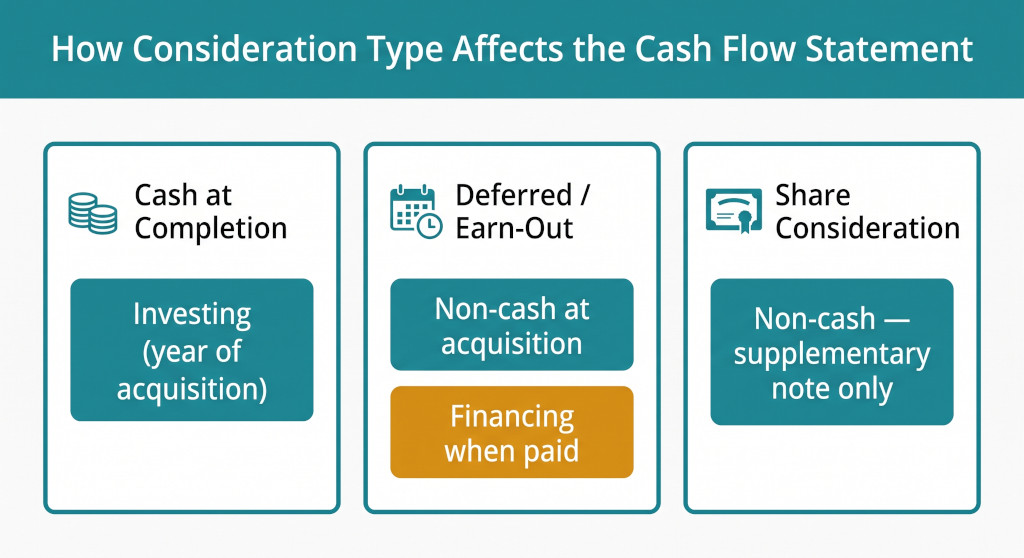
The treatment of deferred and contingent consideration in the cash flow statement is one of the most frequently mishandled areas in practice. The principle is straightforward: cash flow is recognised when cash moves, not when an obligation is recognised.
At acquisition date: Any non-cash element of consideration — a deferred cash payment, an earn-out, or shares issued — does not appear in the cash flow statement. It is recognised as a liability (or equity, for shares) in the consolidated balance sheet and disclosed as a non-cash transaction.
When subsequently paid: The classification depends on what the liability represents. Under IFRS 3 / AASB 3, contingent consideration is a financial liability measured at fair value through profit or loss. When the liability is settled, the question is how to classify the cash outflow.
IAS 7 provides specific guidance: the portion of the payment that relates to the original fair value of the contingent consideration at acquisition date is a financing cash outflow. Any portion paid in excess of that original fair value — representing the subsequent increase in the liability due to fair value changes through P&L — is an operating cash outflow.
In practice, many groups classify the entire earn-out payment as a financing cash outflow for simplicity, which IAS 7 permits where the distinction is immaterial. The accounting policy should be disclosed.
Common mistake: Including deferred consideration in the investing cash outflow in the year of acquisition — showing ($3,200k) rather than ($2,420k) in the worked example above. This overstates the investing outflow and understates the financing outflow in the year the earn-out is eventually paid. The cash has not moved yet, so it is not a cash flow yet.
Share consideration: Where consideration is settled wholly or partly in shares issued by the acquirer, there is no cash flow at all. The transaction is disclosed in full in the supplementary non-cash note. The fair value of shares issued forms part of total consideration in the acquisition note and in the goodwill calculation, but it never passes through the three sections of the cash flow statement.
Disposing of a Subsidiary: Removing the Gain and Presenting Net Proceeds
When a subsidiary is sold, two things must happen in the consolidated cash flow statement:
First, the gain or loss on disposal must be removed from the operating section. The gain is part of consolidated profit, which is the starting point of the indirect method. But no cash is generated by a book gain — the cash comes from the proceeds received, which sit in investing activities. If the gain is not removed from operating activities, it will be double-counted.
Second, the net proceeds from disposal are shown in investing activities: total cash received, less the cash that was held inside the disposed subsidiary at the date of disposal.
Worked Example: Disposal of RetailCo
Apex Group sold its wholly-owned RetailCo subsidiary for $1.8 million cash. RetailCo held $90,000 cash at disposal. The net assets derecognised were:
| Asset / Liability derecognised | Carrying amount $’000 |
|---|---|
| Cash and cash equivalents | 90 |
| Trade receivables | 380 |
| Property, plant and equipment | 960 |
| Trade payables | (290) |
| Bank borrowings | (150) |
| Total net assets derecognised | 990 |
| Proceeds received | $1,800k |
| Less: net assets derecognised | ($990k) |
| Gain on disposal (in consolidated P&L) | $810k |
In the cash flow statement:
| Operating activities: | |
| Gain on disposal of RetailCo (remove from operating) | ($810k) |
| Investing activities: | |
| Disposal of RetailCo, net of cash disposed of | $1,710k |
Being: $1,800k proceeds less $90k cash disposed of
The net effect on the cash flow statement is: ($810k) operating adjustment + $1,710k investing inflow = $900k net cash inflow from the disposal transaction — exactly equal to the proceeds net of cash ($1,710k) minus the non-cash gain ($810k). This confirms the mechanics: the cash received is the proceeds, the non-cash P&L item is the gain, and the two are kept in their correct sections.
If the disposed subsidiary held foreign currency assets, any cumulative translation adjustment that is recycled through P&L on disposal must also be removed from operating activities as a non-cash item. See the detailed treatment in the post on recycling the CTA on disposal of a foreign subsidiary.
Does your consolidation tool handle acquisitions and disposals automatically?
BrizoConsol calculates the net cash flow on acquisition and disposal, generates the IAS 7 disclosure notes, and routes each transaction to the correct section — investing or financing — based on whether control changes. See how it handles a multi-acquisition year. See It In Action
Partial Disposals: Loss of Control vs. No Loss of Control
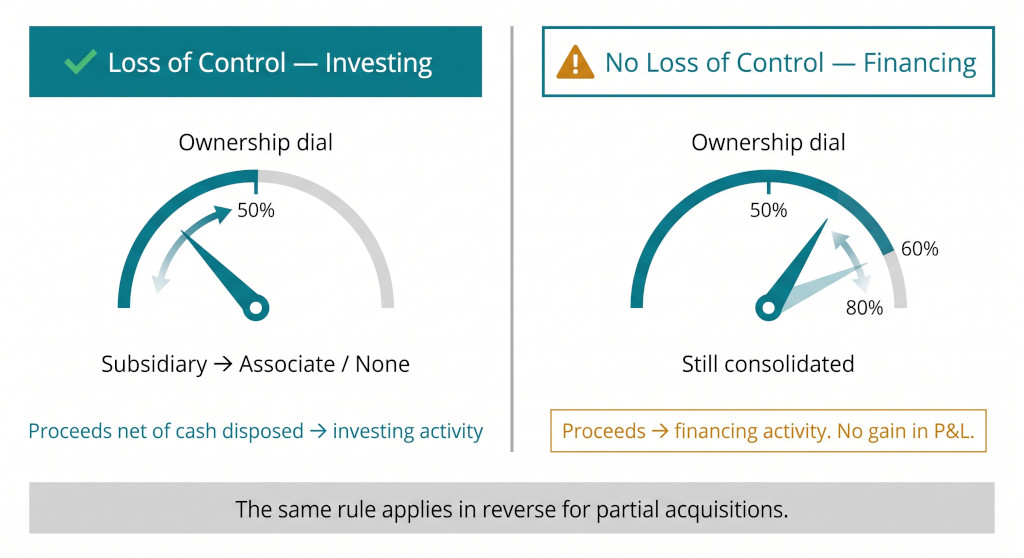
This is the section of IAS 7 that causes the most classification errors, because the answer changes completely depending on whether the disposal results in a change of control.
Loss of control (e.g., sell 60%, retain 40% as associate): This is a disposal of a business. It is presented in investing activities as a single net line: proceeds received less cash held in the subsidiary. A gain or loss on disposal is recognised in P&L and must be removed from operating activities using the same mechanics as a full disposal. The post-disposal retained interest is remeasured to fair value and forms part of the disposal gain calculation.
No loss of control (e.g., sell 20% of a 75%-owned subsidiary, retain 55%): This is an equity transaction. The subsidiary remains consolidated in full. No gain or loss is recognised in P&L. Under IFRS 10, the difference between the proceeds received and the carrying amount of the NCI acquired by the buyer is recognised directly in equity.
In the cash flow statement, proceeds from an equity transaction with NCI are classified as financing activities — not investing. The rationale is that selling equity to a minority is a financing transaction with the group’s capital providers, equivalent in nature to issuing shares. It does not represent a change in the group’s investment base.
| Scenario | P&L impact | Cash flow section |
|---|---|---|
| Full disposal (100% sold) | Gain/loss in P&L | Investing — net proceeds |
| Partial disposal, loss of control | Gain/loss in P&L | Investing — net proceeds |
| Partial disposal, no loss of control | No P&L impact — equity only | Financing — proceeds received |
| Full acquisition (0% to 100%) | No P&L impact on acquisition date | Investing — net cash paid |
| Partial acquisition, gain of control | Previously held interest remeasured | Investing — net cash paid |
| Partial acquisition, no gain of control (buy NCI) | No P&L impact — equity only | Financing — cash paid |
The bottom row is the transaction that Daniel’s team misclassified. Apex Group’s purchase of an additional 15% in MediaCo — taking the stake from 75% to 90% — is a purchase of NCI from an existing minority shareholder. MediaCo was already consolidated; acquiring more of its equity is a financing transaction. It belongs in financing activities, not investing.
| Financing activities: | |
| Purchase of additional NCI in MediaCo (75% → 90%) | ($350k) |
Because no gain or loss arises in P&L, there is no corresponding adjustment in operating activities. The $350k simply appears in financing as a cash outflow, and the NCI balance in the consolidated balance sheet decreases by the carrying amount of the 15% acquired, with any difference between that carrying amount and the $350k paid going directly to equity.
The most common misclassification: Presenting a purchase or sale of NCI in an already-controlled subsidiary as an investing cash flow. This mislabels a financing transaction as an investment decision, overstates investing outflows, and can trigger covenant ratios based on investing cash flows. If there is no change of control, the answer is always financing.
Bringing It Together: The Worked Example Cash Flow
Applying all three of Daniel’s transactions to the consolidated statement of cash flows:
| Section and line item | $’000 |
|---|---|
| Operating activities (extract) | |
| Profit for the year (total, including NCI) | 2,150 |
| Depreciation and amortisation | 480 |
| Gain on disposal of RetailCo (remove from operating) | (810) |
| Changes in working capital (net) | (120) |
| Net cash from operating activities | 1,700 |
| Investing activities | |
| Acquisition of TechCo, net of cash acquired ($2,500k − $80k) | (2,420) |
| Disposal of RetailCo, net of cash disposed of ($1,800k − $90k) | 1,710 |
| Purchase of property, plant and equipment | (340) |
| Net cash used in investing activities | (1,050) |
| Financing activities | |
| Proceeds from new bank borrowings | 800 |
| Purchase of additional NCI in MediaCo (75% → 90%) | (350) |
| Dividends paid to owners of the parent | (600) |
| Dividends paid to non-controlling interests | (85) |
| Net cash used in financing activities | (235) |
| Non-cash supplementary disclosure | |
| Deferred earn-out consideration on TechCo acquisition (not yet paid) | 700 |
Three observations from the worked example. The TechCo earn-out ($700k) appears only as a non-cash disclosure — nothing in any of the three sections, because the cash has not moved. The RetailCo gain of $810k is cancelled in operating and replaced by actual proceeds net of cash ($1,710k) in investing. The MediaCo NCI purchase ($350k) is in financing, not investing, because the subsidiary was already under Apex’s control before and after the transaction.
IAS 7 Disclosure Note Requirements
For each material acquisition and disposal, IAS 7 requires a note that reconciles the cash flow to the underlying transaction. The note for an acquisition must show:
- The fair value of each class of assets acquired and liabilities assumed (not individual line items, but classes: current assets, PP&E, identifiable intangibles, goodwill, current liabilities, non-current liabilities)
- The consideration paid, broken down by component (cash, deferred, shares)
- The cash held in the acquired entity at acquisition date
- The resulting net cash flow included in investing activities
The disposal note must show:
- The fair value of assets and liabilities disposed of by class
- The consideration received
- The cash held in the disposed entity at disposal date
- The resulting net cash flow included in investing activities
- Any portion of the consideration not yet received (where applicable)
For an NCI purchase or sale that does not change control, IAS 7 does not mandate a specific disclosure format, but it is good practice to show the carrying value of NCI acquired or disposed of, the cash consideration, and the equity adjustment recognised. This is consistent with the NCI balance movement that readers will expect to find in the notes to the consolidated accounts.
Summary: Classification Decision Tree
When a group acquires or disposes of an interest in another entity, the first question determines everything:
Does the transaction result in a change of control (gaining or losing it)?
If yes: investing activities. Show a single net line (consideration less cash in target, or proceeds less cash in target). Prepare the IAS 7 disclosure note. If a disposal, remove the gain or loss from operating activities. Disclose any non-cash consideration separately.
If no — the subsidiary remains consolidated before and after: financing activities. No P&L gain or loss arises. The cash paid or received is the financing cash flow. Disclose the equity adjustment in the notes to the consolidated accounts.
Ready to close your group accounts without the manual rework?
BrizoConsol classifies acquisitions and disposals automatically, generates IAS 7 notes, and produces the consolidated cash flow statement directly from your trial balances. Start free and see the difference. Start Free Trial