Intercompany Eliminations in Multi-Currency Groups: How Foreign Exchange Affects Your Consolidation Adjustments
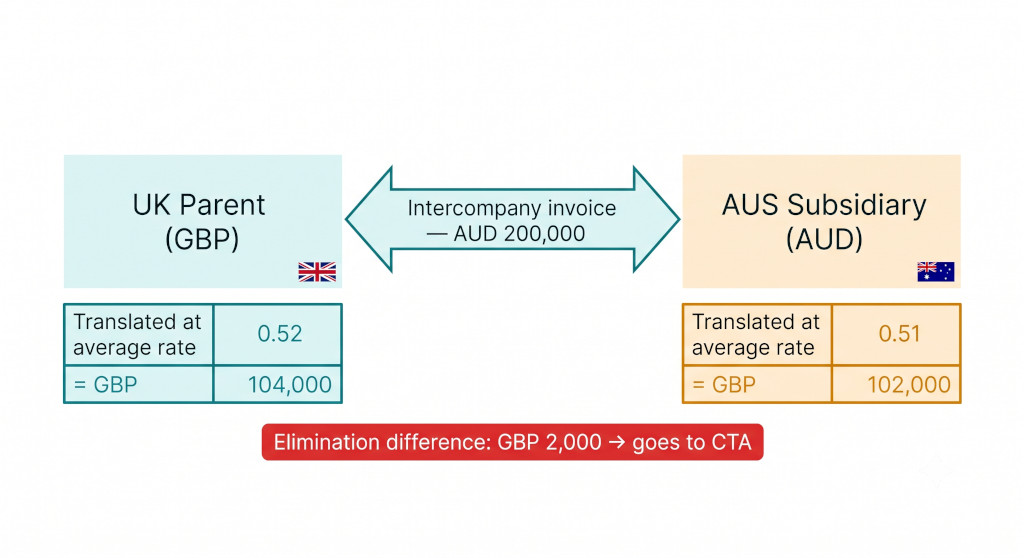
The finance director of a UK group with subsidiaries in Australia and Singapore described the problem with characteristic understatement: “The intercompany balances never agree. I know they should, but they never do.” After two hours of investigation, the answer was always the same — the balances were in fact correct. The parent had recorded the intercompany receivable in GBP, translated at one rate; the subsidiary had recorded the matching payable in AUD or SGD, translated at another. At the group level, the two sides of the same transaction produced different numbers in the consolidation currency — not because anyone had made an error, but because foreign exchange rates had moved between the transaction date and the reporting date.
Multi-currency groups face a dimension of intercompany eliminations that single-currency groups never encounter: the two sides of every intercompany transaction are translated independently, using rates that are almost never identical. The result is that the elimination of intercompany items almost always leaves a residual difference — not a mismatch, not an error, but a foreign exchange effect that must be understood and correctly classified. Get it right and it becomes part of the group’s Currency Translation Adjustment (CTA). Get it wrong and the consolidated accounts either fail to balance or carry unexplained “suspense” amounts that accumulate over time.
This guide explains exactly what happens to intercompany eliminations when foreign currencies are involved — working through trading transactions, intercompany balances, loans, and the special case of loans that form part of the group’s net investment in a foreign operation.
Foreign currency consolidation, handled automatically.
BrizoConsol applies the correct CTA/FCTR treatment across all entities — no spreadsheets needed.
The Core Problem: Different Rates on the Same Transaction
To understand why foreign currency creates complications in intercompany eliminations, it helps to trace a single transaction from start to finish.
The Setup — Meridian Group
Parent: Meridian UK LtdFunctional currency: GBP (presentation currency)
Subsidiary: Meridian Australia PtyFunctional currency: AUD
Average rate for the yearAUD/GBP 0.52
Closing rate at year-endAUD/GBP 0.54
Rate at transaction date (management fee invoice)AUD/GBP 0.51
During the year, Meridian UK charged a management fee of AUD 200,000 to Meridian Australia. The invoice was issued and recorded by both entities at the transaction-date rate.
Here is how the same AUD 200,000 transaction appears in each set of accounts, translated to GBP for consolidation:
| Entity | Local Amount | Translation Basis | Rate Used | GBP Equivalent |
|---|---|---|---|---|
| Meridian UK (parent) | AUD 200,000 → GBP income | Average rate for period (P&L item) | 0.52 | 104,000 |
| Meridian Australia (sub) | AUD 200,000 expense | Average rate for period (P&L item) | 0.52 | 104,000 |
In this case both sides translate at the same average rate — so the elimination is clean. The GBP income in the parent (£104,000) exactly matches the GBP expense in the subsidiary (£104,000), and the elimination journal removes both without residual.
But this clean outcome depends entirely on both entities using the same average rate. In practice, the parent may translate the invoice at the rate on the invoice date (AUD/GBP 0.51 → £102,000) while the subsidiary’s consolidation package translates all P&L items at the period average (0.52 → £104,000). The two GBP figures no longer match. The elimination removes £102,000 of income from the parent and £104,000 of expense from the subsidiary — leaving a net £2,000 credit in the consolidated accounts that must go somewhere.
The simplest way to avoid rate mismatches on intercompany trading transactions is to agree — at the group level — on the rate that will be used to translate intercompany invoices for consolidation purposes: typically the period average rate. If all entities apply the same average rate to all intragroup transactions, the P&L elimination will always be clean. The complication arises almost exclusively when entities use transaction-date rates or when different subsidiaries use different source rates.
Intercompany Balances: The Closing Rate Problem
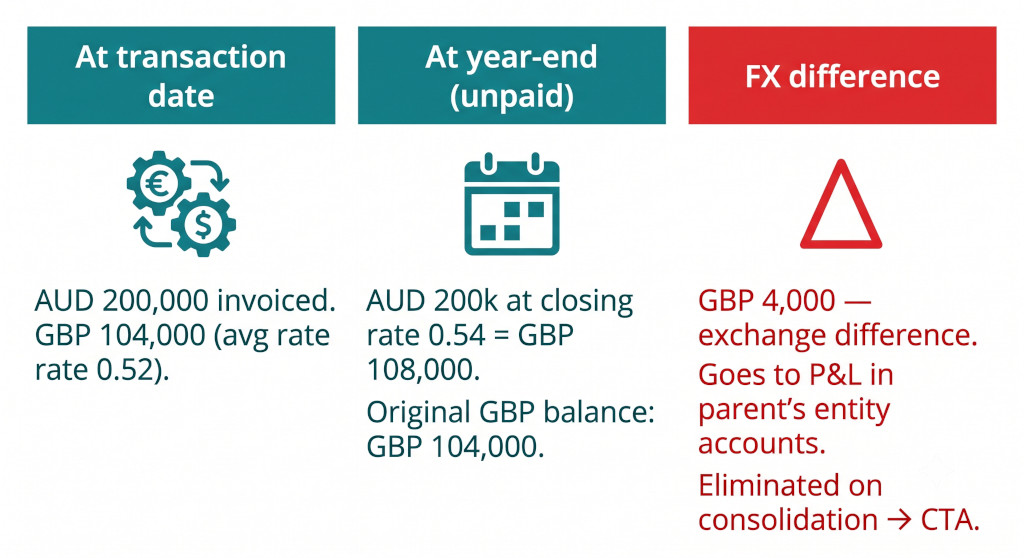
The harder problem arises not on the income statement but on the balance sheet — specifically when an intercompany invoice has been issued but not yet paid at the year-end. The outstanding receivable (in the parent) and payable (in the subsidiary) are both balance sheet items, so under IAS 21 they must be translated at the closing rate. But the original transaction may have been recorded at a different rate, and the two entities are translating from different functional currencies.
Continuing the Meridian Group example: the AUD 200,000 management fee invoice remains unpaid at the year-end. The closing rate is AUD/GBP 0.54.
| Entity | Balance Sheet Item | AUD Amount | Closing Rate | GBP |
|---|---|---|---|---|
| Meridian UK | Intercompany receivable (AUD 200k) | 200,000 | 0.54 | 108,000 |
| Meridian Australia | Intercompany payable (AUD 200k) | 200,000 | 0.54 | 108,000 |
When both sides are denominated in AUD and translated at the same closing rate, the GBP equivalents agree — the elimination is clean on the balance sheet. But notice that Meridian UK originally recognised the AUD receivable at the transaction-date rate of 0.51, giving £102,000. By year-end, translating at 0.54 gives £108,000. The £6,000 difference is a foreign exchange gain in Meridian UK’s entity accounts — it represents the gain on the GBP-equivalent value of the AUD receivable as sterling has weakened against the Australian dollar.
In Meridian UK’s entity accounts, this £6,000 is a valid, recognisable foreign exchange gain — the entity holds an AUD-denominated asset, and that asset is worth more in GBP at the year-end than when it was first recorded. But in the consolidated accounts, this is an intercompany balance that will be eliminated. The £6,000 exchange gain in the parent cannot be kept in consolidated P&L — it has not been earned from an external party. What happens to it?
The residual translation difference — where it goes
The elimination removes the receivable and payable in full (both £108,000 in GBP). The £6,000 exchange gain that the parent had recognised on its AUD receivable is effectively reversed by the elimination — the intercompany receivable is gone, and so is the income attached to it. However, the movement in exchange rate is a real economic phenomenon — sterling has genuinely moved relative to the Australian dollar. The group’s economic exposure to that rate movement is real.
The correct treatment is to reclassify this exchange difference into the Currency Translation Adjustment — specifically, into the foreign currency translation reserve (FCTR) in OCI. It is part of the same pool of translation differences that arise on translating the subsidiary’s net assets, and it belongs in the same equity reserve.
The most common error: leaving the FX difference on intercompany balances in the consolidated income statement rather than reclassifying it to OCI. This overstates (or understates) consolidated profit by an amount that can be material in groups with large intercompany positions and volatile exchange rates. Auditors typically test this specifically when reviewing the consolidation of foreign subsidiaries.
A Full Worked Example: Trading and Balance Sheet Eliminations
Putting the income statement and balance sheet eliminations together for the Meridian management fee transaction:
Assumptions: Invoice date rate AUD/GBP 0.51 (parent records £102,000 income at invoice date); average rate for the year 0.52 (used by Australia for P&L translation); closing rate 0.54. Invoice unpaid at year-end.
| Item | Parent GBP | Subsidiary GBP | Elimination | Net Effect |
|---|---|---|---|---|
| Management fee income / expense (P&L) | 102,000 | (104,000) | Eliminate both | (2,000) → CTA |
| FX gain on receivable (P&L — parent) | 6,000 | — | Reclassify to OCI | (6,000) → CTA |
| Intercompany receivable (balance sheet) | 108,000 | — | Eliminate | — |
| Intercompany payable (balance sheet) | — | (108,000) | Eliminate | — |
| Total reclassified to CTA / FCTR | 8,000 credit to FCTR | |||
The £8,000 credit to FCTR in the consolidated accounts has two components: the £2,000 rate difference on the P&L elimination (parent translated at invoice-date rate, subsidiary at average rate), and the £6,000 FX gain on the parent’s AUD receivable that cannot be recognised in consolidated P&L because the receivable itself is eliminated. Together they represent the group’s translation exposure on the intercompany position — a real economic effect that belongs in OCI rather than profit or loss.
Elimination Journals — Multi-Currency Intercompany Management Fee
| Journal | Account | Dr GBP | Cr GBP | Notes |
|---|---|---|---|---|
| 1a | Management fee income (parent) | 102,000 | At invoice-date rate | |
| Management fee expense (subsidiary) | 104,000 | At average rate | ||
| FCTR / OCI (equity) | 2,000 | Rate difference → CTA | ||
| 1b | FX gain on receivable (parent P&L) | 6,000 | Reclassify from P&L | |
| FCTR / OCI (equity) | 6,000 | → CTA | ||
| 1c | Intercompany payable (subsidiary) | 108,000 | At closing rate | |
| Intercompany receivable (parent) | 108,000 | At closing rate |
Multi-Currency Eliminations Without the Spreadsheet Headache
BrizoConsol eliminates intercompany transactions across currencies automatically — computing the residual FX difference and posting it to the CTA reserve, so your consolidated accounts balance and your FCTR is complete. Start Free Trial
Intercompany Loans in Foreign Currency
Foreign currency intercompany loans generate the same translation mechanics as any other monetary item — the loan balance is translated at the closing rate at each reporting date, and movements in the rate create exchange differences. But for intercompany loans, the consolidation treatment of those exchange differences depends critically on the nature of the loan.
Ordinary short-term intercompany loans
For an intercompany loan where settlement is expected in the foreseeable future — a working capital facility, a revolving credit line, or a loan with a defined repayment schedule — the exchange differences are recognised in profit or loss in each entity’s own accounts, and in the consolidated accounts the loan balance is eliminated. Any residual difference after elimination (arising from the same rate-mismatch mechanics described above) is reclassified to CTA in OCI.
Long-term loans forming part of the net investment: IAS 21.32
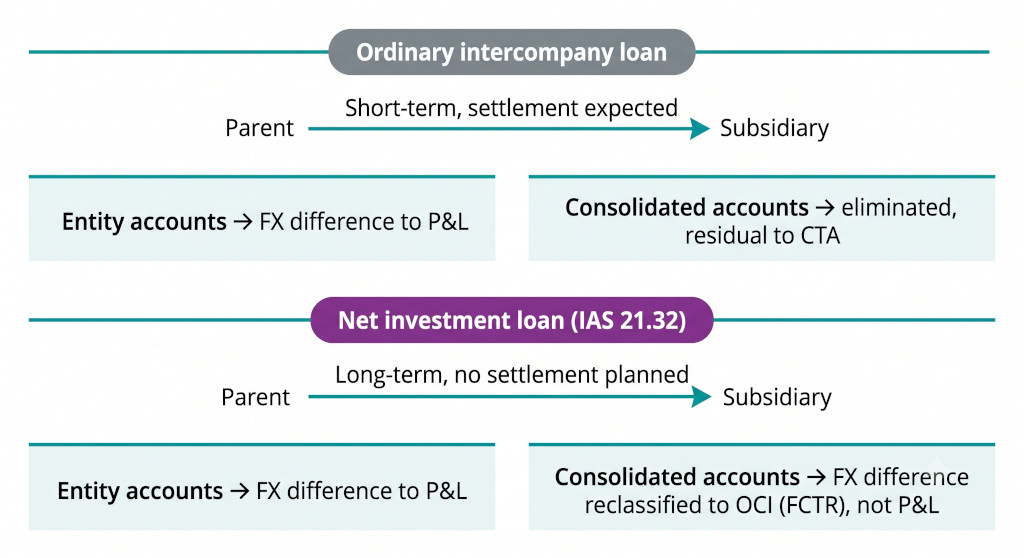
IAS 21.32 (and the equivalent in FRS 102.30.13) contains a specific provision for a particular category of intercompany monetary item: a long-term loan between a parent and a foreign subsidiary where settlement is neither planned nor likely in the foreseeable future. Such a loan is considered part of the parent’s net investment in the foreign operation — economically, it is more like equity than debt, because the parent does not expect to be repaid in the normal course of business.
For these loans, the foreign exchange differences that would otherwise flow through profit or loss in the entity accounts are instead recognised in OCI in the consolidated financial statements — forming part of the FCTR alongside the translation differences on the subsidiary’s net assets. They are not eliminated from the consolidated accounts in the same way as an ordinary intercompany loan; instead, the exchange difference is reclassified from P&L (where it sits in the entity accounts) to OCI at the consolidation level.
On disposal of the foreign subsidiary, the accumulated exchange differences on net investment loans that have been recognised in OCI are recycled to profit or loss as part of the FCTR release — exactly as with the translation differences on the subsidiary’s net assets themselves.
| Loan Type | Entity Accounts (FX difference) | Consolidated Accounts | On Disposal |
|---|---|---|---|
| Short-term / settlement expected | P&L (both entities) | Eliminated; residual difference → CTA (OCI) | No separate CTA recycling |
| Long-term / part of net investment (IAS 21.32) | P&L (both entities) | FX difference reclassified to OCI (FCTR) — not to P&L | FCTR recycled to P&L on disposal (IAS 21.48) |
Qualifying for the IAS 21.32 treatment
The IAS 21.32 treatment is not available simply because a loan is long-term or has no fixed repayment schedule. The criteria are that settlement must be neither planned nor likely in the foreseeable future — which is a factual determination based on the actual intentions and expectations of the group, not simply the stated terms of the loan. Groups seeking to apply IAS 21.32 should document their assessment at the time of origination and update it at each reporting date.
IAS 21.32 applies only in the consolidated accounts. In the individual accounts of the parent and the subsidiary, the exchange differences on the intercompany loan always go through profit or loss — the OCI treatment applies only at the consolidation level. This is a common point of confusion: finance teams sometimes apply the OCI treatment in the entity accounts as well, which is incorrect.
The IAS 21.32 designation must also be consistent. Switching a loan in and out of net investment classification opportunistically — to manage the timing of P&L recognition — is not acceptable. Once a loan is designated as part of the net investment, it should retain that designation unless the facts genuinely change.
Practical Implications: What This Means at Month-End Close
For a multi-currency group running a monthly consolidation close, the FX dimension of intercompany eliminations adds several practical requirements to the process.
Agree on rate conventions across entities
The single most effective way to reduce FX-driven elimination differences is to standardise the exchange rates used across the group for intragroup transactions. Where all entities use the same period-average rate to record intercompany invoices and recharges, the P&L elimination differences largely disappear. The residual differences on unpaid balances at the closing rate are unavoidable, but they are mechanical and predictable.
Separate intercompany FX differences from third-party FX differences
When preparing the consolidation, the foreign exchange differences that arise on intercompany positions must be identified separately from the FX differences on genuine external exposures. The intercompany FX differences are reclassified to CTA; the external FX differences remain in consolidated P&L. Mixing the two distorts both the reported profit and the FCTR balance.
Reconcile before you eliminate
As with single-currency intercompany balances, the two sides of a foreign currency intercompany position should be reconciled in a common currency before the elimination is posted. The reconciliation will typically show an agreed underlying transaction amount (e.g. AUD 200,000) with differences arising entirely from rate translation — not from genuine mismatches in the recorded transactions. Once the reconciliation confirms the underlying amounts agree, the elimination can be posted and the residual FX difference classified appropriately.
Document net investment loan designations
If the group has intercompany loans that qualify for IAS 21.32 treatment, those designations should be documented in the consolidation workings and reviewed annually. The document should record the basis for the conclusion that settlement is neither planned nor likely, and should be updated if the facts change.
The Connection to the Group’s CTA
All the FX differences arising from multi-currency intercompany eliminations ultimately feed into the group’s CTA / FCTR — the same reserve that accumulates translation differences on the net assets of foreign subsidiaries. Understanding this connection is important for anyone preparing or reviewing the FCTR note in the consolidated accounts.
The FCTR movement for the year has several components, of which the intercompany FX differences are one. A well-prepared FCTR movement note will identify: translation differences on subsidiary net assets, translation differences on goodwill attributable to foreign subsidiaries, exchange differences on net investment loans (IAS 21.32), and residual FX differences on eliminated intercompany trading balances. All of these are OCI items; none flows through consolidated P&L.
For groups that consolidate monthly and track the FCTR carefully, the intercompany FX differences typically represent a modest but consistent component of the FCTR movement — one that becomes more material as intercompany trading volumes grow and exchange rate volatility increases.
The full mechanics of the CTA calculation — including how translation differences on net assets are computed and how the FCTR is split between the parent and any non-controlling interest — are covered in the CTA calculation guide and the post on splitting the CTA where NCI is present.
One Consolidation. All Currencies. All Eliminations.
BrizoConsol handles intercompany eliminations across multiple currencies — detecting rate differences, reclassifying FX impacts to the CTA reserve, and producing a complete FCTR movement reconciliation every period. Start Free Trial