What Is SFRS? Singapore Financial Reporting Standards Explained for Finance Leaders
SFRS stands for Singapore Financial Reporting Standards. It is the framework of accounting standards that Singapore-incorporated companies are legally required to use when preparing their financial statements. SFRS is set and maintained by the Accounting Standards Council (ASC), a statutory body under the Accounting and Corporate Regulatory Authority (ACRA), and compliance is mandatory under the Singapore Companies Act.
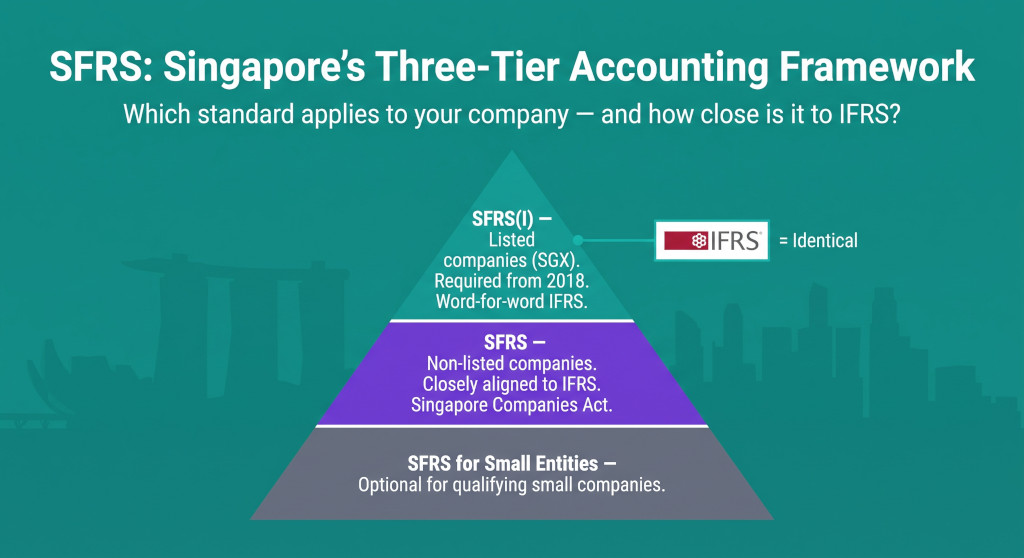
For most finance leaders, the immediate practical question is not just “what is SFRS?” but “which version of SFRS applies to my company, and how close is it to IFRS?” The answer depends on whether the company is listed on the Singapore Exchange (SGX), whether it qualifies as a small entity, and what framework the group parent uses. Singapore operates a three-tier structure — SFRS(I), SFRS, and SFRS for Small Entities — and each tier has different applicability rules, different levels of disclosure, and a different relationship to IFRS.
The Three Tiers of Singapore Financial Reporting Standards
- Required for all companies listed on the SGX (Singapore Exchange) for annual periods beginning on or after 1 January 2018
- Word-for-word adoption of IFRS as issued by the IASB — substantively identical to IFRS
- Any differences from IFRS are limited to transition provisions and Singapore-specific guidance notes from the ASC
- If you prepare SFRS(I) financial statements, your accounts are IFRS-compliant for all practical purposes
- Applies to all Singapore-incorporated companies not using SFRS(I) or SFRS for SE — the majority of Singapore subsidiaries and privately held groups
- Closely aligned to IFRS; the ASC updates SFRS to track IFRS standards, typically with a short lag
- Differences from IFRS are minimal in practice — mainly effective date differences and a small number of Singapore-specific carve-outs
- A non-listed company may voluntarily adopt SFRS(I) instead of SFRS
- Simplified standards for small entities that are not publicly accountable
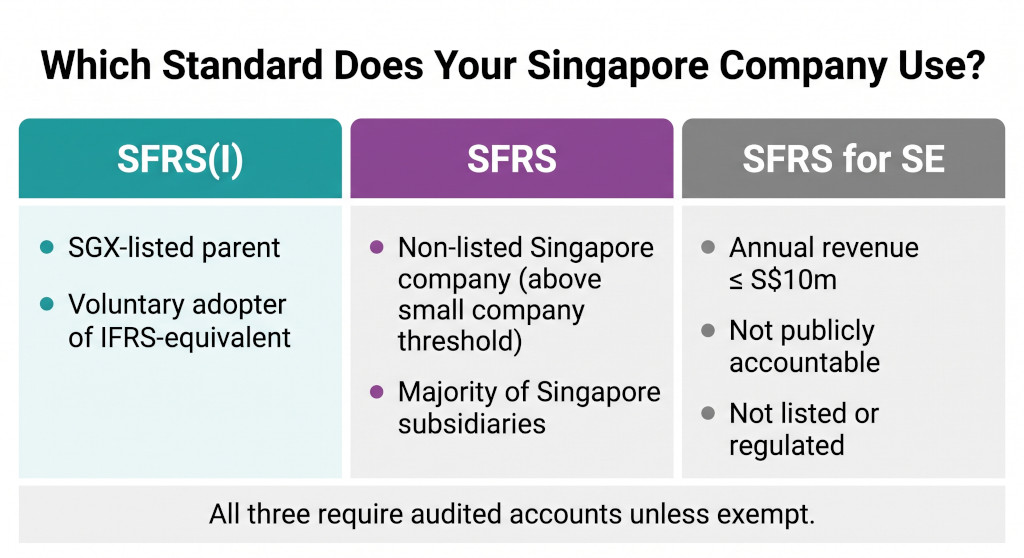
- Eligible if: annual revenue does not exceed S$10 million; entity is not listed, a financial institution, or a charity
- Based on the IFRS for SMEs standard with Singapore modifications
- Significantly reduced disclosure requirements compared to full SFRS
- Not suitable for companies that are part of a group that applies full SFRS or SFRS(I)
The short version: if your company is listed on SGX, you use SFRS(I) = IFRS. If it is a non-listed Singapore company of meaningful size, you use SFRS, which is IFRS-equivalent for almost all purposes. If it is a small private company with revenue under S$10m and you qualify, you may use SFRS for SE. Most Singapore subsidiaries of international groups use SFRS.
BrizoConsolAutomate NCI calculations across all your entities.
BrizoConsol handles non-controlling interest automatically — no manual adjustments required.
SFRS vs IFRS: How Close Are They?
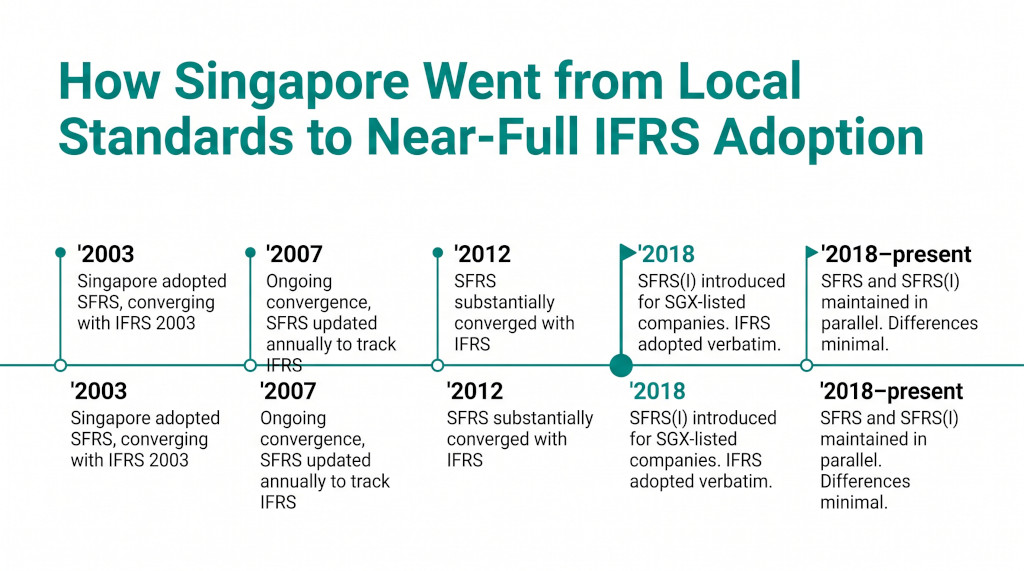
The relationship between SFRS and IFRS is one of progressive convergence over two decades, culminating in SFRS(I) being a verbatim copy of IFRS. For non-listed companies using full SFRS, the alignment is very high — but it is not identical.
| Area | SFRS(I) | SFRS (non-listed) | SFRS for SE |
|---|---|---|---|
| Relationship to IFRS | Identical — verbatim IFRS adoption | Closely aligned; minor lag on effective dates | Based on IFRS for SMEs; further simplified |
| Revenue recognition (IFRS 15 equivalent) | SFRS(I) 15 = IFRS 15, identical | FRS 115 = IFRS 15, identical in substance | Simplified — no variable consideration complexity |
| Leases (IFRS 16 equivalent) | SFRS(I) 16 = IFRS 16, identical | FRS 116 = IFRS 16, identical in substance | Finance/operating distinction retained (IFRS for SMEs basis) |
| Financial instruments (IFRS 9 equivalent) | SFRS(I) 9 = IFRS 9, identical | FRS 109 = IFRS 9, identical in substance | Simplified classification and measurement |
| Business combinations (IFRS 3 equivalent) | SFRS(I) 3 = IFRS 3, identical | FRS 103 = IFRS 3, identical in substance | Simplified — goodwill amortised over useful life |
| Effective dates vs IFRS | Simultaneous with IASB | Typically 6–12 months later | ASC decides on adoption of IFRS for SMEs updates |
| Singapore-specific guidance | CPF guidance, certain transition notes | CPF guidance, certain transition notes | ASC implementation guidance |
The practical implication: a finance leader who is familiar with IFRS will find SFRS(I) immediately recognisable — it is IFRS in all but name. Full SFRS for non-listed companies requires only marginal adjustments for those already familiar with IFRS. SFRS for SE requires more adaptation, particularly around areas where IFRS for SMEs diverges from full IFRS (goodwill amortisation, simplified hedge accounting, reduced disclosures).
Who Applies Which Standard — The Applicability Rules
| Company type | Applicable standard | Can it choose a different standard? |
|---|---|---|
| SGX-listed Singapore company (parent or subsidiary) | SFRS(I) — mandatory | No — SFRS(I) is required for SGX-listed entities from 2018 |
| Non-listed Singapore company, annual revenue > S$10m | SFRS — required | May voluntarily adopt SFRS(I) instead; cannot use SFRS for SE |
| Non-listed Singapore company, annual revenue ≤ S$10m, not publicly accountable | SFRS by default | May elect SFRS for SE; may voluntarily adopt SFRS(I) |
| Singapore branch of a foreign company | Statutory accounts filed under Singapore rules, but consolidation follows parent’s framework | Branch registration requirements apply; consult ACRA |
| Non-listed Singapore company that is a subsidiary of an SFRS(I) or IFRS parent | Entity accounts: typically SFRS; consolidated accounts: SFRS(I) or IFRS at parent level | Entity accounts remain SFRS; consolidated accounts follow parent’s framework |
| Singapore-headquartered holding company, non-listed, group revenue > S$10m | Consolidated accounts: SFRS (or SFRS(I) by election) | May voluntarily adopt SFRS(I) for consolidated accounts |
The small company audit exemption is separate from the accounting standard question. Singapore companies that qualify as “small companies” under the Companies Act (two of three criteria: revenue ≤ S$10m, total assets ≤ S$10m, employees ≤ 50) are exempt from the statutory audit requirement. But they are still required to prepare financial statements under SFRS (or SFRS for SE if eligible). The accounting standard obligation and the audit obligation are different rules.
A Brief History: How Singapore Got to SFRS
Why This Matters for Group Consolidation
The practical significance of SFRS for a group finance team falls into four areas.
1. Statutory filing obligations
Every Singapore-incorporated company must file its annual financial statements with ACRA (the Accounting and Corporate Regulatory Authority) in a format compliant with the applicable SFRS tier. This is a Companies Act obligation, not just an internal reporting choice. Groups with Singapore entities need to maintain SFRS-compliant entity-level accounts for each Singapore subsidiary, irrespective of what framework the parent group uses for its consolidated accounts.
2. Determining the consolidation standard
The consolidated group accounts are prepared under whatever framework the ultimate parent is required or elects to use. A Singapore-headquartered listed group will prepare consolidated accounts under SFRS(I) — which is IFRS-equivalent and can be filed with SGX as IFRS-compliant. A non-listed Singapore-headquartered group with revenue above the small entity threshold prepares consolidated accounts under SFRS. A Singapore subsidiary consolidated into a UK, US, or other non-Singapore parent is consolidated into the parent’s framework — the parent’s standard governs the consolidated accounts, and the Singapore subsidiary’s SFRS entity accounts may need to be converted before consolidation.
3. Conversion work when consolidating Singapore subsidiaries
For an IFRS parent consolidating a Singapore subsidiary that prepares under SFRS(I), the conversion work is minimal — SFRS(I) is IFRS. In most cases, you simply adjust for effective date differences and any Singapore-specific CPF treatment. For a UK parent (FRS 102) or US parent (US GAAP) consolidating a Singapore SFRS subsidiary, a full cross-standard conversion is required before the elimination journals can be posted. The conversion journals will cover lease recognition, financial instrument classification, revenue timing, and any SFRS-to-parent-GAAP differences that affect the subsidiary’s balance sheet and P&L.
For the specific conversion journals between SFRS and the major parent frameworks, see: how to consolidate an SFRS subsidiary into an IFRS parent, how to consolidate an SFRS subsidiary into a UK GAAP (FRS 102) parent, and how to consolidate a US GAAP subsidiary into an SFRS parent.
4. Currency translation
Singapore subsidiaries report in Singapore dollars (SGD). Whenever a non-SGD parent consolidates a Singapore entity, currency translation is required: assets and liabilities translated at the closing rate, income and expenses at the average rate, with the difference recognised in the cumulative translation adjustment (CTA) within other comprehensive income. This applies regardless of which SFRS tier the Singapore subsidiary uses. The translation mechanics follow the parent’s standard — IAS 21 for IFRS parents, FRS 102 Section 30 for UK parents, ASC 830 for US parents — not SFRS.
SFRS vs IFRS: The Key Differences Still Worth Knowing
For finance leaders familiar with IFRS who are picking up SFRS for the first time, the differences to be aware of are:
- Effective dates. New standards adopted under SFRS typically take effect one reporting period after the IFRS mandatory effective date. If IFRS 18 (presentation of financial statements, replacing IAS 1) is effective for IFRS reporters from 1 January 2027, the SFRS equivalent may be effective from 1 January 2028. Check the ASC’s adoption timeline for any standard relevant to your year-end.
- CPF contributions. The Central Provident Fund — Singapore’s mandatory employee savings scheme — has specific guidance in SFRS on timing of recognition and treatment as a post-employment benefit. This is a Singapore-only item with no IFRS equivalent; IFRS preparers encountering it for the first time should review ASC implementation guidance.
- Voluntary adoption of SFRS(I). A non-listed company may choose to adopt SFRS(I) rather than SFRS. There is no requirement to do so, but it can simplify reporting for Singapore subsidiaries of IFRS groups — the entity accounts and the consolidated reporting framework are then on the same standard, reducing the conversion workload at consolidation.
- SFRS for SE goodwill. Under SFRS for SE, goodwill is amortised over its useful life (with a 10-year maximum if the useful life cannot be reliably estimated) — consistent with IFRS for SMEs and the FRS 102 approach. Under full SFRS and SFRS(I), goodwill is not amortised but tested annually for impairment, consistent with IFRS 3 and IAS 36. If your entity transitions between SFRS for SE and full SFRS, the goodwill treatment changes.
For a full side-by-side treatment of where SFRS and IFRS diverge — and how those differences affect group consolidation — see SFRS vs IFRS: key differences in financial reporting for Singapore groups. For the UK GAAP comparison, see SFRS vs UK GAAP: key differences in financial reporting. For the US GAAP comparison, see SFRS vs US GAAP: key differences in financial reporting.
The Bottom Line for Finance Leaders
SFRS is Singapore’s version of IFRS. For listed Singapore groups (SGX), it is IFRS verbatim under the SFRS(I) label. For non-listed Singapore companies, it is IFRS-equivalent with minor effective date differences. For small private companies that qualify, a simplified SFRS for Small Entities option is available.
The distinction between SFRS and IFRS matters most in three situations: when a Singapore subsidiary is being consolidated into a non-IFRS parent (conversion work needed), when a new IFRS standard is approaching its effective date (check whether SFRS has adopted it yet), and when the group is considering whether to voluntarily adopt SFRS(I) for its Singapore entities to reduce conversion friction.
For any group with Singapore entities, the consolidation process begins with knowing which tier of SFRS applies to each entity, whether any conversion is required before eliminating intercompany transactions, and what the SGD/functional currency translation mechanics are. The standards question is the foundation on which every downstream consolidation decision depends.
Consolidating Singapore entities into your group accounts
BrizoConsol handles SFRS, SFRS(I), and cross-standard consolidation for Singapore-headquartered groups and international groups with Singapore subsidiaries — including SGD translation, intercompany eliminations, and GAAP conversion journals. See It in Action Start Free