Subsidiaries on a Different Fiscal Year: BrizoConsol Now Aligns Them Automatically
Not every company in a group closes its books in the same month. A subsidiary acquired with a June year-end keeps it. A company in another country follows its local statutory year. A group that changed its own year-end leaves older subsidiaries on the old one. The monthly figures still consolidate fine. The trouble starts at the year-end close, when each company moves its profit for the year into retained earnings on its own calendar.
In a spreadsheet consolidation this shows up as an equity line that will not reconcile. For a few months after the subsidiary’s year-end, the group’s equity is overstated. For a few months after the parent’s year-end, it is understated. The usual fix is a manual reclassification journal between retained earnings and current year earnings, worked out again at every close and easy to forget.
BrizoConsol now posts that alignment for you. When a subsidiary’s fiscal year starts in a different month from its group’s, the consolidation engine moves the right amount in or out of the group’s retained earnings at each year boundary, on every recalculation.
Subsidiaries on a different year-end, aligned automatically.
BrizoConsol posts fiscal-year alignment journals so every entity reports on the group's financial year.
Why Two Calendars Break Group Equity
BrizoConsol reads every company’s trial balance at the same calendar month end, so the reporting dates already match. What differs is the year-end close.
The group calculates Current Year Earnings on the parent’s fiscal year, from each month’s profit and loss movements. Each subsidiary’s Retained Earnings, though, already contains the profit its own books closed at its own year-end. The two rows are added together on the consolidated balance sheet. As a result:
- After the subsidiary’s year-end, profit it closed into retained earnings is still inside the group’s current year earnings. It is counted twice.
- After the parent’s year-end, the group’s current year earnings reset, but the subsidiary has not yet closed that profit into its retained earnings. It is missing.
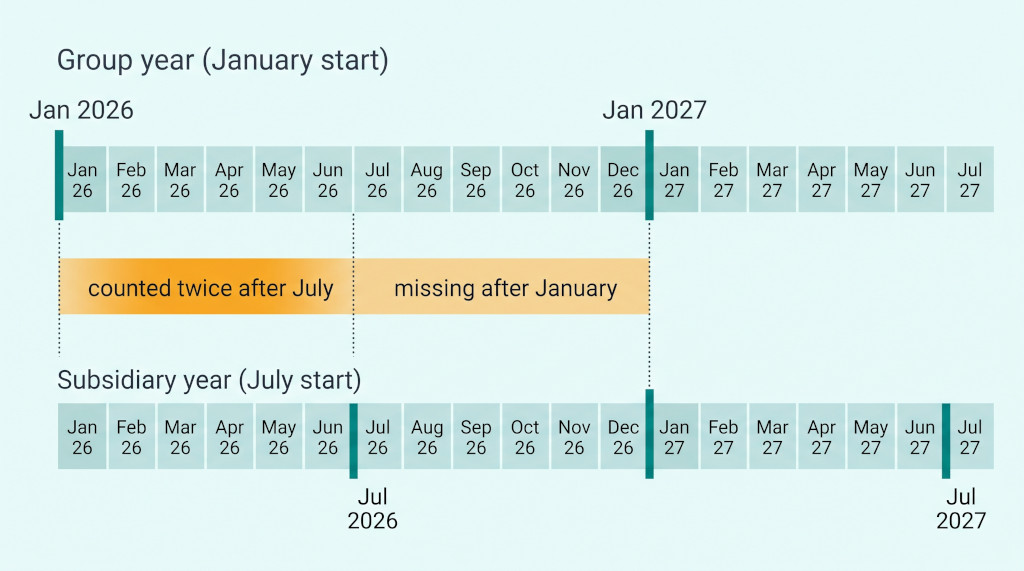
The income statement is not affected; only equity is. Because the group’s assets only reflect the profit actually earned, the balance sheet stops balancing by the duplicated or missing amount.
What BrizoConsol Posts
The engine replaces the subsidiary’s closing calendar with the group’s. It does this with two kinds of group journal, both against the group’s Retained Earnings account:
- At the subsidiary’s year-end: Dr Retained Earnings / Cr Current Year Earnings. This cancels the profit the subsidiary has just closed, because the group’s year has not ended.
- At the group’s year-end: Dr Current Year Earnings / Cr Retained Earnings. This closes the group’s full year of the subsidiary’s profit into retained earnings, whether or not the subsidiary has closed it yet.
For a loss, the directions reverse. Each month’s profit is credited to retained earnings at the next group year-end and debited at the next subsidiary year-end. Amounts falling on the same date are combined. The adjustment at any date is therefore the earnings closed on the group calendar less the earnings closed on the subsidiary calendar.
Each journal is a single line against the group’s Retained Earnings, dated the first day of the boundary month. Current Year Earnings is calculated on the group’s calendar rather than held in an account, so no second profit and loss line is posted, because that would count the reclassification twice. In the journal report, a matching “[CYE] – Current Year Earnings (CYE)” line is displayed beside it so the entry reads as balanced.
A Worked Example
The group’s fiscal year starts in January. Subsidiary S, wholly owned and in the group’s currency, started trading in January 2026 and its fiscal year starts in July. S earns 100 every month.
| Month end | Alignment posted | S’s own retained earnings | Group retained earnings | Group current year earnings | Earned to date |
|---|---|---|---|---|---|
| Jun 2026 | — | 0 | 0 | 600 | 600 |
| Jul 2026 | Dr RE 600 | 600 | 0 | 700 | 700 |
| Dec 2026 | — | 600 | 0 | 1,200 | 1,200 |
| Jan 2027 | Cr RE 1,200 | 600 | 1,200 | 100 | 1,300 |
| Jul 2027 | Dr RE 1,200 | 1,800 | 1,200 | 700 | 1,900 |
In July 2026, S closes its first period (January to June, 600) into its own retained earnings. Without alignment, the group would show retained earnings of 600 plus current year earnings of 700: 1,300 against 700 actually earned. BrizoConsol posts:
Fiscal Year Alignment — July 2026 (S’s year-end)
| Account | Dr | Cr |
|---|---|---|
| Retained Earnings | 600 | |
| [CYE] – Current Year Earnings (CYE) | 600 |
In January 2027 the group’s current year earnings reset. S’s July–December profit of 600 is still in S’s own current year, not yet in its retained earnings. Without alignment, the group would show 600 + 100 = 700 against 1,300 earned. BrizoConsol closes the group’s full 2026 year:
Fiscal Year Alignment — January 2027 (group year-end)
| Account | Dr | Cr |
|---|---|---|
| [CYE] – Current Year Earnings (CYE) | 1,200 | |
| Retained Earnings | 1,200 |
The cumulative adjustment is now +600 (−600 + 1,200). Group retained earnings = S’s 600 + 600 = 1,200, which is the whole of 2026.
In July 2027 S closes July 2026 to June 2027 (1,200) and the engine cancels it again with Dr Retained Earnings 1,200. Group retained earnings stay at 1,200 for 2026, and current year earnings carry January to July 2027. At every month end in the table, group retained earnings plus current year earnings equal what S has actually earned.
The same logic works the other way round. If the group’s year starts in July and S’s in January, the engine transfers S’s January–June profit into group retained earnings in July, before S closes it in January.
Have subsidiaries on a different year-end?
See how BrizoConsol keeps group equity balanced across every close.See It In Action
What It Takes Into Account
Ownership. Months before the group owned the subsidiary are left out, because they are not the group’s result. If the group acquired S in March, the July 2026 entry covers March to June only. The entry is the full amount, not the parent’s percentage. It moves retained earnings only, so the NCI share of profit is left as it is.
Currency. For a foreign subsidiary, movements are converted into the group’s presentation currency at the same monthly average rate the consolidation uses. A subsidiary closing 600 EUR, at an average rate of 1.25 EUR to the group currency, produces an alignment of 480. Currency translation on the subsidiary’s own unclosed earnings follows the subsidiary’s own calendar in Actual.
What counts as the subsidiary’s profit. The movements are the subsidiary’s profit and loss accounts mapped onto the group’s chart. Group-level journals attributed to the subsidiary are included. CTA, NCI and joint venture postings are left out, as they are when the group calculates current year earnings.
Any group year, any depth. The group’s year does not have to start in January. An April-start group with an October-start subsidiary is aligned at each April and October. Every company in the group whose year start differs is aligned, including a subsidiary of a subsidiary.
Scope. Alignment applies to the Actual scenario. Budget and Forecast carry no fiscal close in BrizoConsol, so there is nothing to align.
When It Runs
You do not switch anything on. The alignment is posted at the end of every recalculation chain, whether that chain started with automatic eliminations, CTA, NCI or a balance update. It runs just before the report caches are rebuilt, so the statements read the journals that chain has just written. A group whose companies all share its fiscal year has nothing to post.
Each pass recalculates the amounts and only rewrites a journal whose amount has changed, so a repeat recalculation changes nothing. If you change a company’s Fiscal Year Start Month, BrizoConsol recalculates that company as well as its group. It replaces the alignment schedule and removes any year-end close left at the old boundary. Move the company onto the group’s fiscal year and its alignment journals are removed.
The Change fiscal year start dialog in the company’s settings now says so: “A company whose year starts on a different month from its group is aligned automatically: the group posts a journal moving the closed part of the year out of retained earnings.”
Where You See It
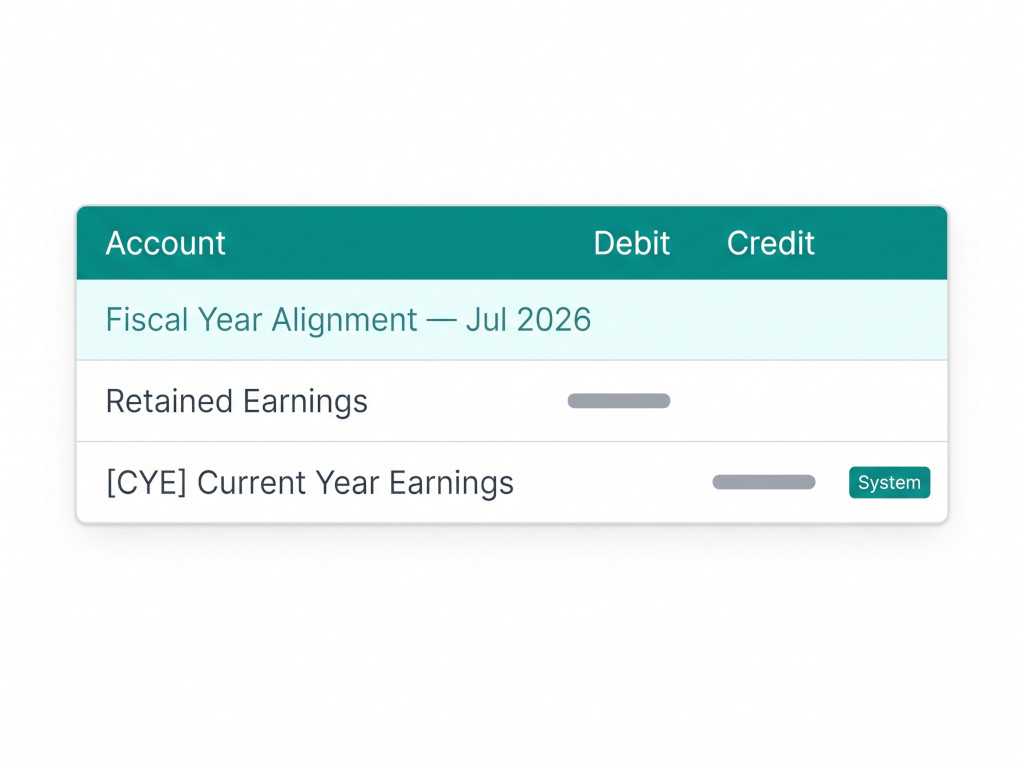
The journals are posted on the group organisation with the journal type Fiscal Year Alignment, shown as entered by System. Each is described “System Fiscal Year Alignment – ” followed by the subsidiary’s name. They appear in the Elim. & Journals Report with the Retained Earnings line and the matching [CYE] line. The group’s Retained Earnings balance includes them, so the consolidated balance sheet balances and the statement of changes in equity closes at the balance sheet’s equity. The income statement does not change.
First-Time Checklist
- Check each company’s Fiscal Year Start Month in its consolidation settings (Period, currency and fiscal year settings). Correct any that are wrong before relying on the alignment.
- Identify the subsidiaries whose fiscal year starts in a different month from the group’s. These are the ones that will receive alignment journals.
- Make sure the group’s chart of accounts has a Retained Earnings account. Without one, there is nothing for the alignment to post to and no journals are written.
- Run a consolidation recalculation for the group.
- Open the Elim. & Journals Report and look for Fiscal Year Alignment entries. Expect one at each subsidiary year-end and each group year-end within your data.
- Check one entry by hand: at a subsidiary year-end, it should equal the profit that subsidiary closed for the months the group owned it, in group currency.
- Open the consolidated balance sheet for a month just after a subsidiary year-end and confirm total assets equal total liabilities and equity.
- Open the consolidated statement of changes in equity for the same month and confirm closing equity agrees with the balance sheet.
- If you previously posted a manual reclassification for this, reverse it, or the adjustment will be counted twice.
Consolidate groups with mixed year-ends without manual reclasses
Start a free trial and connect your entities. The alignment runs from the first recalculation. Start Free Trial
Subsidiaries on a different year-end, aligned automatically.
BrizoConsol posts fiscal-year alignment journals so every entity reports on the group's financial year.