Why Xero Cannot Produce a Consolidated Statement of Cash Flows Across Multiple Organisations in Different Currencies
For finance teams running multi-entity groups, one of the most persistent frustrations is the cash flow statement. Specifically: Xero cannot produce a consolidated statement of cash flows that spans multiple organisations, and when those organisations operate in different functional currencies, the problem compounds significantly. This is not a criticism of Xero as a platform — it is an excellent general-purpose accounting system for individual entities. But it was designed and architected around a single-organisation model, and that design has real consequences for group reporting.
This article explains exactly why the limitation exists, what it means for your group reporting process, and what finance teams and accounting firms typically do to work around it — along with where those workarounds tend to break down.
What Xero Actually Does Well
Xero produces a statement of cash flows at the individual entity level natively using the direct method. It categorises cash receipts and payments into operating, investing, and financing activities based on bank account movements reasonably well within a single organisation (though indirect method templates can be configured in Xero HQ for practice users). For an SME with one legal entity and one functional currency, this direct reporting is entirely adequate.
Consolidate your Xero entities — automatically.
BrizoConsol pulls from all your Xero organisations and delivers group reports in minutes.
The challenge begins the moment a group has two or more Xero organisations. Each organisation is a completely separate data silo. There is no native mechanism in Xero to combine, consolidate, or even read across organisations simultaneously. Every organisation has its own chart of accounts, its own currency settings, its own bank feeds, and its own reporting environment. They do not share data in real time.
The Core Problem: Cash Flows Cannot Simply Be Added Together
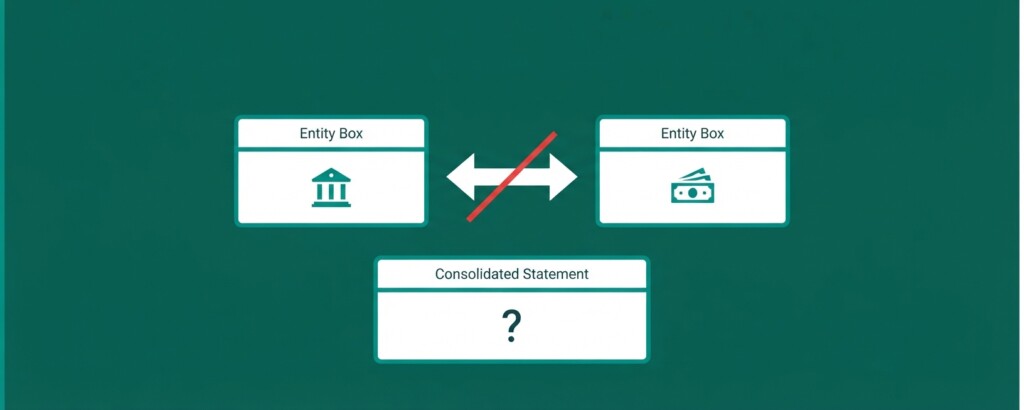
Even if you could export the cash flow statements from each Xero organisation and add them together in Excel, you would not produce a valid consolidated statement of cash flows. There are several interconnected reasons for this.
First, intercompany cash movements must be eliminated. If your parent entity lends cash to a subsidiary, the parent records a cash outflow under investing activities, and the subsidiary records a cash inflow under financing activities. In the consolidated view, this movement never left the group — it is simply cash moving between two pockets of the same economic entity. If you add the two statements together without elimination, you overstate both inflows and outflows.
Intercompany cash eliminations are not optional adjustments — they are a fundamental requirement of consolidation. Failing to eliminate them means your consolidated cash flow statement misrepresents how much cash the group is actually generating and where it is going.
Second, and more technically challenging, is the treatment of foreign currency translation differences. IAS 7 (and its equivalents under local GAAP) requires that when you consolidate entities with different functional currencies, cash flows must be translated at the exchange rates in effect at the dates of the transactions — or an approximation such as a weighted average rate for the period. The opening and closing cash balances are translated at spot rates on those respective dates. The difference that arises from translating cash flows at transaction (or average) rates versus translating opening and closing cash balances at spot rates is a translation adjustment, and it must be presented as a separate reconciling line in the consolidated cash flow statement.
| Closing cash balance — subsidiary (EUR 420,000 translated at closing rate 1.08) | USD 453,600 |
| Opening cash balance — subsidiary (EUR 380,000 translated at opening rate 1.12) | USD 425,600 |
| Reported net increase in cash (at average rate 1.10) | USD 44,000 |
| Exchange difference on cash balances (residual translation adjustment) | USD -16,000 |
| Reconciled movement (net increase plus FX adjustment) | USD 28,000 |
That USD -16,000 figure in the example above is not an error — it is the mechanical result of using different exchange rates for different purposes, as required by accounting standards. Xero has no way to calculate or present this figure across multiple organisations, because it does not know how the cash balances of one organisation relate to those of another, nor does it apply group-level translation logic.
Why FX Translation Makes This Even Harder
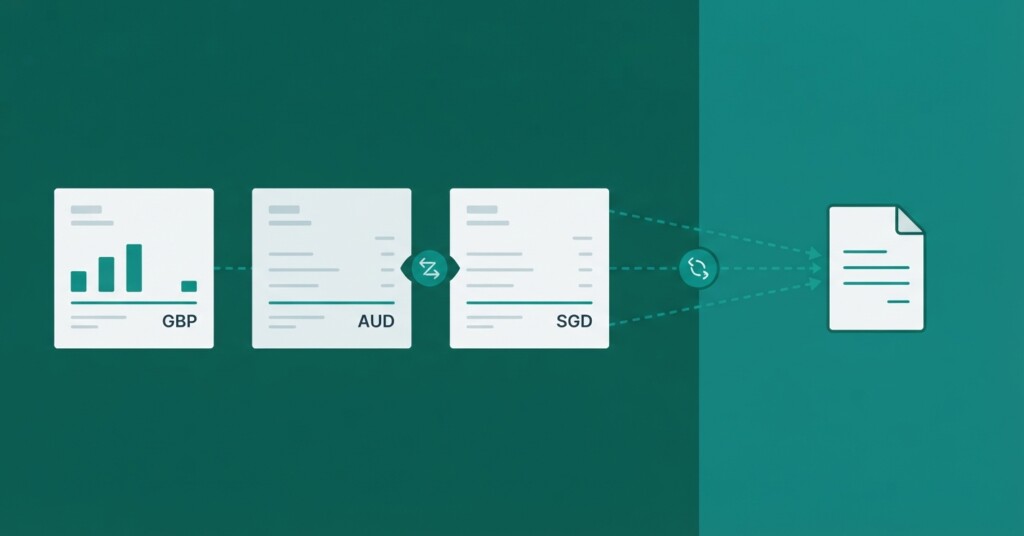
When a group has, say, a UK parent reporting in GBP, an Australian subsidiary in AUD, and a Singapore branch in SGD, the finance team faces a layered FX problem. Each entity’s cash flows need to be translated into the presentation currency of the group. This involves applying average rates to income statement flows (operating activities), closing rates to balance sheet positions, and then computing and disclosing the resulting translation differences.
Translating cash flows at a single spot rate or at the closing rate — which is what many Excel-based consolidations default to — is technically incorrect under IAS 7 and will produce a cash flow statement that does not reconcile to the movement in cash shown on the consolidated balance sheet. Auditors increasingly flag this as a material error.
Xero does support multi-currency within a single organisation. You can record transactions in foreign currencies, and Xero will calculate unrealised and realised exchange gains and losses. But this is entity-level FX handling — it does not extend to translating an entire subsidiary’s functional-currency financial statements into a parent’s presentation currency. That is a consolidation function, not a bookkeeping function.
Non-Controlling Interests Add Another Layer
If any subsidiaries within the group are not wholly owned, the cash flow statement also needs to reflect the NCI position correctly. Dividends paid to non-controlling shareholders, for example, are shown as financing outflows attributable to NCI. Cash flows associated with acquiring or disposing of NCI are treated differently from other acquisitions. Xero, operating as a transactional accounting system for individual entities, has no concept of ownership percentages, NCI calculations, or the apportionment of cash flows between controlling and non-controlling interests.
What Finance Teams Actually Do Today
Most finance teams managing a multi-entity Xero group default to one of two approaches, and both have significant drawbacks.
The first approach is to treat the consolidated cash flow statement as a reconciliation exercise done entirely in Excel. The team exports trial balances or cash flow outputs from each Xero organisation, translates foreign currency figures manually using rates sourced from a bank or central bank website, performs intercompany eliminations on separate schedules, and then constructs the consolidated statement by hand. This is time-consuming, error-prone, and almost impossible to audit trail effectively.
The second approach — more common in smaller groups — is to produce the consolidated cash flow statement using the direct method derived from the consolidated bank balances, effectively ignoring the requirement to reconcile net profit to operating cash. This is faster but produces a statement of limited analytical value and may not meet statutory reporting requirements.
| Approach | Speed | Accuracy Risk | Audit-Ready | FX Treatment |
|---|---|---|---|---|
| Manual Excel consolidation | Slow — 2 to 5 days | High — formula errors, wrong rates | Difficult to evidence | Often approximate |
| Direct method from bank data | Faster | Moderate — misses accruals | Incomplete | Typically ignored |
| Automated consolidation platform | Fast after setup | Low — rules-based and consistent | Structured and traceable | Applied systematically |
The Intercompany Elimination Problem in the Cash Flow Context
Intercompany eliminations for the balance sheet and income statement are already complex. For the cash flow statement, they require an additional step: identifying which balance sheet and income statement eliminations affect cash, and which do not. An intercompany management fee that has been invoiced but not yet paid, for instance, should be eliminated from the income statement consolidation — but if it has not been paid, there is no cash movement to eliminate. The timing of cash settlement across entities matters, and it can differ from the timing of accounting recognition.
| Account | Dr | Cr |
|---|---|---|
| Intercompany Payable — Subsidiary (elimination) | 50000 | |
| Intercompany Receivable — Parent (elimination) | 50000 |
Elimination of intercompany loan balance at period end. No cash flow elimination required as no repayment was made during the period — the opening and closing balances are equal and the cash movement nets to zero at group level.
| Account | Dr | Cr |
|---|---|---|
| Cash Flows from Financing Activities — Subsidiary (elimination of loan repayment) | 30000 | |
| Cash Flows from Investing Activities — Parent (elimination of loan repayment received) | 30000 |
Elimination of intercompany cash transfer during the period. Parent recorded a USD 30,000 investing inflow; subsidiary recorded a USD 30,000 financing outflow. Both must be eliminated from the consolidated cash flow statement as the cash never left the group.
Tracking these eliminations correctly, at the cash flow level, requires a system that understands the relationship between entities and can match intercompany transactions. Xero provides no mechanism for this matching across organisations.
What a Correct Consolidated Cash Flow Statement Requires
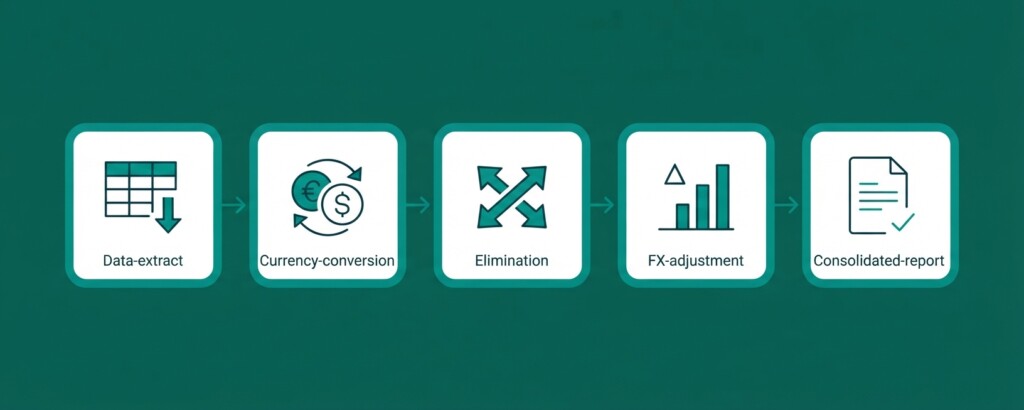
To produce a consolidated statement of cash flows that is technically correct across multiple Xero organisations in different currencies, a finance team needs to perform the following steps systematically:
- Extract trial balance and cash flow data from each Xero organisation for the period
- Apply average exchange rates to income statement items and closing rates to balance sheet items for each non-presentation-currency entity
- Identify all intercompany cash transactions during the period and prepare elimination entries
- Calculate the FX translation adjustment on opening and closing cash balances for each foreign currency entity
- Allocate cash flows between controlling interests and NCI where applicable
- Aggregate the translated, eliminated figures into a consolidated indirect-method cash flow statement
- Reconcile the net movement in cash to the difference between opening and closing consolidated cash on the balance sheet, including the FX line
- Document all rates, eliminations, and adjustments with a clear audit trail
Each of these steps is manageable individually. Performing all of them together, every month, across four or five entities in different time zones, with different period-end dates, is where the workload becomes unsustainable and the error risk becomes unacceptable.
What to Look for in a Consolidation Solution
Finance teams reaching the limits of Excel-based consolidation should look for tools that connect directly to Xero’s API to pull trial balance data, apply configurable exchange rate tables for translation, maintain an intercompany matching and elimination engine, and produce the consolidated cash flow statement as an output of the consolidation process rather than as a separate manual exercise.
The FX translation adjustment on cash should be calculated automatically from the difference between translated opening cash, translated closing cash, and the sum of translated cash flows during the period. This reconciliation should be visible and auditable, not hidden inside a spreadsheet cell.
NCI attribution should be configurable by entity and by ownership percentage, so that the portion of cash flows attributable to minority shareholders is correctly identified in the financing section of the consolidated statement.
The most practical test of any consolidation tool is whether it can produce a consolidated cash flow statement that reconciles — automatically — to the movement in cash on the consolidated balance sheet, including the FX translation line. If it cannot, it is not truly solving the problem; it is simply moving the manual work to a different screen.
Closing Thoughts
Xero is a strong platform for entity-level accounting, and for groups that have accepted manual consolidation as a necessary cost, it works well enough as the data source. But finance professionals and accounting firms need to be clear-eyed about what Xero does not do: it does not consolidate, it does not translate subsidiary financials into a group presentation currency, it does not eliminate intercompany transactions, and it does not produce a consolidated cash flow statement. These are not minor gaps — they are the core requirements of group financial reporting.
For SME groups growing beyond two or three entities, or for accounting firms managing multiple client groups, the continued reliance on Excel for these functions creates meaningful risk. The statement of cash flows is often where that risk is most visible, because errors in FX translation and intercompany elimination show up directly as unexplained reconciling differences — differences that can take hours to find and are embarrassing to explain to auditors or boards.
How BrizoConsol handles this
BrizoConsol connects directly to each Xero organisation via the Xero API — see how the Xero integration works — pulling trial balance data for every entity into a single consolidation. You map each entity’s accounts to a common chart of accounts once, using AI-assisted auto-mapping, and BrizoConsol applies that mapping on every subsequent sync.
For the cash flow statement specifically, BrizoConsol applies average rates to income statement movements and closing rates to balance sheet positions for each foreign-currency entity, then calculates the FX translation adjustment on cash automatically as the residual difference between translated opening cash, translated closing cash, and the sum of translated cash flows. That figure appears as a named line in the consolidated cash flow statement rather than as an unexplained variance.
Intercompany cash transactions are handled through the intercompany eliminations engine, where you define each elimination by type and BrizoConsol applies it consistently each period. Eliminations that affect cash flows — such as intercompany loan repayments — are distinguished from those that do not, so the consolidated statement reflects only cash that crossed the group boundary. Where subsidiaries are partially owned, NCI attribution is configured by ownership percentage at entity level, and dividends to minority shareholders are correctly classified in the financing section. The full elimination and translation history is stored in a searchable audit trail, so every figure in the consolidated cash flow statement can be traced back to its source.
Consolidate your Xero entities — automatically.
BrizoConsol pulls from all your Xero organisations and delivers group reports in minutes.