When One Subsidiary Sells a Fixed Asset to Another: Eliminating the Profit and Correcting the Depreciation at Consolidation
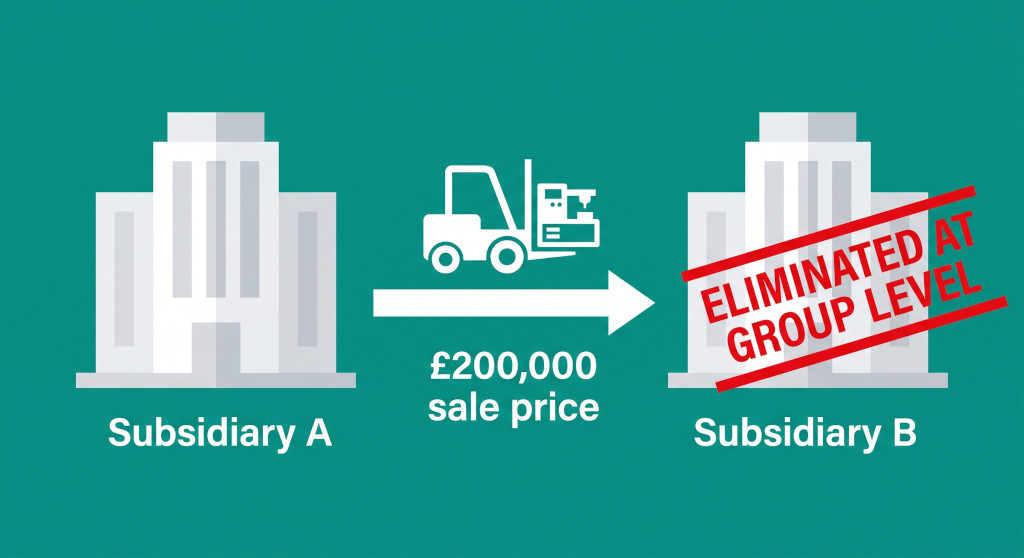
James had been group controller at Meridian Manufacturing for three years and had developed a reliable feel for the consolidation. So when he opened ManufactureCo’s accounts for the March quarter and saw a £50,000 profit on disposal of plant, his first instinct was to check whether an asset had been sold to a third party. It had not. ManufactureCo had transferred a CNC machine to its sister company, AssemblyCo, at a negotiated intercompany price of £200,000. AssemblyCo had duly capitalised it and started depreciating it.
At entity level, both sets of accounts were correct. ManufactureCo recorded the sale and the gain. AssemblyCo capitalised the machine at its acquisition cost and charged depreciation accordingly. But at group level, none of this should exist. The machine never left the group. No profit was ever realised. And AssemblyCo is now depreciating from an inflated cost base, which means group depreciation expense will be overstated every year until the machine is scrapped or sold externally.
James had two elimination entries to make, not one. The first is obvious to most finance teams. The second — the depreciation correction, which must be carried forward and compounded every single reporting period — is the one that quietly builds up a material error in the consolidated accounts when it is missed.
Stop building consolidations in spreadsheets.
BrizoConsol automates multi-entity consolidation — setup in minutes, reports the same day.
Why This Problem Only Exists at Group Level
An intercompany fixed asset sale passes every entity-level check. The seller has sold an asset at fair value. The buyer has acquired an asset at cost. Neither entity is doing anything wrong. The problem is structural: a transaction that nets to zero from the group’s perspective has been recorded as a profitable external event in the individual accounts.
When you consolidate, you are attempting to present the group as if it were a single economic entity. From that perspective, the machine has simply moved from one warehouse to another. The £50,000 “gain” is fictional — the group never received external cash for it. And the buyer’s £200,000 cost base is inflated relative to what the group originally paid, so every subsequent depreciation charge is too high.
This is different from the inventory version of the same problem. With unrealised profit in closing inventory, the adjustment fully reverses in the period when the goods are sold externally. Fixed assets are different: the asset stays on the balance sheet for years, and the depreciation over-charge accumulates every single period until disposal. One intercompany asset sale can generate consolidation adjustments for a decade.
The Worked Example: Four Key Numbers
ManufactureCo purchased a CNC machine for £180,000 with a six-year useful life, straight-line. After one full year with ManufactureCo, the machine had carrying value of £150,000. ManufactureCo then sold it to AssemblyCo at the start of Year 2 for £200,000.
| Item | Amount |
|---|---|
| Original cost to group | £180,000 |
| Accumulated depreciation after Year 1 (ManufactureCo) | £30,000 |
| Carrying value at date of intercompany sale | £150,000 |
| Intercompany sale price (AssemblyCo capitalises at this figure) | £200,000 |
| Gain recorded by ManufactureCo | £50,000 |
| Remaining useful life from AssemblyCo’s perspective | 5 years |
| AssemblyCo’s annual depreciation (£200,000 ÷ 5) | £40,000 |
| Group’s annual depreciation (£150,000 ÷ 5) | £30,000 |
| Annual excess depreciation at group level | £10,000 |
The £10,000 annual excess arises because AssemblyCo is depreciating from a cost of £200,000 instead of the group’s carrying value of £150,000. That £50,000 excess cost base, spread over five years, produces £10,000 too much depreciation each year. Over the full remaining life, the total excess depreciation will equal the original eliminated profit exactly — £50,000. This is how unrealised profit on a depreciable asset unwinds: not in a single period, but gradually through the depreciation line.
Year One: Two Journals, Not One
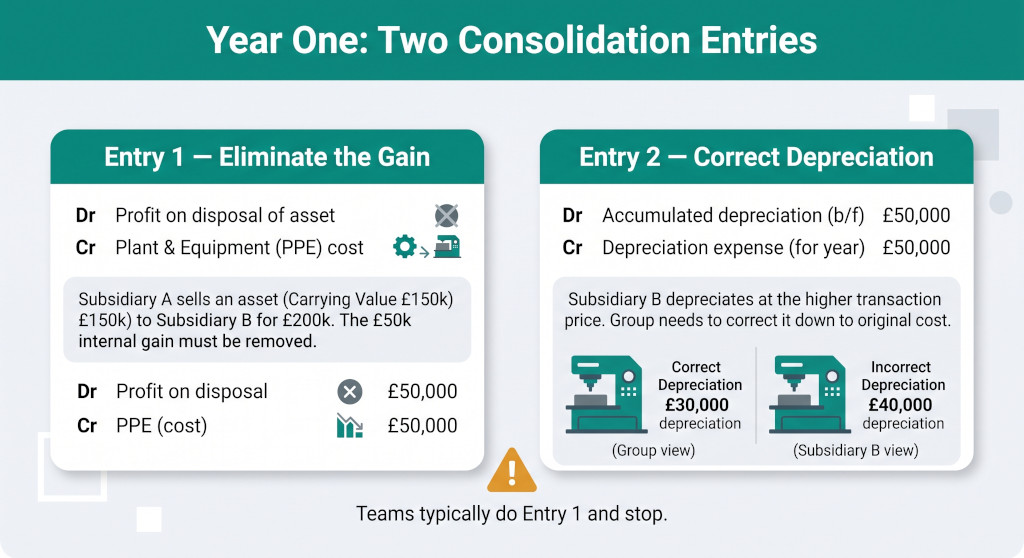
In the year of the intercompany sale, ManufactureCo’s accounts include a £50,000 profit on disposal. AssemblyCo’s accounts include £40,000 of depreciation on its new £200,000 asset. Both must be corrected at consolidation.
Entry 1 — Eliminate the unrealised gain
| Account | Dr | Cr |
|---|---|---|
| Profit on disposal of PPE (P&L) | £50,000 | |
| Property, Plant & Equipment — cost | £50,000 |
Removes the intercompany gain from the consolidated P&L and reduces the asset cost from £200,000 to £150,000, which is the group’s carrying value at the date of transfer.
Entry 2 — Correct the over-depreciation
| Account | Dr | Cr |
|---|---|---|
| Accumulated depreciation | £10,000 | |
| Depreciation expense (P&L) | £10,000 |
Reduces the accumulated depreciation to £30,000 and depreciation expense to £30,000 — what the group would have charged if the asset had never been transferred between entities.
After both entries, the consolidated position is:
| PPE cost after elimination (£200k − £50k) | £150,000 |
| Accumulated depreciation after correction (£40k − £10k) | (£30,000) |
| Consolidated carrying value | £120,000 |
The carrying value of £120,000 is exactly what the group would have shown if the transfer had never happened: the original cost of £180,000, less two full years of group depreciation at £30,000 per year (one year with ManufactureCo, one with AssemblyCo). The depreciation line in the consolidated P&L is £30,000, not £40,000. The profit on disposal is nil.
The depreciation correction (Entry 2) is the one most often missed. Teams eliminate the gain and consider the work done. But AssemblyCo will continue to over-depreciate by £10,000 every year — and without Entry 2, that error compounds silently across every future period.
Year Two and Beyond: Carrying the Adjustment Forward
The intercompany gain was recognised in ManufactureCo’s P&L in Year 2 (the year of the sale). By the time Year 3 begins, that gain has moved from P&L into ManufactureCo’s retained earnings. It sits in equity. The consolidation must still eliminate it — but now the debit goes to retained earnings rather than the income statement.
At the same time, the Year 2 depreciation correction increased consolidated profit by £10,000 compared with AssemblyCo’s own records. That additional profit is now embedded in the consolidated opening retained earnings. The Year 3 consolidation must carry forward this benefit as a credit to retained earnings while simultaneously applying a fresh current-year depreciation correction.
Year 3 requires three separate entries:
Entry 1 — Carry forward the cost reduction
| Account | Dr | Cr |
|---|---|---|
| Retained earnings (opening) | £50,000 | |
| Property, Plant & Equipment — cost | £50,000 |
The gain is now in retained earnings, not P&L. This entry keeps the cost reduction permanent across every subsequent period until disposal.
Entry 2 — Carry forward the prior-year depreciation correction
| Account | Dr | Cr |
|---|---|---|
| Accumulated depreciation | £10,000 | |
| Retained earnings (opening) | £10,000 |
Restores the £10,000 benefit from Year 2’s depreciation correction into opening retained earnings, reflecting the cumulative unwinding to date.
Entry 3 — Current-year depreciation correction
| Account | Dr | Cr |
|---|---|---|
| Accumulated depreciation | £10,000 | |
| Depreciation expense (P&L) | £10,000 |
Corrects this year’s depreciation overcharge. This entry repeats in identical form each year for the full five-year remaining life.
After Year 3, the consolidated PPE position is:
| PPE cost after cost elimination | £150,000 |
| AccumDep: AssemblyCo Year 1 & 2 (£40k × 2 = £80k) less total adj (£20k) | (£60,000) |
| Consolidated carrying value | £90,000 |
This again matches the group’s expected carrying value: three total years of depreciation at £30,000 on the original cost of £180,000 gives accumulated depreciation of £90,000, leaving a carrying value of £90,000. The consolidation adjustment is working correctly.
Watch out for the consolidation software assumption. Some tools allow you to enter the gain elimination journal as a one-off in the year of the transaction and then auto-roll it forward. Others require you to re-enter all three components each year. Know which behaviour your system uses — an auto-rolled journal that only picks up Entries 1 and 2 but not Entry 3 will silently accumulate a depreciation error.
When the Asset Is Eventually Sold or Scrapped
If AssemblyCo holds the asset for the full five remaining years and scraps it, no special disposal entry is needed at consolidation. By that point, the accumulated depreciation corrections will have totalled £50,000, exactly unwinding the original gain elimination. The asset will have a nil carrying value in both entity and consolidated accounts, and the unrealised profit will have been fully released through the depreciation line over the five-year period.
The more complex case arises if AssemblyCo sells the asset externally before the end of its useful life. Suppose AssemblyCo sells after three years (at the end of Year 4 of the group’s ownership). By then, only three years of depreciation corrections have been processed — £30,000 of the original £50,000 gain has been unwound. The remaining £20,000 must be released in full in the disposal year.
In that year, the consolidation will need to credit the disposal gain by £20,000 (or reduce the loss) to release the remaining unrealised profit. This is handled by crediting retained earnings and debiting the gain on disposal in the consolidation working papers. This is the same principle applied to unrealised profit elimination on associate asset sales, where the remaining unrecognised profit is released on external disposal.
Consolidation adjustments tracked automatically
BrizoConsol maintains a register of intercompany elimination entries — including recurring fixed asset adjustments — that rolls forward each period without manual re-entry. See how it handles your specific group structure. See It In Action
The Deferred Tax Dimension
If the group is subject to tax, the elimination of the intercompany gain creates a deferred tax asset (DTA). Tax follows the legal entity: ManufactureCo pays tax on its £50,000 gain. AssemblyCo gets tax relief on its depreciation from the inflated cost of £200,000. From the group’s perspective, however, the gain has been eliminated, creating a difference between the tax base of the asset and its consolidated carrying value.
In the year of the sale, the group creates a DTA equal to the eliminated gain multiplied by the applicable tax rate. At a 25% rate:
| Account | Dr | Cr |
|---|---|---|
| Deferred tax asset | £12,500 | |
| Tax expense (P&L) | £12,500 |
DTA = £50,000 eliminated profit × 25% tax rate. This partially offsets the P&L impact of removing the gain.
Each subsequent year, as the £10,000 depreciation correction unwinds the temporary difference, the DTA reduces by £2,500 (£10,000 × 25%). The DTA will be nil by the end of Year 5 when the last depreciation correction is processed. For a detailed treatment of how consolidation adjustments create and unwind deferred tax positions, see the deferred tax in group consolidation guide.
What If the Selling Subsidiary Has a Non-Controlling Interest?
When ManufactureCo is not wholly owned by the parent — say, 80% parent and 20% NCI — the elimination of the intercompany gain must still be made in full. But the impact is shared between the group (parent shareholders) and the NCI in proportion to their respective ownership.
This is an upstream sale (subsidiary to sister company, effectively passing through the parent level). The £50,000 gain elimination is allocated as follows:
| Group share of gain eliminated (80%) | £40,000 |
| NCI share of gain eliminated (20%) | £10,000 |
| Total gain eliminated | £50,000 |
The elimination journal is identical in form — the full £50,000 is removed from P&L and from PPE cost. But in the retained earnings and NCI columns of the consolidated statement of changes in equity, the £50,000 reduction is split 80:20. The NCI balance on the balance sheet is £10,000 lower as a result. Each year as the depreciation correction reverses the unrealised profit, the NCI balance is rebuilt in proportion. For a full treatment of upstream, downstream, and lateral elimination allocations, see the guide on intercompany eliminations when there is a non-controlling interest.
A Year-by-Year Tracker
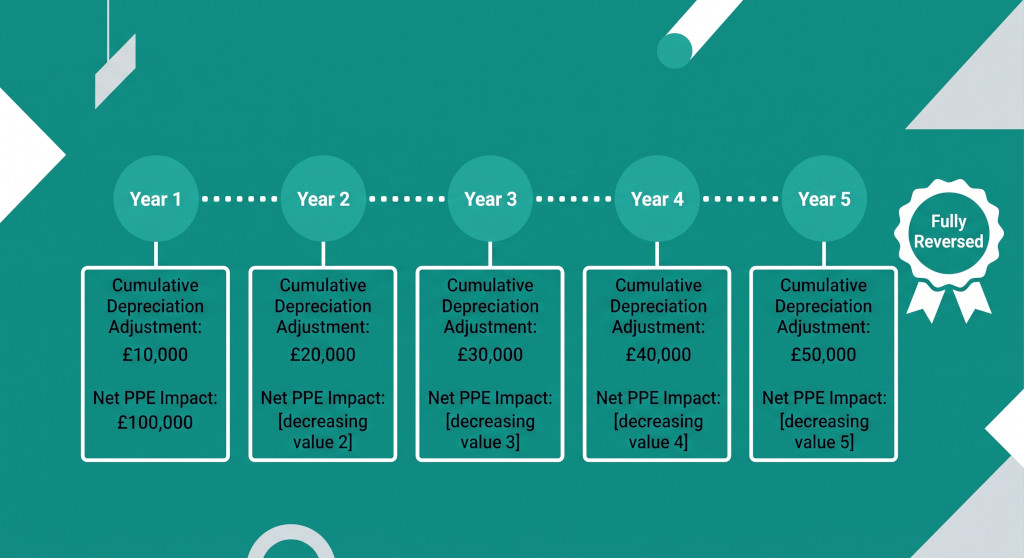
The table below shows how the adjustments build and unwind over the five-year remaining life of the machine. “Cumulative cost adjustment” is the PPE cost reduction carried forward in every period. “Cumulative dep adjustment” is the total reduction in accumulated depreciation across all years to date. “Net PPE impact” is the net reduction in carrying value that the elimination creates — starting at £40,000 in Year 2 (the year of sale) and shrinking by £10,000 each year.
| Year (AssemblyCo ownership) | Current year dep correction | Cumulative cost adj to PPE | Cumulative dep adj | Net PPE impact (reduction) |
|---|---|---|---|---|
| Year 1 (year of sale) | £10,000 | £50,000 | £10,000 | £40,000 |
| Year 2 | £10,000 | £50,000 | £20,000 | £30,000 |
| Year 3 | £10,000 | £50,000 | £30,000 | £20,000 |
| Year 4 | £10,000 | £50,000 | £40,000 | £10,000 |
| Year 5 (final year) | £10,000 | £50,000 | £50,000 | £0 |
By Year 5, the cumulative depreciation adjustment exactly equals the original profit eliminated (£50,000), and the net PPE impact has fallen to zero. The asset is fully depreciated under both entity and group accounts. The unrealised profit has been entirely released. No disposal entry is needed.
Register this adjustment in your consolidation adjustment schedule on the date of the intercompany transfer, note the asset’s expected useful life, and set a reminder for the disposal year. A fixed asset elimination that is set up once and never reviewed will still be sitting in your consolidation working papers — at zero net impact — ten years later, generating spurious journal entries long after the asset has been scrapped.
A Checklist for Getting This Right
- Identify the intercompany asset transfer early. The trigger is any disposal gain in one entity matched by a new asset acquisition in another entity in the same period. Flag it before the consolidation starts, not after.
- Record the gain elimination and the depreciation correction as two separate journal entries in your consolidation pack. A single net entry will make the working harder to follow and harder to audit.
- Calculate the annual excess depreciation before closing the period. You need the difference between the buyer’s depreciation rate (on the inflated cost) and the group’s rate (on the carrying value at transfer). Document both rates in the workings.
- Add the adjustment to your rolling elimination register with the asset’s expected remaining life and annual correction amount. Review the register at every month-end close.
- Set up the deferred tax entry in the same period as the gain elimination. The DTA and its annual unwind should sit alongside the PPE entries in the tax section of your consolidation working papers.
- Split the gain and the unwind between parent and NCI if the selling subsidiary is not wholly owned. Update the NCI column in the SOCE accordingly each period.
- Review the register when any asset is disposed of externally. If AssemblyCo sells the machine before the end of its useful life, calculate the unrealised profit still outstanding and release it in full in the disposal period.
- Close the register entry when the asset reaches the end of its useful life. At that point the cumulative depreciation adjustment will equal the original gain, the net PPE impact will be nil, and no further entries are required.
Stop tracking this in a spreadsheet
BrizoConsol maintains a structured elimination register for intercompany asset transfers — including automatic rollforward of recurring depreciation corrections. Start a free trial and load your first consolidation today. Start Free Trial