Accounting Policy Alignment Before Consolidation: What to Standardise and How to Document It
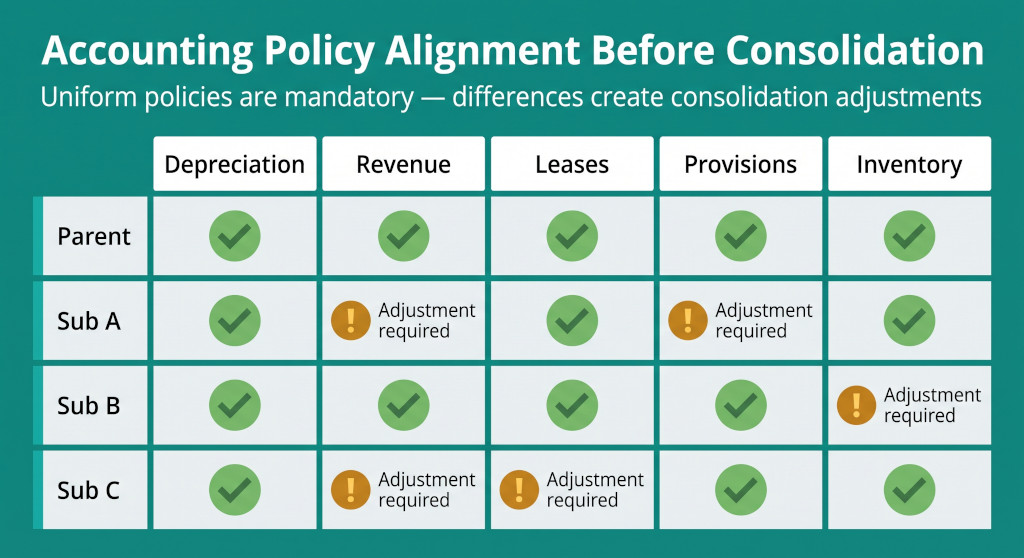
A consolidated group is required to prepare its financial statements using uniform accounting policies. IFRS 10 paragraph B87 states this explicitly: if a member of the group uses accounting policies other than those adopted in the consolidated financial statements for like transactions and events in similar circumstances, appropriate adjustments are made when preparing those consolidated financial statements. FRS 102 paragraph 9.17 and ASC 810 contain equivalent requirements.
In practice, this requirement is consistently underestimated. A group may have a parent reporting under IFRS with a 10-year straight-line policy for office equipment while a subsidiary uses 5 years. One entity may recognise revenue on delivery; another on shipment. A subsidiary reporting under FRS 102 may have operating leases that are off-balance-sheet, while the group applies IFRS 16. Each of these differences creates a mandatory consolidation adjustment — a journal that must be calculated, posted, and documented every reporting period.
This guide covers the five main areas requiring policy alignment, the consolidation journal for each, the distinction between same-framework policy differences and cross-GAAP differences, and how to document the outcome in a Group Accounting Policy Manual.
Stop building consolidations in spreadsheets.
BrizoConsol automates multi-entity consolidation — setup in minutes, reports the same day.
These are consolidation-only adjustments. The subsidiary’s statutory accounts are not changed — it continues to apply its own accounting policies for its own reporting obligations. The alignment journal exists only in the consolidation workpaper and is reversed at the entity level when the next period’s entity accounts are prepared.
The Five Areas That Most Commonly Require Alignment
1 — Depreciation: Useful Lives and Capitalisation Thresholds
Most groups with multiple entities have at least one inconsistency here
Different entities commonly apply different useful lives to the same categories of asset — office equipment, leasehold improvements, vehicles, IT hardware — either because they adopted different policies before joining the group, or because local management made different judgements about the assets’ expected use. The consolidated group must apply consistent useful lives to similar assets in similar circumstances.
Capitalisation thresholds are also a frequent source of misalignment. One entity capitalises assets above £1,000; another uses £5,000. For assets in the £1,000–£5,000 range, one entity has them on the balance sheet while the other has expensed them immediately. The group policy must be stated and applied consistently.
Calculating the adjustment: identify the difference between what depreciation the subsidiary charged under its own policy and what it would have charged under the group policy. The adjustment reduces or increases the subsidiary’s depreciation charge and correspondingly adjusts the PPE net book value.
Journal — Depreciation life extension adjustment (Sub charges more than group policy requires)
| Account | Dr (£) | Cr (£) |
|---|---|---|
| Property, plant and equipment (increase NBV to group policy) | 18,000 | |
| Depreciation expense (reduce charge to group policy rate) | 18,000 |
Example: Group policy — plant depreciated over 10 years. SubCo policy — plant depreciated over 7 years. SubCo charged £42,000 depreciation; group policy would require £24,000. Adjustment: Dr PPE £18,000 / Cr Depreciation expense £18,000. The cumulative NBV difference (from prior periods) is an opening retained earnings adjustment.
2 — Revenue Recognition: Timing and Method
The highest-risk alignment area for groups with long-term contracts or mixed business models
Under IFRS 15 (and ASC 606 / FRS 102 Section 23), revenue is recognised when — or as — performance obligations are satisfied. For most straightforward sales, the group’s entities will naturally align. The misalignments arise in three situations:
Timing of point-in-time recognition: one entity recognises revenue on shipment (when legal title passes at the warehouse); another on delivery (when the customer receives the goods). For any period with significant in-transit inventory, the difference is material. The group policy must specify the point of transfer of control, and entities not meeting it require an adjustment.
Over-time vs point-in-time for long-term contracts: a construction or services subsidiary may still be recognising revenue on contract completion rather than over time (percentage of completion), contrary to IFRS 15’s requirement where performance obligations are satisfied over time. The revenue adjustment in this case affects not just timing but the allocation of revenue between periods.
Principal vs agent: where one entity in the group acts as agent (taking a commission) and another acts as principal (buying and reselling), the gross vs net presentation of revenue differs. If the group policy is to assess each entity’s role independently, no adjustment is needed — but if an entity has incorrectly classified its role, the adjustment can be very large (gross revenue vs commission income).
3 — Lease Accounting: IFRS 16 vs Off-Balance-Sheet
The most material consolidation adjustment for groups with FRS 102 subsidiaries
Where the group reports under IFRS and applies IFRS 16, but a subsidiary prepares its entity accounts under FRS 102 (which does not require IFRS 16-style on-balance-sheet recognition for all leases), the operating leases of the subsidiary must be recognised as right-of-use assets and lease liabilities at consolidation.
This is often the single largest consolidation adjustment in a group with UK GAAP subsidiaries. A subsidiary with £120,000 of annual operating lease expense on a five-year lease may have an IFRS 16 lease liability of £400,000–£500,000 that does not appear on the entity’s balance sheet but must appear on the consolidated balance sheet.
The adjustment requires: the lease term, the discount rate (typically the subsidiary’s incremental borrowing rate), and the remaining lease payments. From these, the ROU asset and lease liability are calculated at commencement, and depreciation (ROU) and interest (liability) replace the straight-line lease expense in the entity’s accounts.
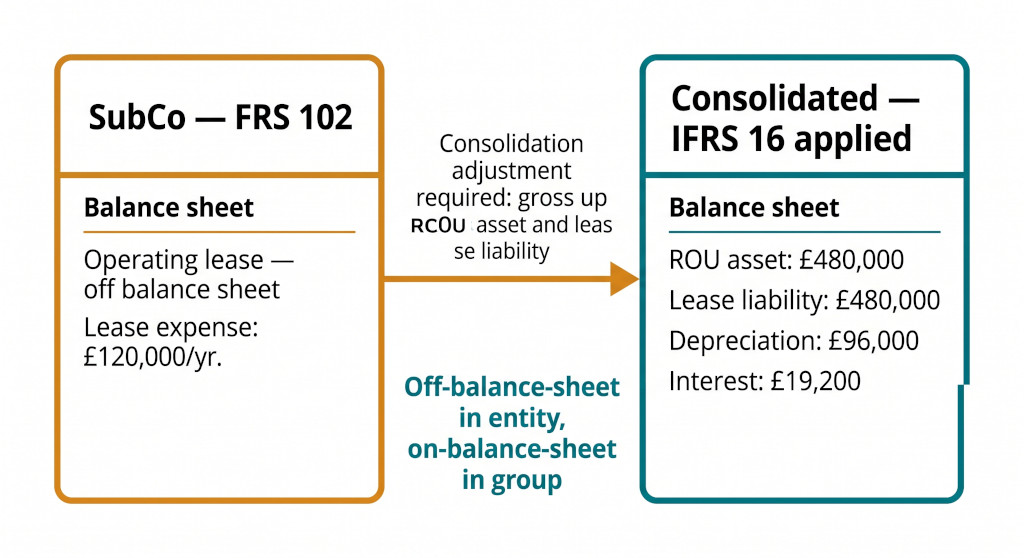
Journal — IFRS 16 recognition at consolidation for FRS 102 subsidiary operating lease
| Account | Dr (£) | Cr (£) |
|---|---|---|
| Right-of-use asset | 480,000 | |
| Lease liability | 480,000 | |
| Lease liability (repayment of principal in the period) | 100,800 | |
| Finance cost (interest on lease liability) | 19,200 | |
| Operating lease expense (reverse the entity’s straight-line charge) | 120,000 | |
| Depreciation expense (ROU asset: £480,000 ÷ 5 years) | 96,000 | |
| Accumulated depreciation — ROU asset | 96,000 |
The net P&L impact in the early years is typically an increase in total cost (depreciation + interest > straight-line lease expense) — the opposite of what the entity’s P&L shows. The consolidated EBITDA is higher than the entity’s EBITDA because the lease expense is replaced by depreciation (excluded from EBITDA) and interest (typically excluded from EBITDA). For a full walkthrough of FRS 102 subsidiary into IFRS parent adjustments, see how to consolidate a FRS 102 subsidiary into an IFRS parent.
4 — Provisions: Recognition Thresholds and Measurement Bases
Judgement-driven and inconsistent across management teams without a clear group policy
Provisions require a present obligation, probable outflow, and reliable estimate. Different subsidiaries — managed by different finance directors with different risk appetites — will apply this three-part test differently to similar facts. Common misalignments include: warranty provisions (one entity accrues based on historical rates; another waits for specific claims to be received); bad debt provisions (one entity uses an aged debtor matrix; another uses specific debtor assessment only); and restructuring provisions (one entity recognises when the board decides internally; another waits for formal external announcement to employees).
The group accounting policy must specify the recognition threshold, the measurement basis, and the review frequency for each material provision category. Where an entity’s provision does not comply with the group policy, the consolidation adjustment either increases the provision (Dr expense / Cr provision) or releases it (Dr provision / Cr expense).
5 — Inventory Costing: FIFO, Weighted Average, and LIFO
Critical in groups with US GAAP subsidiaries, where LIFO is still permitted
IAS 2 and FRS 102 permit FIFO or weighted average cost; LIFO is prohibited. US GAAP (ASC 330) still permits LIFO, and many US entities use it for tax reasons. A US GAAP subsidiary using LIFO must be converted to FIFO or weighted average at consolidation if the group reports under IFRS. The difference — the “LIFO reserve” — can be material in periods of rising prices.
Within IFRS groups, the most common inventory costing misalignment is between entities using FIFO and those using weighted average. For homogeneous goods held in significant quantities, the choice of method can produce meaningfully different closing stock values in periods of price volatility. The group policy should specify a single method, and entities not applying it require a consolidation adjustment.
Same-Framework Policy Differences vs Cross-GAAP Differences
Two distinct types of policy misalignment require different responses:
Same Framework, Different Choices
- Both entities report under IFRS but make different elections within it (revaluation model vs cost model for PPE; different useful life estimates)
- The adjustment corrects the choice to match the group policy
- No framework-level difference to explain — the adjustment is purely about applying a consistent policy within the same set of rules
- Typically simpler to calculate and document
- Example: SubCo revalues land; group policy is cost model → reverse revaluation at consolidation
Cross-GAAP Framework Differences
- Parent reports under IFRS; subsidiary under FRS 102 or US GAAP
- Some differences are mandatory GAAP differences (e.g., development cost capitalisation: required under IAS 38; prohibited under US GAAP)
- Others are policy choices that happen to differ across frameworks
- Cross-GAAP adjustments are typically posted as a block of “conversion journals” before the standard policy alignment adjustments
- Example: US GAAP sub uses LIFO; IFRS parent requires conversion to FIFO before policy alignment can even begin
For the full set of conversion journals when the subsidiary and parent report under different frameworks, see a practical cross-GAAP consolidation method.
The Entity-Policy Matrix
The starting point for any policy alignment process is a matrix that maps each entity against each material policy area, identifying where alignment exists and where a consolidation adjustment is required. This matrix becomes the core of the Group Accounting Policy Manual.
| Entity | PPE Depreciation | Revenue Recognition | Lease Accounting | Provisions | Inventory |
|---|---|---|---|---|---|
| ParentCo (IFRS) | Aligned | Aligned | Aligned | Aligned | Aligned |
| Sub A (IFRS) | Adjustment — equipment 5yr vs 10yr group | Aligned | Aligned | Adjustment — warranty: specific claims only vs % of revenue | Aligned |
| Sub B (FRS 102) | Aligned | Adjustment — revenue on completion vs IFRS 15 over time | Adjustment — operating leases off B/S; apply IFRS 16 | Aligned | Aligned |
| Sub C (US GAAP) | Aligned | Aligned | Aligned | Aligned | Adjustment — LIFO reserve; convert to FIFO |
Each cell in the matrix that shows “Adjustment required” should link to a specific workpaper that quantifies the adjustment and specifies the journal. The matrix is reviewed at least annually, and whenever a new entity joins the group or an existing entity changes its accounting policies.
Documenting the Group Accounting Policy Manual
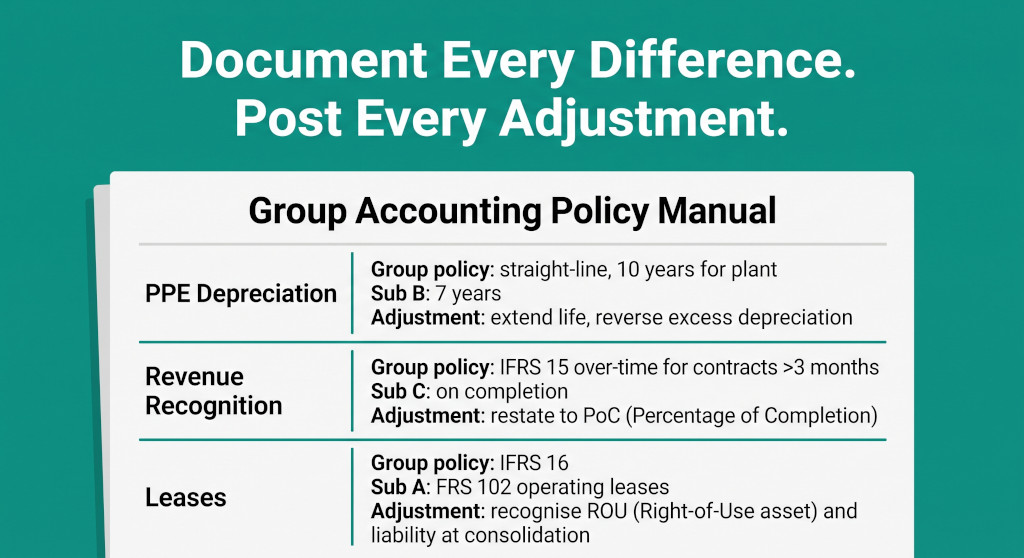
The Group Accounting Policy Manual (GAPM) is the document that records the group’s accounting policies, identifies all known entity-level deviations, specifies the adjustment for each, and assigns ownership. It is not a one-time document — it must be maintained as the group evolves, new entities are acquired, and standards change.
A practical GAPM typically contains:
- Framework statement: which reporting standard governs the consolidated accounts, the effective date of adoption, and any elections made (e.g., whether to apply IFRS 16 short-term exemption, which NCI measurement method is used at acquisition).
- Policy statement per area: for each material area (PPE, intangibles, revenue, leases, inventory, provisions, financial instruments, foreign currency), the group policy is stated precisely — not just the standard reference, but the specific elections and estimates (e.g., “office equipment: straight-line over 10 years, residual value nil”).
- Entity compliance table: the matrix above, confirmed and signed off by the CFO of each entity at least annually.
- Adjustment workpapers: for each cell showing “Adjustment required,” a linked workpaper containing the calculation, the journal reference, the amount for the current period, and the cumulative prior-period amount in opening equity.
- Change log: a record of when the GAPM was last reviewed, what changed, and who approved the change.
The most common failure mode is a GAPM that exists but is not maintained. A document written at acquisition that is never updated becomes worse than no document at all — it gives false assurance that the adjustments have been reviewed when they have not. The GAPM should be reviewed by the group FC as part of every annual close, not filed away after the first consolidation.
Materiality and the Adjustment Threshold
Not every policy difference requires a consolidation adjustment. Where the adjustment would be immaterial to the consolidated financial statements, it can be documented and noted in the GAPM without posting a journal. The group should set an explicit materiality threshold for consolidation adjustments — a common approach is 0.5% of consolidated revenue or 5% of consolidated profit before tax, whichever is lower — and apply it consistently.
Materiality should be assessed on a cumulative basis. An adjustment that is below the threshold in any single period may accumulate across periods (particularly depreciation differences, where the difference grows as the useful life diverges further) until it becomes material. A periodic review of cumulative immaterial adjustments is good practice.
Practical Checklist: Policy Alignment at First Consolidation
- Obtain each entity’s accounting policies from its most recent statutory accounts or entity accounting policy statement.
- Map each entity’s policies against the group GAPM using the entity-policy matrix.
- Identify all cells where adjustment is required; for each, quantify the current-period adjustment and the cumulative opening equity adjustment.
- Confirm whether any differences are cross-GAAP (requiring conversion journals before policy adjustment) or within-framework (requiring policy adjustment only).
- Post each adjustment in the consolidation workpaper with a reference to the GAPM section it relates to.
- Review all lease agreements of entities not reporting under IFRS 16 and calculate the IFRS 16 adjustment for each material lease.
- Confirm the inventory costing method for each entity and calculate any LIFO-to-FIFO conversion required.
- For each provision category, confirm the entity’s recognition threshold and measurement basis against the group policy; adjust where required.
- Have each entity CFO or finance director sign off the entity’s compliance table in the GAPM.
- Update the GAPM change log to record the review date and any changes from the prior period.
For the policies that arise specifically when a subsidiary under FRS 102 is consolidated into an IFRS parent — including goodwill reversal and lease recognition — see aligning accounting policies when your construction subsidiary reports under FRS 102. For revenue recognition inconsistencies in mixed-model groups, see why your e-commerce group’s revenue figures don’t agree. For the full onboarding process when a new entity joins the group, see how to onboard a new entity into your group consolidation.
Policy differences tracked, adjustments posted automatically
BrizoConsol stores each entity’s policy settings, flags deviations from the group standard, and maintains the policy adjustment journals as standing entries that roll forward each period — so the GAPM adjustments don’t have to be rebuilt from scratch at every close. See It in Action