NCI at Acquisition: How to Calculate Non-Controlling Interest on the Date of Purchase
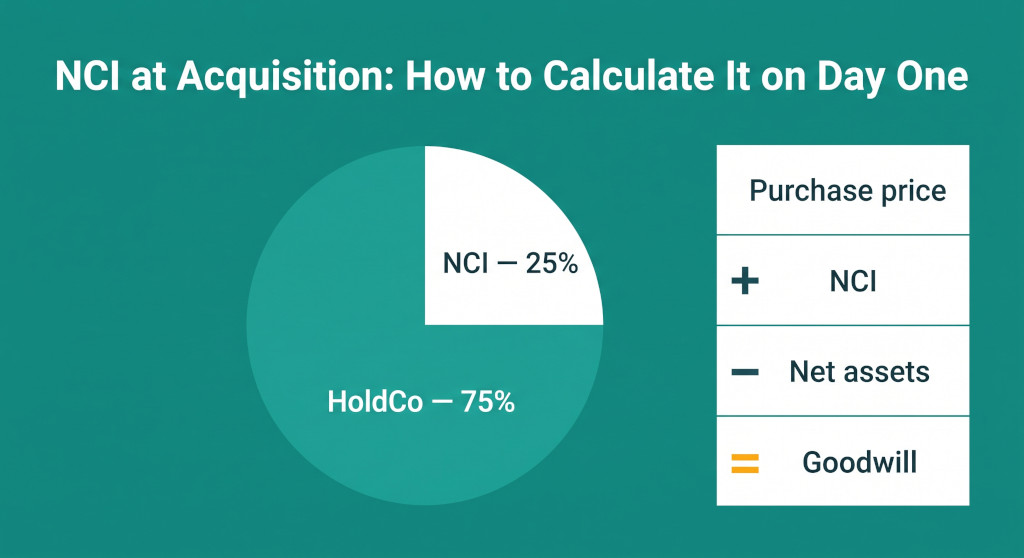
When HoldCo acquires 75% of SubCo, it controls SubCo from the acquisition date and must consolidate SubCo’s full balance sheet into the group accounts. But because HoldCo doesn’t own 100% of SubCo, the other 25% has to appear somewhere in the consolidated equity. That 25% minority interest — the non-controlling interest, or NCI — must be recognised and measured on the date of acquisition before the goodwill calculation can be completed.
For most finance teams, goodwill feels like the headline number from an acquisition. The purchase price is known, the advisers have produced a fair value schedule for the net assets, and goodwill falls out as the residual. What trips people up is that goodwill is not just the excess of purchase price over net assets — it is the excess of the total consideration transferred (including the fair value of any NCI) over the fair value of the identifiable net assets. Until NCI is measured, goodwill cannot be calculated. And under IFRS 3, there are two different ways to measure NCI at acquisition, each of which gives a different goodwill figure.
This post works through both methods from first principles, using a single acquisition scenario throughout. The journal entries for each method are shown in full, and a comparison table sets out exactly how the opening consolidated balance sheet differs depending on which method is applied.
Automate NCI calculations across all your entities.
BrizoConsol handles non-controlling interest automatically — no manual adjustments required.
The Acquisition Scenario
On 1 January 20X1, HoldCo acquires 75% of SubCo for $1,200,000 cash. At the acquisition date, SubCo’s identifiable assets and liabilities have been fair-valued by external advisers. The fair values are:
| SubCo — identifiable assets and liabilities at fair value | $ |
|---|---|
| Property, plant & equipment | 900,000 |
| Inventory | 300,000 |
| Trade receivables | 250,000 |
| Cash and cash equivalents | 100,000 |
| Trade payables | (80,000) |
| Borrowings | (70,000) |
| Fair value of identifiable net assets | 1,400,000 |
The fair value of the 25% NCI stake — based on a recent transaction in SubCo shares among minority shareholders — has been assessed at $380,000. HoldCo’s implied value for the full 100% of SubCo is therefore $1,200,000 / 75% = $1,600,000, but the minority’s stake is worth $380,000, not $400,000 (25% × $1,600,000), because minority shares often trade at a discount to the controlling interest price. This discount is real-world market evidence and is used in the fair value method.
Why the NCI Measurement Method Matters
Under IFRS 3, the acquiring company must choose — on an acquisition-by-acquisition basis — how to measure the NCI at the acquisition date. There are two permitted methods:
- Method A: Fair value of the NCI. The NCI is measured at its fair value at the acquisition date, typically based on market prices for the minority shares or a valuation of the minority stake. This approach recognises the full goodwill of the acquired business, including the goodwill attributable to the NCI.
- Method B: NCI’s proportionate share of the acquiree’s identifiable net assets. The NCI is measured as NCI% multiplied by the fair value of SubCo’s identifiable net assets. This approach recognises only the goodwill attributable to HoldCo’s share of the acquisition — the NCI’s share of goodwill is not recognised.
The choice between Method A and Method B is made once per acquisition and cannot be changed retrospectively. Most groups adopt a default method in their group accounting policy, then apply it consistently unless specific circumstances make the other method more appropriate for a particular transaction.
Under US GAAP (ASC 805), Method A — the fair value approach — is mandatory. There is no election. Under UK GAAP (FRS 102), Method B — the proportionate share — is the required treatment; FRS 102 does not permit the fair value method for NCI. Groups reporting under IFRS have the choice; what they give up in simplicity (Method B is easier to calculate) they may gain in comparability (Method A shows the full economic value of goodwill). For an overview of how these standards differ more broadly, see IFRS vs UK GAAP: key differences in financial reporting.
Method A: Fair Value of the NCI
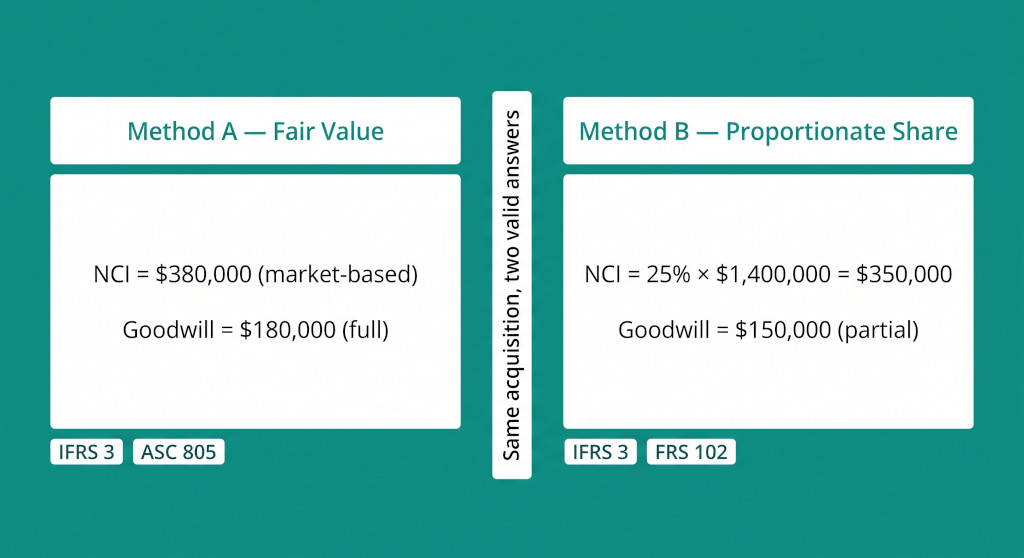
Under Method A, NCI at acquisition is measured at its fair value: $380,000. The goodwill calculation then includes both HoldCo’s consideration and the fair-valued NCI on one side of the equation, and the full fair value of SubCo’s net assets on the other.
| Consideration transferred by HoldCo (cash) | $1,200,000 |
| Fair value of NCI (Method A) | $380,000 |
| Combined value of 100% of SubCo | $1,580,000 |
| Less: fair value of SubCo’s identifiable net assets | ($1,400,000) |
| Goodwill (full goodwill — Method A) | $180,000 |
The $180,000 goodwill represents the full economic goodwill of the SubCo business — the premium over fair-valued net assets that the market attributes to the business as a whole, not just to HoldCo’s 75% share of it. Of that $180,000, approximately $135,000 (75%) is attributable to HoldCo and approximately $45,000 (25%) is attributable to the NCI.
The consolidation journal at acquisition date under Method A is:
| Account | Dr | Cr |
|---|---|---|
| Property, plant & equipment (at fair value) | $900,000 | |
| Inventory (at fair value) | $300,000 | |
| Trade receivables (at fair value) | $250,000 | |
| Cash and cash equivalents | $100,000 | |
| Goodwill (full goodwill) | $180,000 | |
| Trade payables | $80,000 | |
| Borrowings | $70,000 | |
| Cash — purchase consideration | $1,200,000 | |
| Non-Controlling Interest (equity) — Method A | $380,000 |
Acquisition entry under IFRS 3 using the fair value method for NCI. Total debits = Total credits = $1,730,000. The NCI of $380,000 appears as a separate component within consolidated equity. Goodwill of $180,000 is the full goodwill attributable to both HoldCo (75%) and NCI (25%).
Method B: NCI’s Proportionate Share of Identifiable Net Assets
Under Method B, NCI at acquisition is calculated as the NCI percentage multiplied by the fair value of SubCo’s identifiable net assets — not at the market value of the minority interest. The NCI’s share of goodwill is not recognised.
| NCI% × fair value of identifiable net assets | |
| 25% × $1,400,000 | $350,000 |
With NCI at $350,000, the goodwill calculation changes:
| Consideration transferred by HoldCo (cash) | $1,200,000 |
| Less: HoldCo’s share of identifiable net assets (75% × $1,400,000) | ($1,050,000) |
| Goodwill (partial goodwill — Method B) | $150,000 |
The $150,000 represents only HoldCo’s share of goodwill. The NCI’s implied share of goodwill — $30,000 (25% × $120,000, where $120,000 is the total implied goodwill of the business based on HoldCo’s 75% purchase price) — is simply not recognised on the consolidated balance sheet under this method. This is why Method B produces lower goodwill than Method A.
| Account | Dr | Cr |
|---|---|---|
| Property, plant & equipment (at fair value) | $900,000 | |
| Inventory (at fair value) | $300,000 | |
| Trade receivables (at fair value) | $250,000 | |
| Cash and cash equivalents | $100,000 | |
| Goodwill (partial goodwill) | $150,000 | |
| Trade payables | $80,000 | |
| Borrowings | $70,000 | |
| Cash — purchase consideration | $1,200,000 | |
| Non-Controlling Interest (equity) — Method B | $350,000 |
Acquisition entry under IFRS 3 using the proportionate share method for NCI. Total debits = Total credits = $1,700,000. Goodwill of $150,000 represents HoldCo’s share only; the NCI’s $30,000 implied goodwill is not recorded. This is also the required method under FRS 102.
Comparing the Two Methods: The Opening Balance Sheet
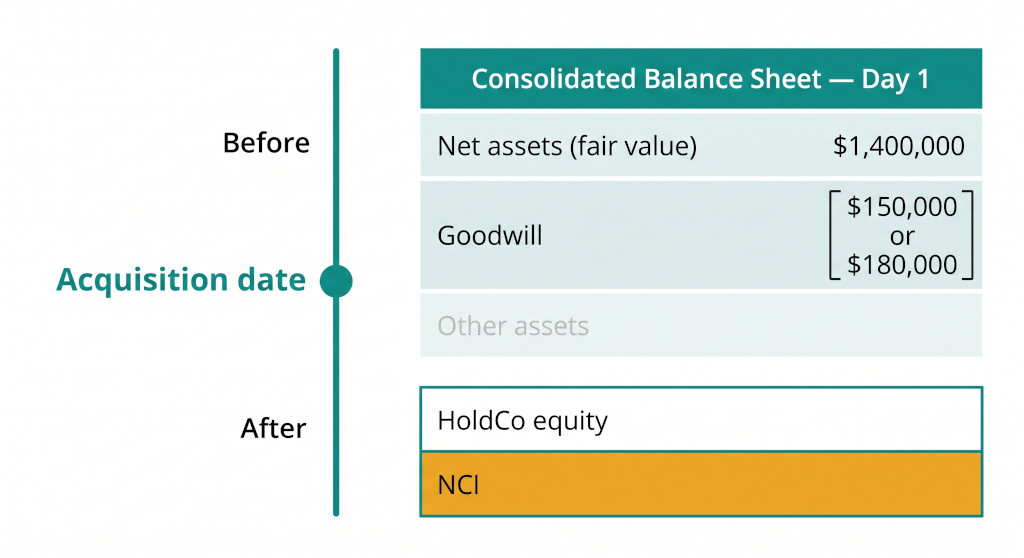
The choice of method creates two different opening positions for the consolidated balance sheet. The identifiable net assets are the same under both methods — they are always brought in at fair value. Only goodwill and NCI differ.
| Consolidated balance sheet line | Method A (Fair value) | Method B (Proportionate share) | Difference |
|---|---|---|---|
| PP&E (at fair value) | $900,000 | $900,000 | — |
| Inventory | $300,000 | $300,000 | — |
| Trade receivables | $250,000 | $250,000 | — |
| Cash and cash equivalents | $100,000 | $100,000 | — |
| Goodwill | $180,000 | $150,000 | +$30,000 (A) |
| Trade payables | ($80,000) | ($80,000) | — |
| Borrowings | ($70,000) | ($70,000) | — |
| Net assets (consolidated) | $1,580,000 | $1,550,000 | +$30,000 (A) |
| HoldCo equity (cash paid, before HoldCo’s own balance sheet) | ($1,200,000) | ($1,200,000) | — |
| Non-controlling interest (equity) | $380,000 | $350,000 | +$30,000 (A) |
The $30,000 difference flows through consistently: Method A has $30,000 more goodwill on the asset side and $30,000 more NCI in equity. The consolidated net assets are higher under Method A — not because SubCo is worth more, but because Method A recognises additional goodwill attributable to the minority that Method B leaves unrecognised. For a deeper examination of how this choice affects impairment testing and who absorbs a goodwill write-down in subsequent periods, see the post on goodwill in group consolidation: calculation, impairment, and common errors.
Handling your first partial acquisition?
BrizoConsol tracks NCI balances from the acquisition date through every subsequent period — recording the opening position, allocating profit and loss between HoldCo and NCI, and reconciling the NCI equity column automatically. See It in Action
Which Standard Applies to Your Group
| Standard | NCI measurement method permitted | Election? |
|---|---|---|
| IFRS 3 | Fair value (Method A) or proportionate share (Method B) | Yes — elected per acquisition |
| ASC 805 (US GAAP) | Fair value only (Method A) | No |
| FRS 102 (UK GAAP) | Proportionate share only (Method B) | No |
| SFRS(I) 3 (Singapore) | Fair value (Method A) or proportionate share (Method B) | Yes — same as IFRS 3 |
What If There Is No Observable Market Price for the NCI Stake?
Method A requires a fair value for the NCI at the acquisition date. For listed companies, this is straightforward — the market price of the minority shares on the acquisition date provides observable evidence. For private companies, where the minority shares are not traded, a fair value must be estimated using valuation techniques: typically an income approach (discounting projected cash flows), a market approach (comparable company multiples), or a combination. Applying a minority discount to an implied 100% enterprise value is common, which is why the NCI fair value of $380,000 in the example is less than the implied pro-rata value of 25% × ($1,200,000 / 75%) = $400,000.
If a reliable fair value cannot be obtained without excessive cost or effort, Method B is available under IFRS 3 as an alternative. In practice, many private company acquisitions use Method B partly for this reason — it requires only the fair value of the identifiable net assets (which must be calculated anyway for the purchase price allocation) rather than a separate valuation of the minority stake.
Common error: Using HoldCo’s implied per-share price to value the NCI, as if the minority 25% stake were worth exactly 25% of what HoldCo paid per share. This ignores the minority discount and produces an NCI figure that is systematically too high, inflating both goodwill and the opening NCI balance under Method A.
What Happens to NCI After the Acquisition Date
The acquisition-date NCI figure is the starting point for an NCI balance that moves every period. After the acquisition date, the NCI balance is adjusted for the NCI’s share of SubCo’s profits or losses, any dividends SubCo pays to the minority shareholders, the NCI’s share of any other comprehensive income (including currency translation adjustments if SubCo is a foreign subsidiary), and any changes in ownership percentage that occur in subsequent periods.
Under Method A, the goodwill balance that opens at $180,000 is tested for impairment at the full amount — any impairment loss is allocated between HoldCo and NCI in proportion to their respective shares of goodwill. Under Method B, the $150,000 goodwill is all attributable to HoldCo, so any impairment affects HoldCo’s equity only. This is a material difference when the acquired business underperforms.
For the mechanics of how NCI is updated in the consolidated statement of changes in equity each period, see NCI in the consolidated statement of changes in equity. For how intercompany transactions between HoldCo and a partly-owned subsidiary affect the NCI elimination, see intercompany eliminations when there is a non-controlling interest. For groups with foreign subsidiaries that have NCI, the CTA must be split between HoldCo and NCI each period — the mechanics are covered in NCI and currency translation adjustments.
Step-by-Step Checklist: NCI at Acquisition
- Confirm the exact ownership percentage and acquisition date. The NCI percentage is 100% minus HoldCo’s ownership. If HoldCo acquires 75%, NCI is 25%. If the acquisition occurs mid-period, the acquisition date is the date control is obtained — not the date the purchase price is paid, if these differ.
- Obtain the purchase price allocation (PPA). The fair values of all of SubCo’s identifiable assets and liabilities must be determined at the acquisition date. The NCI calculation (under both methods) depends on the fair value of identifiable net assets, so the PPA is a prerequisite. See acquisition accounting in group consolidation: a step-by-step guide to IFRS 3 for the full PPA process.
- Determine which accounting standard governs the consolidation. US GAAP groups must use Method A (fair value). FRS 102 groups must use Method B (proportionate share). IFRS groups may use either, but should confirm their group accounting policy before proceeding.
- If using Method A, obtain or commission a fair value for the NCI stake. For listed subsidiaries, use the closing market price of the minority shares on the acquisition date. For private subsidiaries, obtain a valuation that applies an appropriate minority discount.
- Calculate NCI and goodwill using the correct method. Method A: NCI at fair value; goodwill = consideration + NCI fair value − net assets at fair value. Method B: NCI = NCI% × net assets at fair value; goodwill = consideration − (HoldCo% × net assets at fair value). Both should produce consistent total journal entries that balance debit to credit.
- Post the acquisition journal in the consolidation workpaper. The journal recognises each identifiable asset and liability at fair value, records goodwill, credits cash for the purchase consideration, and credits NCI for the opening balance. This is a consolidation-level journal — it does not appear in any entity’s own books.
- Record the method chosen in the group accounting policy note. Under IFRS 3, disclose the method used to measure NCI for the acquisition in the notes to the consolidated financial statements. If you have used Method A, also disclose the key assumptions in the NCI valuation. This documentation becomes the starting point for all subsequent NCI calculations. For the ongoing calculation of NCI once operations are under way, see how to calculate NCI in financial consolidation.
Consolidating a partly-owned subsidiary for the first time?
BrizoConsol records the opening NCI balance at acquisition and carries it forward automatically — allocating profits, dividends, and OCI movements to the NCI column at every close, without manual workpaper maintenance. Start Free Trial