How to Eliminate Intercompany Dropshipping Transactions When Your E-commerce Group Uses a Separate Fulfilment Entity to Ship Directly to Customers
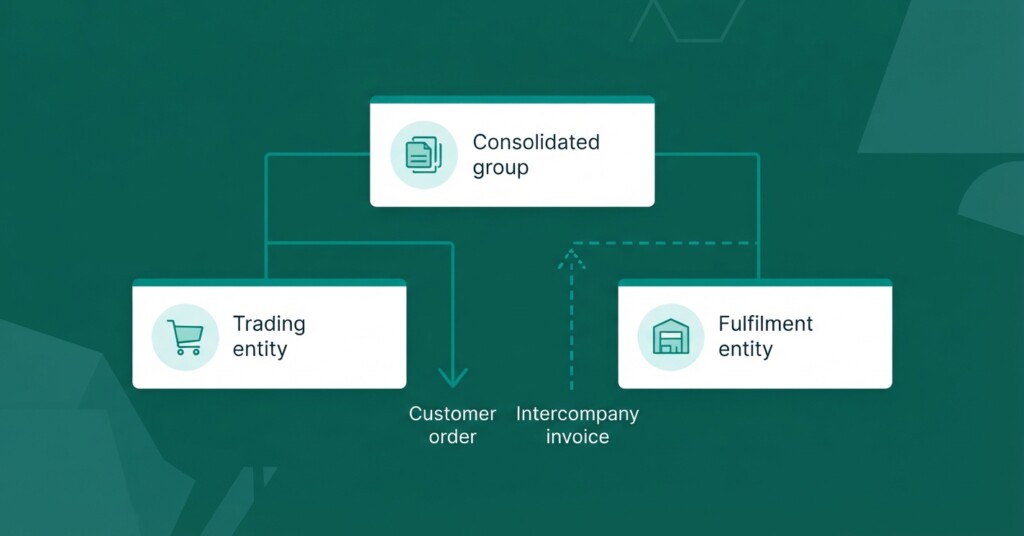
If your e-commerce group has separated its trading and fulfilment operations into distinct legal entities, you already know that month-end consolidation comes with a specific headache: intercompany dropshipping transactions. The selling entity takes the customer order and recognises the revenue. The fulfilment entity ships the goods and charges the seller for the service or the cost of goods. By the time your consolidation spreadsheet is open, you have intercompany sales, intercompany purchases, intercompany receivables, intercompany payables, and sometimes an intercompany margin sitting in closing inventory — all of which must be eliminated before your group financial statements mean anything.
This article walks through exactly how those eliminations work, with journal entries, a numeric example, and practical guidance on where the process typically breaks down for SME finance teams.
Why E-commerce Groups Commonly Split Trading and Fulfilment
The structure is more common than it might appear. A parent company might own a consumer-facing trading entity — the one that owns the website, processes payments, and recognises retail revenue — alongside a separate warehouse and logistics entity that physically picks, packs, and dispatches goods directly to end customers. The fulfilment entity never has a relationship with the end customer; it only ever invoices the trading entity. From the customer’s perspective, it is a seamless experience. From an accounting perspective, every shipment generates an intercompany transaction.
Intercompany eliminations without the manual work.
BrizoConsol identifies and eliminates intercompany balances automatically at consolidation.
Groups adopt this structure for legitimate commercial reasons: operational efficiency, separate VAT or tax registrations, third-party logistics partnerships, or simply because the business grew by acquiring a warehouse operation. Whatever the origin, the consolidation implication is the same — intercompany revenue and costs must be fully eliminated, and any unrealised margin in inventory must be adjusted.
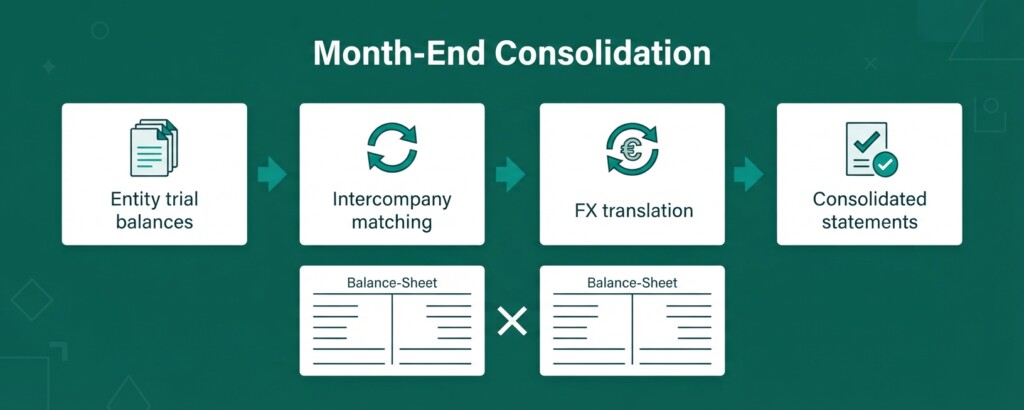
The Four Eliminations You Need to Make
Before you open a journal, it helps to be clear about what actually needs eliminating. In a dropshipping model with a separate fulfilment entity, there are typically four distinct adjustments required at consolidation.
- Eliminate the intercompany revenue recognised by the fulfilment entity and the corresponding intercompany cost recognised by the trading entity (the intercompany sale of fulfilment services or goods).
- Eliminate the intercompany receivable on the fulfilment entity’s balance sheet and the intercompany payable on the trading entity’s balance sheet.
- Remove any unrealised intercompany profit embedded in inventory still held by the trading entity at period end (where goods are sold to the trader at a marked-up transfer price before being dropshipped).
- Reverse the eliminations from the prior period that have now been realised through external sales.
A Worked Example: TradeCo and FulfilCo
Consider a simplified group with two entities. TradeCo is the trading entity that sells products to end customers via an online store. FulfilCo is the 100%-owned fulfilment subsidiary that holds inventory, ships goods, and charges TradeCo at a transfer price that includes a margin above FulfilCo’s cost. During the month, FulfilCo ships 500 units at a transfer price of £40 per unit, giving an intercompany invoice of £20,000. FulfilCo’s cost to produce or procure those units was £30 per unit, so £15,000 in total, meaning FulfilCo earns a £5,000 intercompany gross margin. TradeCo sells 400 of those units externally at £70 each, generating £28,000 in external revenue, with TradeCo’s standalone COGS at £16,000 (400 units × £40). At month end, 100 units remain in TradeCo’s inventory, carried at the £40 transfer price — £4,000 on TradeCo’s balance sheet, of which £1,000 represents FulfilCo’s intercompany margin.
| Item | TradeCo (Seller) | FulfilCo (Fulfilment) | Group (Pre-Elimination) |
|---|---|---|---|
| External revenue | £28,000 | £0 | £28,000 |
| Intercompany revenue | £0 | £20,000 | £20,000 |
| Cost of goods sold (TradeCo COGS) | £16,000 | £0 | £16,000 |
| Cost of goods sold (FulfilCo COGS) | £0 | £15,000 | £15,000 |
| Closing inventory | £4,000 | £0 | £4,000 |
| Intercompany receivable | £0 | £20,000 | £20,000 |
| Intercompany payable | £20,000 | £0 | £20,000 |
Before eliminations, combined figures show £20,000 of intercompany revenue and £20,000 of intercompany purchases that do not represent external transactions, inflating combined COGS to £31,000 (£16,000 at TradeCo plus £15,000 at FulfilCo). The balance sheet shows a £20,000 receivable and payable that net to zero at group level but inflate both sides until eliminated. And the closing inventory includes £1,000 of profit that FulfilCo has recognised but the group has not yet earned from an external customer.
Step-by-Step Consolidation Journals
| Account | Dr | Cr |
|---|---|---|
| Intercompany Revenue (FulfilCo) | 20000 | |
| Cost of Goods Sold (Intercompany Purchases) | 20000 |
Elimination 1 — Remove the intercompany sale of goods between FulfilCo and TradeCo. FulfilCo’s £20,000 revenue is debited to zero, and group COGS is credited by £20,000 to eliminate the intercompany purchase. This reduces combined COGS (£31,000) to £11,000 before the inventory margin adjustment.
| Account | Dr | Cr |
|---|---|---|
| Intercompany Payable (TradeCo) | 20000 | |
| Intercompany Receivable (FulfilCo) | 20000 |
Elimination 2 — Remove the intercompany balance sheet positions. TradeCo’s £20,000 payable to FulfilCo and FulfilCo’s £20,000 receivable from TradeCo cancel each other out at group level. Neither balance represents an obligation or asset with an external party.
| Account | Dr | Cr |
|---|---|---|
| Cost of Goods Sold — Unrealised Profit Adjustment | 1000 | |
| Inventory (TradeCo) | 1000 |
Elimination 3 — Remove the unrealised intercompany margin in closing inventory. Of the 100 units remaining in TradeCo’s stock, each carries £10 of FulfilCo margin (£40 transfer price minus £30 cost). The group cannot recognise this £1,000 profit until TradeCo sells those units to an external customer. Inventory is reduced to its group cost of £3,000; COGS is increased by £1,000 (bringing consolidated COGS to £12,000 for the 400 units sold externally).
The unrealised profit elimination is the one most frequently missed in manual consolidations. If your team relies on entity-level trial balances and Excel, it is easy to eliminate the intercompany revenue and payable/receivable but overlook the margin still sitting in inventory. The result is overstated group profit and overstated group inventory — two errors that compound over time if the stock levels remain elevated.
What Happens in the Following Month
Intercompany eliminations are not fire-and-forget. The £1,000 unrealised profit elimination posted in month one must be reversed in month two — but only to the extent those units have now been sold externally. If TradeCo sells all 100 remaining units in month two, the reversal is straightforward: the £1,000 adjustment unwinds and the group correctly picks up the margin as realised profit in month two. If only 50 units sell, half the elimination reverses and you carry forward a revised adjustment for the remaining 50 units. Tracking this correctly across months requires a clear audit trail of which eliminations relate to which inventory positions.
FX Complications in Cross-Border Dropshipping Groups
Many e-commerce groups have international structures — perhaps TradeCo operates in GBP and FulfilCo invoices in EUR. When currency differences exist between entities, the intercompany elimination becomes more complex. The invoice raised by FulfilCo in EUR will be translated into GBP at the rate applicable to the transaction date. By the time month-end closes, TradeCo must retranslate its EUR payable at the closing exchange rate, recognising an FX gain or loss. While the matching intercompany receivable and payable eliminate against each other on the balance sheet, under IAS 21 and FRS 102 the resulting exchange difference is not eliminated — it remains recognised in the consolidated statement of profit or loss because it reflects an ongoing currency exposure for the group.
Never simply force the intercompany payable and receivable to agree by adjusting one side without understanding how FX retranslation was applied. Both entities should translate at the proper transaction date rate for the original invoice. Subsequent period-end retranslation of foreign currency monetary balances at closing rates generates an FX gain or loss in the individual entity’s P&L. Crucially, under accounting standards like IAS 21 and FRS 102, exchange differences on intercompany trading balances (trade payables and receivables) must remain in consolidated profit or loss — they cannot be transferred to OCI or the foreign currency translation reserve, as trade balances do not qualify as part of a net investment in a foreign operation.
Building an Intercompany Reconciliation Before You Eliminate
A fundamental prerequisite for clean eliminations is that the intercompany balances agree before you try to eliminate them. In practice, they rarely agree perfectly on day one of close. FulfilCo may have issued invoices that TradeCo has not yet received and posted. TradeCo may have processed a credit note that FulfilCo has not yet recognised. Payment timing differences create further mismatches. The standard approach is to establish an intercompany reconciliation process as a gate before consolidation journals are posted — any difference above a materiality threshold must be resolved at the entity level, not patched at consolidation.
| FulfilCo intercompany receivable per FulfilCo trial balance | £20,000 |
| TradeCo intercompany payable per TradeCo trial balance | £20,000 |
| Difference (reconciling items to investigate) | £0 |
| Intercompany revenue to eliminate (FulfilCo P&L) | £20,000 |
| Intercompany purchases to eliminate from COGS | £20,000 |
| Unrealised profit in closing inventory (100 units × £10 margin) | £1,000 |
| Net group inventory after elimination | £3,000 |
Why This Process Is Difficult to Manage in Excel
For a two-entity group with a single currency and a clean intercompany reconciliation, the manual elimination process above is manageable — time-consuming, but manageable. The difficulty scales quickly. Add a third entity, introduce monthly foreign currency invoicing, maintain rolling inventory positions with intercompany margin across multiple product lines, and the manual spreadsheet becomes a significant risk. Finance teams spend disproportionate time chasing intercompany differences, re-checking prior-period elimination reversals, and reconciling translated balances rather than reviewing the actual financial performance of the business.
Automated consolidation tools address this by maintaining a persistent record of each intercompany relationship, applying elimination rules consistently every period, tracking unrealised profit in inventory across months, and generating a clear audit trail of every adjustment. The business rationale is not complexity for its own sake — it is that a group with multiple entities and recurring intercompany flows should not be dependent on one person’s spreadsheet to produce accurate consolidated accounts.
Practical Checklist for Month-End Intercompany Elimination
- Confirm intercompany invoice volumes and values between TradeCo and FulfilCo agree before close.
- Reconcile intercompany receivables and payables — resolve differences at entity level, not at consolidation.
- Identify closing inventory at TradeCo that was purchased from FulfilCo at a transfer price above group cost.
- Calculate the unrealised margin in closing inventory by reference to the intercompany margin percentage or unit margin.
- Post elimination journals: revenue/cost, receivable/payable, unrealised profit in inventory.
- Reverse prior-period unrealised profit eliminations for inventory sold externally in the current period.
- Identify and account for FX retranslation differences on intercompany trade balances in profit or loss.
- Document the elimination schedule with cross-references to entity trial balances for audit purposes.
Getting the Group Accounts Right the First Time
Dropshipping through a separate fulfilment entity is a practical and often commercially sensible structure for e-commerce groups. The intercompany accounting is not especially exotic — but it does require discipline, consistency, and a clear understanding of where revenue has genuinely been earned at group level versus where it has simply moved between related parties. The eliminations described here are required under both IFRS and UK GAAP and are not optional even for smaller groups producing consolidated accounts.
The finance teams and controllers who manage this best are typically those who have documented the intercompany relationships clearly, established a reconciliation gate before close, and built elimination schedules that persist from one period to the next rather than being rebuilt from scratch each month. Whether you manage this in a dedicated consolidation tool or a well-controlled spreadsheet, the logic is the same — and getting it right protects both the accuracy of your group reporting and the credibility of your financial close process.
See Multi-Entity Consolidation Without the Spreadsheet Risk
BrizoConsol is built for SME finance teams managing intercompany eliminations, FX translation, and group reporting across multiple entities. See how it handles the workflows described in this article.