How to Eliminate Intercompany Rental Charges When Your Retail Group Uses a Central PropCo to Hold All Store Leases and Charge OpCos a Monthly Occupancy Fee
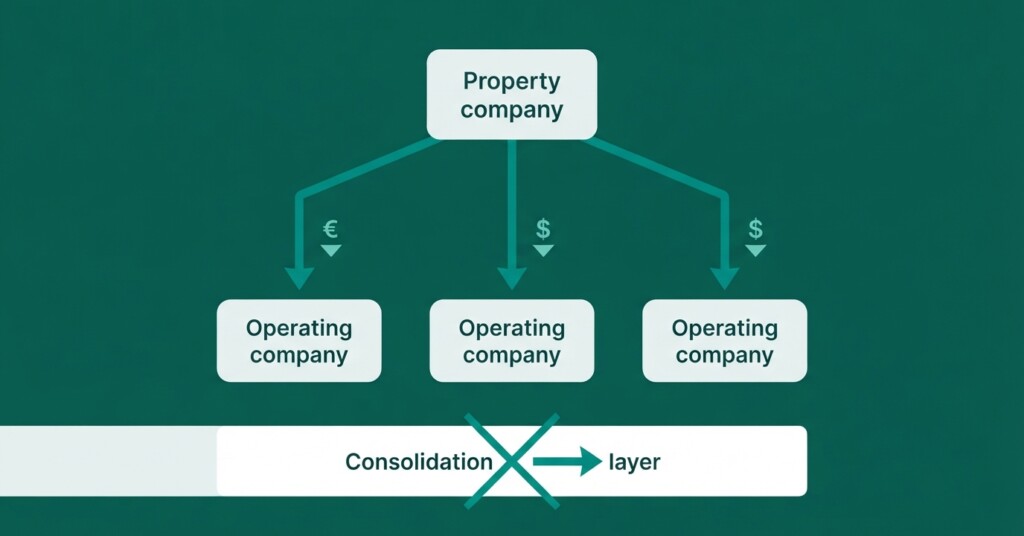
For retail groups that have separated their property-holding function into a dedicated PropCo entity, the monthly occupancy fee charged down to each operating company (OpCo) is one of the most common — and most mishandled — intercompany transactions at consolidation time. If your group consists of a central property company that holds all store leases and recharges a monthly fee to your retail OpCos, you need a clear, consistent process to eliminate those charges before you publish group financials. Get it wrong and you will overstate both group revenue and group expenses, grossing up numbers across the consolidated income statement.
This article walks through the mechanics of how the PropCo/OpCo rental structure works, what needs to be eliminated and why, and how finance teams can build a reliable process that does not rely on a fragile spreadsheet patched together each month-end.
Why Retail Groups Use a PropCo Structure
Separating property from trading operations is a well-established structure in retail. The PropCo signs the head leases with landlords, recognises the right-of-use (ROU) assets and lease liabilities under IFRS 16 or equivalent local GAAP, and then charges each OpCo a monthly occupancy fee — often called an internal rent or recharge — to recover its costs and, in some cases, earn a margin.
Intercompany eliminations without the manual work.
BrizoConsol identifies and eliminates intercompany balances automatically at consolidation.
From a standalone entity perspective, this makes sense. The PropCo has rental income; each OpCo has a rental expense. Each set of statutory accounts is clean. The problem emerges at group level: both sides of the same transaction sit inside the consolidated group, and they must be removed in full before the group income statement and balance sheet can be presented.
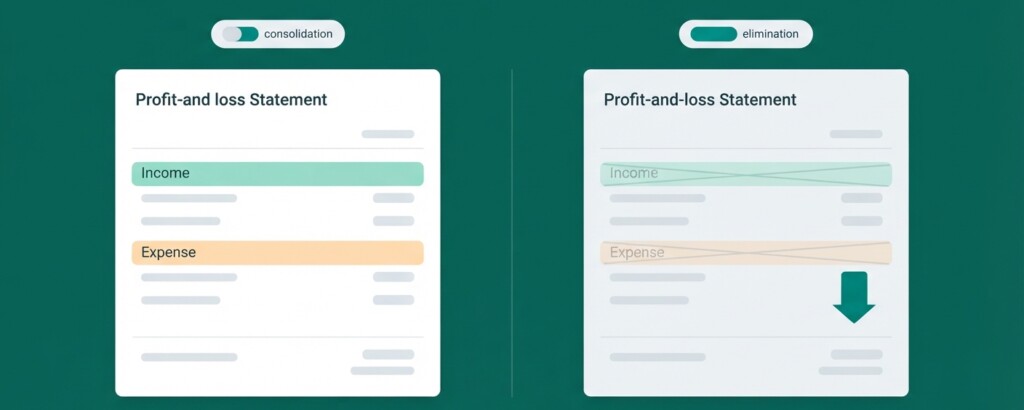
The core rule is straightforward: any transaction between two entities that are both inside the consolidation boundary must be eliminated in full at group level. The group cannot report income and expense for a payment that merely moves money between its own subsidiaries.
Understanding What Each Entity Records
Before you can eliminate correctly, you need to understand exactly what each entity books each month. Consider a simplified retail group with one PropCo and three OpCos.
The PropCo records the following in its own books each month: the lease liability and ROU asset movements under IFRS 16 (depreciation and finance charges), the cash payment to the landlord, and the intercompany rental income it charges to each OpCo. Each OpCo records the intercompany rental charge as an occupancy or property expense in its own profit and loss account. The cash settlement — whether actual or via an intercompany loan account — creates a matching balance in the intercompany receivable on the PropCo side and an intercompany payable on each OpCo side.
| Entity | P&L Line | Amount (monthly) | Balance Sheet Line |
|---|---|---|---|
| PropCo | Intercompany rental income | £120,000 | Intercompany receivable |
| OpCo 1 | Occupancy expense (interco) | £50,000 | Intercompany payable |
| OpCo 2 | Occupancy expense (interco) | £40,000 | Intercompany payable |
| OpCo 3 | Occupancy expense (interco) | £30,000 | Intercompany payable |
| Group consolidated (before elim) | Revenue: £120,000 / Expense: £120,000 | Net £nil | Gross balances on both sides |
Before elimination, the consolidated trial balance contains £120,000 of intercompany income and £120,000 of intercompany expense. These gross figures cancel out mathematically, but they must be formally eliminated — they cannot simply be left in place and assumed to net out, because doing so inflates both revenue and costs, distorts gross margin ratios, and may mislead readers of the group accounts.
The Elimination Journal Entries
The elimination is performed at consolidation level, not in any individual entity’s books. This is an important distinction: you do not adjust the OpCo or PropCo ledgers. You post consolidation-only adjustments that exist solely in the consolidated working papers or consolidation tool.
There are two types of elimination to perform each month: the P&L elimination (removing the income and expense) and the balance sheet elimination (removing the intercompany receivable and payable).
| Account | Dr | Cr |
|---|---|---|
| Intercompany rental income (PropCo) | 120,000 | |
| Occupancy expense — intercompany (OpCo 1) | 50,000 | |
| Occupancy expense — intercompany (OpCo 2) | 40,000 | |
| Occupancy expense — intercompany (OpCo 3) | 30,000 |
Elimination of intercompany occupancy fee charges in the consolidated income statement. Debit removes PropCo rental income; credits remove each OpCo occupancy expense. Entry is consolidation-only and does not appear in any entity’s statutory ledger.
| Account | Dr | Cr |
|---|---|---|
| Intercompany payable — OpCo 1 | 50,000 | |
| Intercompany payable — OpCo 2 | 40,000 | |
| Intercompany payable — OpCo 3 | 30,000 | |
| Intercompany receivable — PropCo | 120,000 |
Elimination of intercompany balance sheet positions arising from the occupancy fee. The gross receivable and payable balances are removed in full so that the consolidated balance sheet does not carry internal group positions.
Where PropCo Charges a Margin — an Extra Complication
Many PropCo structures are designed to be cost-neutral, where the total of the OpCo charges simply equals the PropCo’s own lease costs. But some groups add a margin — the PropCo charges OpCos slightly more than the external lease cost, either to cover central property management costs or as a deliberate internal transfer pricing mechanism.
When a margin is included, the elimination is mechanically identical: you still eliminate 100% of the intercompany income and 100% of the intercompany expense. The margin does not change the elimination approach because both sides of the transaction — income and expense — are entirely internal to the group. The group’s consolidated P&L reflects only external landlord costs (or underlying IFRS 16 depreciation and finance expenses).
| External underlying lease cost incurred by PropCo | £100,000 |
| PropCo internal margin charged to OpCos | £20,000 |
| Total intercompany occupancy fee billed to OpCos | £120,000 |
| Less: Intercompany occupancy fee eliminated | (£120,000) |
| Net external property cost recognised in group accounts | £100,000 |
After elimination, the group accounts correctly reflect only the underlying third-party lease costs. The internal margin of £20,000 is eliminated entirely and generates no group profit — as it should not, because no value has been created merely by moving money between subsidiaries.
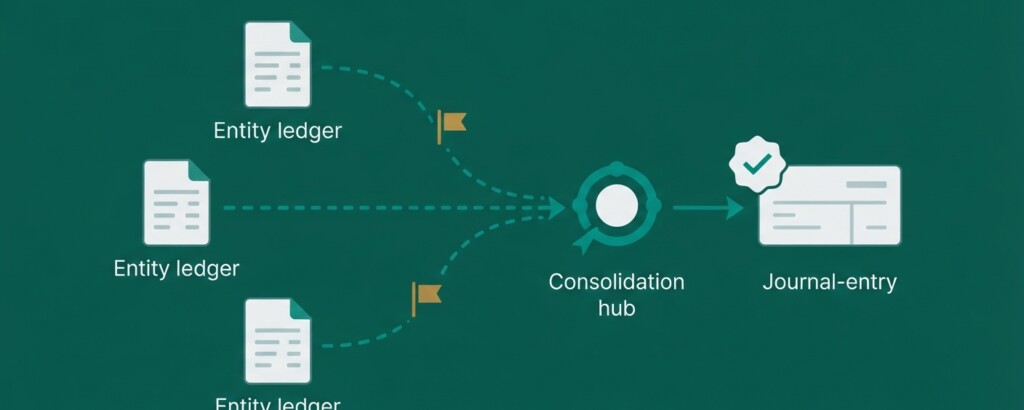
If your PropCo operates in a different functional currency from one or more OpCos — for example, a UK-based PropCo charging a Euro-denominated OpCo in an overseas market — the elimination requires careful foreign exchange treatment. Under IAS 21, foreign exchange differences arising on the settlement or retranslation of monetary balances (such as intercompany trade receivables and payables) cannot be eliminated against equity. Because they represent an exposure to currency fluctuations, these exchange differences must remain in the consolidated profit and loss statement, rather than being transferred to the currency translation reserve.
Reconciling Intercompany Balances Before You Eliminate
Elimination journals only work cleanly when both sides of the intercompany match. In practice, a common month-end problem is that the PropCo has raised its invoice and booked income, but one or more OpCos has not yet processed the charge — or vice versa. Any mismatch means the elimination will leave a residual balance that is unexplained and will cause the consolidation to fail to balance.
Before running your eliminations, every entity should confirm its intercompany balances match the counterparty’s records. This is an intercompany reconciliation, and it should happen before the consolidation elimination step, not after.
- Each entity extracts its intercompany receivable and payable balances relating to the PropCo occupancy fee.
- The PropCo confirms the total receivable matches the sum of all OpCo payables.
- Any timing differences — where one entity has accrued and the other has not — are resolved by posting matching accruals in the relevant entity before the consolidation cut-off.
- Once balances agree on both sides, the elimination journals can be posted with confidence.
- A signed-off intercompany confirmation document or system-generated match report is retained as audit evidence.
IFRS 16 and the PropCo’s Own Lease Accounting
Under IFRS 16, the PropCo will recognise a right-of-use asset and a lease liability on its own balance sheet for each head lease it holds. These are real assets and liabilities of the PropCo entity — and they carry through into the consolidated balance sheet, because they represent the group’s obligation to its external landlords. They are not eliminated.
What is eliminated is only the intercompany income and expense created by the recharge from PropCo to OpCo. The underlying lease asset and liability sit correctly in the group accounts, reflecting the group’s genuine external exposure, with depreciation and interest flowing through the consolidated income statement. This distinction is important: teams sometimes incorrectly attempt to eliminate the ROU asset or lease liability, which is wrong — those balances represent real obligations to third-party landlords.
Think of it this way: the group owes the landlord regardless of which internal entity holds the lease. The lease asset and liability belong in the consolidated balance sheet. What does not belong there is the internal fee that simply moves the cost between group members.
Non-Controlling Interests and Partial Ownership
If one or more of your OpCos is not wholly owned — for example, an outside shareholder holds a 30% non-controlling interest (NCI) in OpCo 2 — the elimination requires careful attention to profit allocation. You still eliminate 100% of the intercompany income and expense, because the full transaction is intercompany regardless of ownership split. However, because this is a downstream or lateral recharge for occupancy services consumed during the period, the elimination of any internal margin earned by PropCo is attributed to the controlling shareholders rather than NCI.
In practice, this means the NCI share of OpCo 2’s profit is based on OpCo 2’s standalone operating performance, where the occupancy fee represents a genuine entity-level operating cost. Minority shareholders do not receive an unearned share of group lease eliminations. Managing these calculations across partly owned entities is one of the more technically demanding parts of consolidation, and manual spreadsheet models frequently produce errors — particularly when ownership percentages change during the year.
Building a Repeatable Month-End Process
The intercompany elimination for a PropCo/OpCo rental structure should be one of the most predictable parts of your consolidation, because the structure is consistent from month to month. The amounts may change slightly as leases expire or new stores open, but the mechanism is always the same. This predictability makes it a good candidate for automation.
Finance teams still managing this process in Excel typically maintain a consolidation workbook that pulls in trial balances from each entity, applies elimination adjustments on a separate tab, and aggregates the result. The problem is that the intercompany reconciliation step — confirming both sides agree before eliminating — is usually done manually by email, which introduces delay and the risk of eliminating mismatched figures.
Consolidation platforms that are connected to entity-level accounting data can automate the matching step, flag discrepancies before the elimination runs, and apply the elimination journal automatically once balances are confirmed. This removes a significant portion of the manual effort at month-end and provides a clear audit trail showing that eliminations were supported by confirmed intercompany matches.
Common Errors to Avoid
- Eliminating only the net difference between PropCo income and OpCo expense when a margin is included, rather than eliminating both sides in full.
- Forgetting to eliminate the balance sheet positions (intercompany receivable and payable) and only addressing the P&L lines.
- Running the elimination before the intercompany reconciliation is confirmed, leaving unexplained variances in the consolidated trial balance.
- Treating the PropCo ROU asset and lease liability as intercompany items to be eliminated — these are external obligations and must remain in the consolidated balance sheet.
- Failing to account for FX differences in profit or loss when PropCo and OpCo entities operate in different functional currencies.
- Misallocating elimination adjustments between controlling and non-controlling interests when subsidiaries are partially owned.
The Broader Case for Connected Consolidation Data
The PropCo/OpCo elimination is a good illustration of a wider truth about group reporting: the quality of your consolidated accounts depends almost entirely on the quality of the data flowing in from each entity and the reliability of the process used to reconcile and eliminate intercompany items. A single mismatched intercompany balance can delay financial close for days while teams hunt down the discrepancy across multiple ledgers.
When your consolidation process is connected to live accounting data from each entity — rather than relying on manually exported trial balances emailed at month-end — the intercompany matching step becomes continuous rather than a stressful last-minute exercise. Finance teams can see in real time whether PropCo and each OpCo have booked matching figures, resolve discrepancies before the close period, and run their eliminations with confidence.
For CFOs and controllers managing a retail group with multiple store-operating entities and a central PropCo, this kind of connected approach is not a luxury — it is the difference between a three-day close and a two-week one.
See How Automated Consolidation Handles Intercompany Eliminations
BrizoConsol connects to your entity-level accounting data, automates intercompany matching, and runs your consolidation eliminations — including PropCo occupancy fee charges — without the manual Excel effort. See how it works for retail groups managing multiple OpCos.