How to Record the Deferred Tax Liability That Arises When a Fair Value Uplift on Acquisition Creates a Temporary Difference at Consolidation
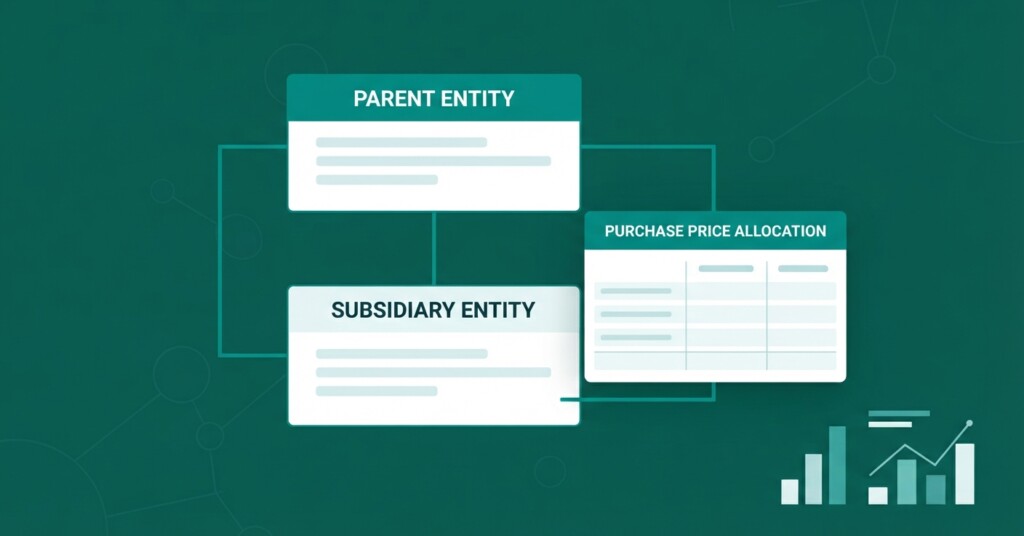
When a group acquires a subsidiary, the purchase price allocation process often results in the fair value of identifiable assets being recognised at amounts higher than their tax base. This gap — a taxable temporary difference — triggers a deferred tax liability (DTL) at the consolidation level. For many SME finance teams, this is one of the more counterintuitive adjustments in group reporting: the subsidiary’s own books show no such liability, yet the consolidated statements must carry one. Getting it right matters for accurate net assets, goodwill calculation, and ongoing group tax disclosures.
This article walks through exactly how this DTL arises, how to calculate it, where it sits in the consolidation journal, and how it interacts with goodwill and non-controlling interests (NCI). We use a worked example throughout so you can trace every number.
Why a Fair Value Uplift Creates a Temporary Difference
Under IFRS 3 (and its equivalents), when you acquire a business you must recognise the acquired assets and liabilities at fair value on the acquisition date, not at the carrying amounts held in the subsidiary’s own books. Common examples include property whose market value has risen above its depreciated cost, customer lists or brand names with no book value in the subsidiary, and inventory revalued to net realisable value.
Bring a new subsidiary in from its acquisition date.
Enter the consideration and fair value of net assets — BrizoConsol calculates goodwill and NCI at acquisition.
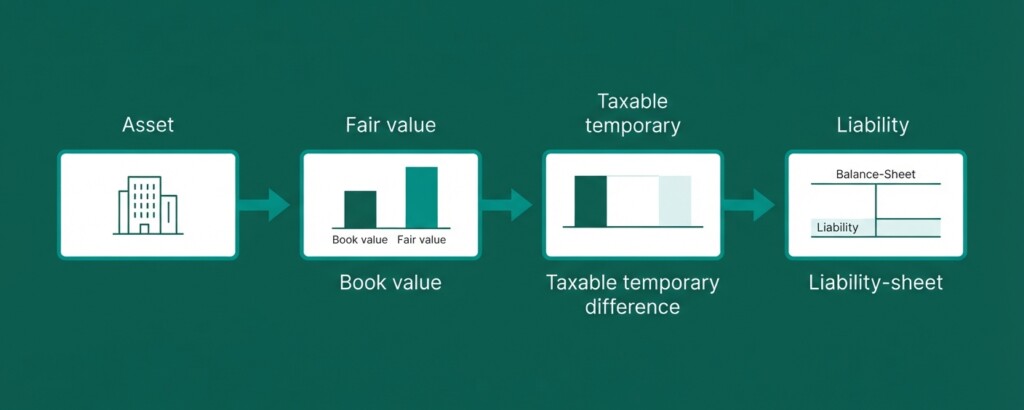
Tax authorities, however, do not follow acquisition accounting. The tax base of those same assets remains exactly what it was before the deal — the original cost (or whatever tax-written-down value applies). The tax authority will only allow deductions based on the original cost, not the uplifted fair value. So immediately after acquisition you have an asset worth more in the accounts than the tax base allows. That difference is a taxable temporary difference, and IAS 12 requires you to recognise a DTL on it.
A deferred tax liability on a fair value uplift is a consolidation-only entry. It does not appear in the subsidiary’s standalone financial statements. It lives exclusively in the consolidated working papers and must be re-measured each reporting period as the underlying asset is depreciated or amortised.
The Worked Example: Acquiring Redstone Manufacturing Ltd
Suppose the group (Northgate Holdings) acquires 80% of Redstone Manufacturing Ltd for £3,200,000. At acquisition, the fair value exercise identifies the following uplifts over book value:
| Asset | Book Value (£) | Fair Value (£) | Uplift (£) | Remaining Useful Life |
|---|---|---|---|---|
| Freehold property | 800,000 | 1,200,000 | 400,000 | 40 years |
| Customer relationships | 0 | 300,000 | 300,000 | 5 years |
| Inventory | 150,000 | 175,000 | 25,000 | Sold within 1 year |
| Total | 950,000 | 1,675,000 | 725,000 | — |
The applicable tax rate is 25%. None of these uplifts are deductible for tax purposes — the tax base of each asset remains at its pre-acquisition book value.
Calculating the Deferred Tax Liability
The DTL is simply the total taxable temporary difference multiplied by the tax rate applicable to the entity. Because this is a consolidation adjustment, you should use the tax rate of the entity that owns the assets, not the parent’s rate if they differ.
| Fair value uplift — freehold property | £400,000 |
| Fair value uplift — customer relationships | £300,000 |
| Fair value uplift — inventory | £25,000 |
| Total taxable temporary difference | £725,000 |
| Applicable tax rate | 25% |
| Deferred tax liability at acquisition | £181,250 |
This £181,250 is recognised on the acquisition date as part of the purchase price allocation. Critically, it feeds back into the goodwill calculation — the gross-up of assets at fair value increases net assets, but the DTL partially offsets that increase, so goodwill is calculated after recognising the DTL.
Recording the Acquisition-Date Consolidation Journal
The acquisition-date consolidation journal eliminates the investment in the subsidiary, recognises the fair value uplifts, establishes the NCI, and records the DTL. Below is the full journal entry for Northgate Holdings acquiring 80% of Redstone Manufacturing Ltd.
Net identifiable assets at book value are £950,000. After uplifts of £725,000 and the DTL of £181,250, net identifiable assets at fair value are £1,493,750. NCI at 20% = £298,750. Goodwill = £3,200,000 – (£1,493,750 × 80%) = £3,200,000 – £1,195,000 = £2,005,000.
| Account | Dr | Cr |
|---|---|---|
| Net assets of Redstone (book value — share capital, retained earnings, reserves) | 950,000 | |
| Freehold property — fair value uplift | 400,000 | |
| Customer relationships — fair value uplift | 300,000 | |
| Inventory — fair value uplift | 25,000 | |
| Goodwill | 2,005,000 | |
| Investment in Redstone Manufacturing Ltd | 3,200,000 | |
| Non-controlling interest | 298,750 | |
| Deferred tax liability — fair value uplift | 181,250 |
Acquisition-date consolidation journal. Eliminates the investment, recognises fair value uplifts on identifiable assets, records DTL at 25% on total uplift of £725,000, establishes NCI at 20% of net identifiable assets at fair value, and derives goodwill as the residual. Journal balances: total debits £3,680,000, total credits £3,680,000.
How the DTL Unwinds Over Time
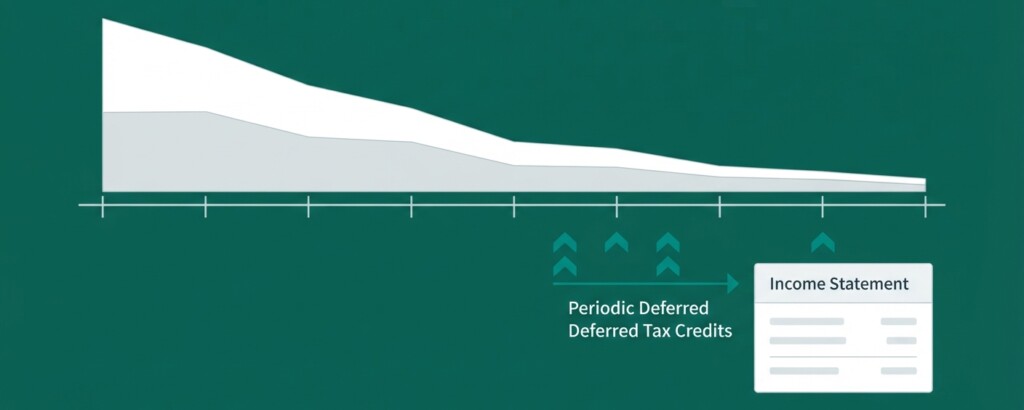
The DTL is not a permanent fixture. As the uplifted assets are depreciated, amortised, or consumed, the temporary difference reduces and the DTL unwinds. This unwinding creates a deferred tax credit in the consolidated income statement each period. Finance teams often miss this step, leaving an overstated DTL on the balance sheet and understating consolidated profit after tax.
Using the Redstone example, here is how the unwinding works in Year 1 of post-acquisition consolidation:
| Asset | Uplift Amortised / Consumed in Year 1 (£) | DTL Released (£) |
|---|---|---|
| Freehold property (£400,000 ÷ 40 years) | 10,000 | 2,500 |
| Customer relationships (£300,000 ÷ 5 years) | 60,000 | 15,000 |
| Inventory (fully consumed in year) | 25,000 | 6,250 |
| Total | 95,000 | 23,750 |
| Account | Dr | Cr |
|---|---|---|
| Deferred tax liability — fair value uplift | 23,750 | |
| Income tax expense (deferred tax credit) | 23,750 |
Year 1 consolidation journal to unwind the DTL as uplifted assets are depreciated, amortised, or sold. Reduces income tax expense in the consolidated income statement by £23,750 and reduces the DTL on the consolidated balance sheet by the same amount. Must be prepared each period as a standalone consolidation adjustment.
Do not allow the DTL unwinding journal to be omitted in subsequent periods simply because the acquisition journal was posted in a prior year. Each consolidation cycle must independently recalculate how much of the uplift has been consumed and release the corresponding DTL. Failing to do so overstates tax liabilities and understates consolidated profit — a material misstatement risk in group audits.
NCI Complications: Gross-Up or Proportionate?
The treatment of NCI affects whether goodwill is recognised in full or only to the extent of the parent’s share. Under IFRS 3, groups may choose either the full goodwill method (NCI at fair value) or the proportionate method (NCI at share of net identifiable assets). Under both methods, the DTL on fair value uplifts is recognised in full because the uplifts themselves are recognised in full — the NCI share of those assets sits on the balance sheet regardless of the method chosen for goodwill.
This means the DTL always offsets the full uplift when calculating net identifiable assets. The NCI calculation then takes its percentage of the post-DTL net identifiable assets, as shown in the worked example above (£1,493,750 × 20% = £298,750).
Ongoing Disclosure and Group Reporting Considerations
IAS 12 requires disclosure of the deferred tax assets and liabilities recognised for each type of temporary difference, as well as the movement in deferred tax balances during the period, distinguishing amounts recognised from business combinations from subsequent unwinding recognised in profit or loss.
In management reporting, the DTL unwinding credit improves reported profit after tax in the consolidated P&L each period. Finance managers preparing monthly consolidated management accounts should ensure the deferred tax release is captured in their consolidation model, otherwise monthly profit will be understated relative to the statutory position.
If the subsidiary is a foreign operation with a different functional currency from the parent, under IAS 21.47 the fair value adjustments and the related DTL are treated as assets and liabilities of the foreign operation. They are expressed in the subsidiary’s functional currency and translated at the closing exchange rate each period, with the retranslation difference recognised in other comprehensive income (flowing through the foreign currency translation reserve rather than profit or loss). This interaction between FX translation and deferred tax on fair value uplifts is a common source of complexity in cross-border groups.
Common Mistakes SME Finance Teams Make
- Omitting the DTL entirely when the uplift appears small — even modest uplifts create material DTL balances that auditors will seek.
- Failing to recalculate and unwind the DTL in each subsequent consolidation period, leaving the liability permanently overstated.
- Applying the parent entity’s tax rate rather than the subsidiary’s local tax rate to the temporary difference.
- Incorrectly treating the DTL unwind as an operating item rather than as a movement within income tax expense.
- Losing track of the DTL in Excel-based consolidations when there is no formal purchase price allocation schedule maintained and updated period by period.
- Forgetting to retranslate the DTL at the closing rate when the subsidiary reports in a foreign currency, and misrouting the difference to P&L instead of OCI.
Where Manual Consolidations Break Down
Most SME group finance teams manage consolidation in Excel. For a single acquisition with two or three uplifted assets, the purchase price allocation workbook is manageable in the early periods. The problems compound over time: as the group acquires more entities, as useful lives vary across asset classes, and as foreign exchange rates move, maintaining an accurate DTL schedule across multiple tabs and workbooks becomes error-prone.
Consolidation software that holds the acquisition-date purchase price allocation as structured data — with asset class, uplift amount, useful life, and tax rate — can automatically calculate the unwinding journal each period, apply the correct closing rate to the DTL balance where FX is involved, and feed the result directly into the consolidated trial balance. This eliminates the risk of a team member forgetting the unwinding step, recalculating from scratch each quarter, or applying a stale tax rate after a legislative change.
For groups with multiple acquisitions, each with their own PPA schedules and different subsidiary tax rates, the difference between a well-structured automated consolidation process and a manually maintained Excel model is the difference between a two-week month-end close and a three-day one.
A good test of whether your consolidation process handles this correctly: can you produce, at any month end, a schedule showing the original DTL recognised on each acquisition, cumulative unwinding to date, closing DTL balance, and the next 12 months of expected releases? If that takes more than an hour to produce, the process likely needs more structure.
Summary: Key Steps to Get This Right
- Complete a formal purchase price allocation at acquisition, identifying every asset uplifted to fair value and its tax base.
- Calculate the DTL as total taxable temporary difference multiplied by the subsidiary’s applicable local tax rate.
- Record the full DTL in the acquisition-date consolidation journal, ensuring it reduces net identifiable assets and is reflected in the goodwill calculation.
- Establish a period-by-period unwinding schedule for each asset class based on its useful life or expected consumption pattern.
- Post the unwinding journal as a consolidation adjustment each period, crediting income tax expense in the consolidated P&L.
- If the subsidiary is a foreign operation, retranslate the closing DTL balance at the period-end exchange rate and route the difference to the foreign currency translation reserve.
- Maintain the PPA schedule as a living document and update the useful life assumptions if assets are impaired or sold early.
- Disclose the movement in DTL arising from business combinations in the group’s financial statement notes.
How BrizoConsol handles this
BrizoConsol holds the acquisition-date purchase price allocation as structured data against each subsidiary. You enter the uplifted asset classes, the fair value amounts, the remaining useful lives, and the subsidiary’s local tax rate once, at the point of recording the acquisition. From that point, BrizoConsol calculates the opening DTL, generates the unwinding journal automatically for each subsequent reporting period, and posts it as a consolidation-level adjustment without manual recalculation.
Where the subsidiary reports in a foreign currency, BrizoConsol applies the period-end closing rate to the DTL balance and routes the retranslation difference to the foreign currency translation reserve rather than profit or loss, consistent with IAS 21. The NCI calculation picks up net identifiable assets after the DTL, so the goodwill figure is correct from the outset. If your entities connect via Xero or through the Excel import, the consolidation journals sit in a searchable audit trail, and you can produce a full DTL movement schedule — opening balance, current-period unwinding, closing balance, and forward releases — at any month end without rebuilding it from individual workbooks.
Bring a new subsidiary in from its acquisition date.
Enter the consideration and fair value of net assets — BrizoConsol calculates goodwill and NCI at acquisition.