MYOB Advanced for Multi-Entity Groups: Limitations and What Finance Teams Use Instead
Priya had been the group financial controller at a mid-sized Australian services business for three years. The group had grown from two entities to six — a holding company, four operating subsidiaries, and a small New Zealand entity — and each month-end close was getting harder. The intercompany loan recharges were mismatching. The management fee invoices needed reconciling across four entities before anyone could aggregate the numbers. The Excel model her predecessor built was held together with VLOOKUP formulas and goodwill tracked manually on a tab no one fully trusted.
When the board approved a move from MYOB AccountRight to MYOB Advanced (now rebranded as MYOB Acumatica), Priya assumed the group reporting problem would be solved. The MYOB Advanced sales material talked about intercompany accounting, shared charts of accounts, multi-currency support, and consolidated reporting. What she found when the system went live was more nuanced. MYOB Advanced is a capable ERP — it made running each entity cleaner and faster. But the consolidated group accounts she needed to produce every month still required work that the system couldn’t do on its own.
This is not a criticism of MYOB Advanced as a product. It is a well-built cloud ERP that is genuinely suited to multi-entity organisations at a certain level of complexity. The problem is the gap between what “intercompany accounting” means inside an ERP and what “group consolidation” means in accounting standards. These are different tasks, and understanding the difference saves finance teams from the frustration of expecting one system to do both.
Consolidate your MYOB entities in minutes.
BrizoConsol connects to MYOB and automates your group financial statements.
What MYOB Advanced Actually Does for Multi-Entity Groups
MYOB Advanced supports multi-entity organisations through a shared tenant structure. All entities sit within the same system, using the same chart of accounts framework, the same approval workflows, and the same reporting environment. This is a genuine operational advantage over running separate MYOB AccountRight files that have no connection to each other.
Specifically, MYOB Advanced can do the following for multi-entity groups: manage intercompany transactions between entities in the same tenant (creating the payable in one entity and the receivable in the other automatically); apply a shared chart of accounts so that account names and codes are consistent across all entities; support multiple base currencies, translating entity transactions at transaction-date rates; produce consolidated financial reports that aggregate entity figures and optionally filter out intercompany balances flagged within the system; and manage financial periods separately for each entity within the same tenant.
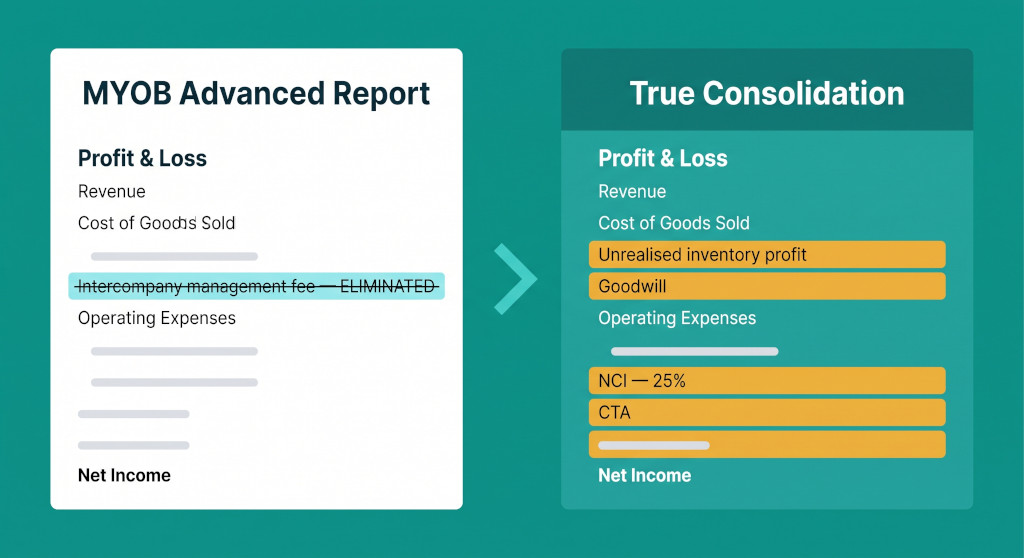
That intercompany elimination feature is where confusion most often arises. When MYOB Advanced “eliminates” an intercompany transaction on a consolidated report, it is removing a flagged transaction from the aggregated view — essentially a reporting filter. This is useful. If Entity A invoices Entity B a $10,000 management fee, and both transactions are tagged as intercompany within MYOB Advanced, the consolidated report can exclude them. The consolidated revenue and expense both reduce by $10,000, and the group result looks correct for that one transaction.
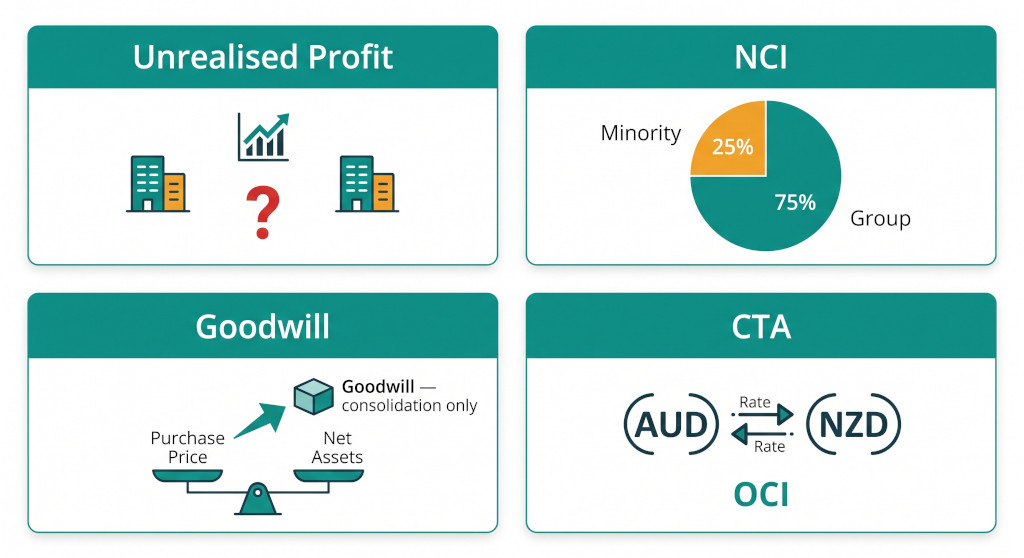
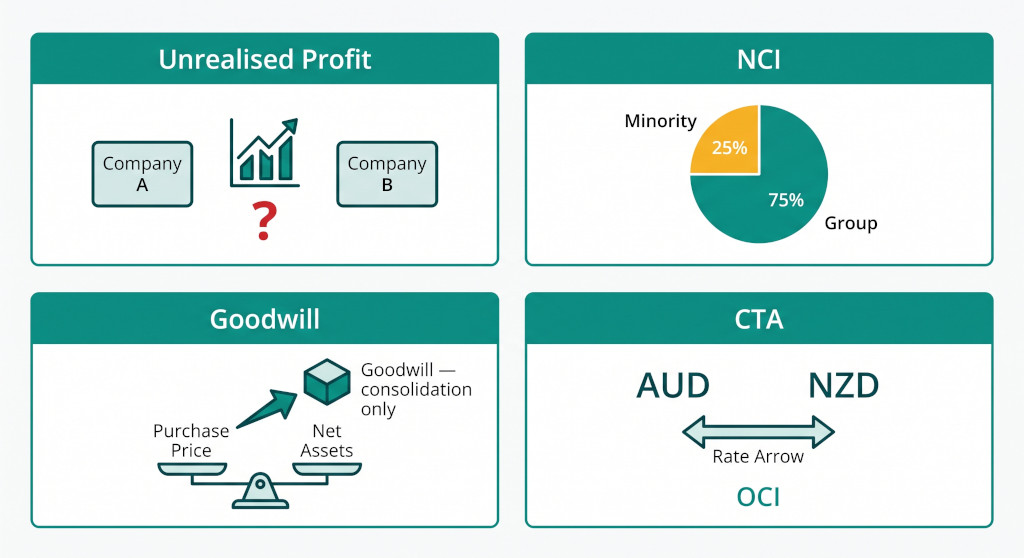
The intercompany elimination in MYOB Advanced is a reporting filter applied to tagged transactions. Full accounting consolidation requires additional adjustments — goodwill, unrealised profit, NCI, and CTA — that operate at a level the ERP was not designed to handle.
The limitation begins when the consolidation requires adjustments that go beyond removing flagged transactions. The four scenarios below are where MYOB Advanced-based groups consistently run into problems — and where a dedicated consolidation layer is needed.
Gap 1: Unrealised Intercompany Profit in Closing Inventory
Consider a manufacturing group with two MYOB Advanced entities: ManufactureCo, which makes the product, and DistributorCo, which sells it to external customers. ManufactureCo sells finished goods to DistributorCo at cost plus a 25% markup. During the reporting period, ManufactureCo sells $400,000 of goods to DistributorCo. By period-end, DistributorCo has sold $300,000 of those goods to external customers but still holds $100,000 worth in closing inventory.
MYOB Advanced eliminates the intercompany sale — the $400,000 revenue in ManufactureCo and the corresponding $400,000 cost in DistributorCo both disappear from the consolidated view. So far, so good. But here is the problem: the $100,000 of inventory still sitting in DistributorCo’s balance sheet is recorded at the intercompany transfer price, which includes ManufactureCo’s 25% markup. That markup — $20,000 — represents profit that has not yet been realised through a sale to an external customer. Under IFRS, US GAAP, and most major group-consolidation frameworks, that unrealised profit must be eliminated from both the closing inventory balance and group profit.
| Goods sold by ManufactureCo to DistributorCo | $400,000 |
| ManufactureCo’s cost of those goods (at cost) | $320,000 |
| Intercompany markup (25%) | $80,000 |
| Goods sold by DistributorCo to external customers | $300,000 |
| Goods remaining in DistributorCo’s inventory (at transfer price) | $100,000 |
| Unrealised profit in closing inventory (25/125 × $100,000) | $20,000 |
MYOB Advanced has eliminated the intercompany sale, but it has no mechanism to calculate or post the $20,000 unrealised profit adjustment. The consolidated inventory balance remains $20,000 too high, and consolidated profit is $20,000 overstated. The required consolidation journal — which needs to be posted outside the ERP and applied at the group reporting layer — looks like this:
| Account | Dr | Cr |
|---|---|---|
| Cost of Sales (Group P&L) | $20,000 | |
| Inventories (Group Balance Sheet) | $20,000 |
Eliminates unrealised intercompany profit in DistributorCo’s closing inventory. Required under IFRS 10, FRS 102 Section 9, and ASC 810. Not generated automatically by MYOB Advanced.
Groups that run intercompany goods transfers will need to calculate and post this adjustment manually at every period-end. For groups with multiple intercompany supply chains and several product categories at different margin rates, this can involve a significant amount of work. See our guide to eliminating unrealised intercompany margins in a manufacturing group for a fuller treatment of how these adjustments cascade through the group P&L.
Gap 2: Non-Controlling Interest Is Not Calculated
MYOB Advanced aggregates 100% of every entity’s figures into the consolidated report. This is correct when HoldCo owns 100% of every subsidiary. But many groups have a minority shareholder in at least one entity — a co-founder who retained a stake, a joint venture partner, a management team with an equity interest. When HoldCo owns less than 100% of a subsidiary, the consolidated accounts must show the minority shareholders’ share of net assets and profit as a separate line: the non-controlling interest, or NCI.
Here is a concrete example. HoldCo owns 75% of Sub A. Sub A has equity of $800,000 at the start of the period and earns $200,000 profit during the year. At period-end, Sub A’s equity is $1,000,000. In the consolidated accounts, the NCI (25%) is $250,000. Consolidated equity attributable to HoldCo shareholders is $750,000 from Sub A’s contribution. The consolidated P&L must show $50,000 (25% of $200,000) as profit attributable to NCI, separately from the $150,000 attributable to the group.
Common mistake: Finance teams using MYOB Advanced’s consolidated report include 100% of Sub A’s profit in the group result. The consolidated P&L overstates the profit attributable to the parent’s shareholders by $50,000, and the balance sheet has no NCI line in equity. This is a material misstatement.
MYOB Advanced has no NCI module. Calculating NCI and posting the required equity split requires an external consolidation layer. The NCI calculation depends on the subsidiary’s opening equity, the share of current-period profit, any dividends paid, and any movements from prior-period adjustments — all of which must be tracked in a consolidation workpaper or a dedicated consolidation tool. For more on how NCI is calculated correctly, see our full guide to NCI in financial consolidation.
Gap 3: Goodwill Exists Only in the Consolidation — Not in Any Entity
When HoldCo acquires a subsidiary, it almost always pays more than the net asset value of the business it buys. The excess of purchase price over fair-valued net assets is goodwill — a consolidation-only asset that appears in the group balance sheet but nowhere in the books of either HoldCo or the subsidiary. HoldCo records the cost of its investment at acquisition price. The subsidiary records its own net assets at their normal values. Goodwill is only visible at the consolidation level.
Suppose HoldCo acquired 100% of TradeOpCo for $900,000 two years ago. At acquisition, TradeOpCo’s fair-valued net assets were $720,000.
| Purchase price paid by HoldCo | $900,000 |
| Fair value of TradeOpCo’s net assets at acquisition | $720,000 |
| Goodwill recognised at acquisition | $180,000 |
In the consolidated balance sheet, goodwill of $180,000 appears as an intangible asset. HoldCo’s investment in TradeOpCo (the $900,000 cost) is eliminated against TradeOpCo’s equity ($720,000), with the $180,000 difference recognised as goodwill. None of this exists in any entity’s own books. MYOB Advanced has no mechanism to record, carry forward, or impairment-test goodwill at the consolidation level. If an impairment review determines that goodwill has fallen in value, the write-down journal must also be prepared and applied outside the system.
| Account | Dr | Cr |
|---|---|---|
| Goodwill (Group Balance Sheet) | $180,000 | |
| Investment in TradeOpCo (Group Balance Sheet) | $900,000 | |
| Share Capital — TradeOpCo (Group Balance Sheet) | $720,000 |
Acquisition elimination entry. Removes HoldCo’s investment against the subsidiary’s pre-acquisition equity and recognises goodwill of $180,000. Posted in the consolidation layer rather than as a transaction in either entity’s books.
Groups that have made acquisitions — even a single one — must maintain goodwill outside MYOB Advanced. This typically means an Excel schedule. The risk is that goodwill rolls forward year after year without a systematic impairment review process, and without any check that the opening balance is consistent with prior-period consolidation workpapers. For a deeper treatment of goodwill calculation and the common errors that arise at the consolidation layer, see goodwill in group consolidation: calculation, impairment, and common errors.
Gap 4: Currency Translation at Consolidation Rates Is Not Performed
MYOB Advanced translates foreign currency transactions at transaction-date rates — which is correct for each entity’s own accounts. But consolidation of a foreign subsidiary requires a different approach. Under IAS 21, FRS 102, and ASC 830, the subsidiary’s closing balance sheet items must be translated at the closing (period-end) exchange rate, and P&L items at the average rate for the period. The difference between the closing rate applied to net assets and the historical rates at which those assets were originally recorded goes to Other Comprehensive Income (OCI) as a currency translation adjustment (CTA) — not to the P&L.
Consider Priya’s group again. The New Zealand subsidiary has NZD net assets of NZD 500,000. At the start of the year, the NZD/AUD rate was 0.90, so the opening group balance showed AUD 450,000. By period-end, the rate has moved to 0.93. The closing balance sheet must show NZD 500,000 × 0.93 = AUD 465,000. The AUD 15,000 difference is not a profit or loss — it is a translation adjustment that goes to OCI and sits in a separate equity reserve. MYOB Advanced does not provide a full statutory consolidation process that automatically calculates and manages CTA reserves, OCI presentation, and consolidation-level FX adjustments in the way a dedicated consolidation platform does.
| NZ subsidiary net assets (NZD) | NZD 500,000 |
| Opening rate (NZD/AUD) | 0.90 |
| Closing rate (NZD/AUD) | 0.93 |
| Net assets at opening rate (AUD) | AUD 450,000 |
| Net assets at closing rate (AUD) | AUD 465,000 |
| CTA to OCI — foreign exchange translation gain | AUD 15,000 |
Groups with foreign subsidiaries that rely on MYOB Advanced’s aggregated figures without performing this retranslation are understating or overstating group net assets depending on currency movement, and they are missing the OCI line entirely. For a step-by-step guide to calculating CTA correctly, see how to calculate the cumulative translation adjustment in group consolidation.
Running a group on MYOB Advanced?
BrizoConsol connects directly to MYOB and handles the consolidation layer that MYOB Advanced doesn’t — unrealised profit, NCI, goodwill, and CTA — alongside your existing ERP setup. See It in Action
The Comparison: What MYOB Advanced Does vs. What a Dedicated Consolidation Tool Adds
| Task | MYOB Advanced | Dedicated consolidation layer |
|---|---|---|
| Shared chart of accounts across entities | ✓ Built in | Inherits from MYOB or applies own group COA mapping |
| Intercompany transaction automation (payable/receivable pairing) | ✓ Built in | Reads from MYOB via API |
| Elimination of tagged intercompany balances on reports | ✓ Reporting filter | Full journal-based elimination with audit trail |
| Unrealised profit in closing inventory | ✗ Not calculated | ✓ Calculated and journalled |
| Non-controlling interest split in P&L and equity | ✗ Not supported | ✓ Calculated per entity ownership structure |
| Goodwill recognition and roll-forward | ✗ Not supported | ✓ Recorded at acquisition, tracked each period |
| Closing-rate retranslation of foreign subsidiaries (IAS 21/FRS 102/ASC 830) | ✗ Transaction-date rates only | ✓ Closing rate + average rate + CTA to OCI |
| Entities outside MYOB Advanced (Xero, QuickBooks, Excel) | ✗ Not included | ✓ API connections + Excel import for full group |
| Consolidated P&L, balance sheet, cash flow with drill-down | Partial — aggregation without full adjustments | ✓ Full statutory-quality statements with entity drill-down |
The right framing is not that MYOB Advanced fails at consolidation — it is that MYOB Advanced is an ERP designed to manage operations, and the consolidation adjustments described above are a separate accounting discipline that requires a separate tool.
What Finance Teams Use Alongside MYOB Advanced
Most MYOB Advanced groups use one of three approaches for the consolidation layer. The first is Excel, maintained manually each period. This works at low entity count but breaks down as the group grows — the reasons Excel consolidation breaks under complexity are well documented, and the maintenance burden is significant. The second approach is a reporting tool such as Velixo or Phocas, which connect to MYOB Advanced and improve reporting speed, but which are also not consolidation engines — they aggregate and format; they do not post goodwill, NCI, or CTA adjustments.
The third approach — and the one that addresses the full set of consolidation requirements — is a dedicated consolidation platform that sits alongside MYOB Advanced, connects to it via API to pull trial balance data from each entity, and handles the adjustments that the ERP cannot. BrizoConsol connects to MYOB AccountRight and MYOB Business (and MYOB Advanced for entities migrating across) via API, pulling the trial balance from each entity at the close of each period. Account mapping, elimination entries, goodwill schedules, NCI calculations, and CTA retranslation are all managed in the consolidation environment. For groups that have non-MYOB entities — a subsidiary on Xero, a holding entity on QuickBooks, or an entity that submits an Excel trial balance — those can be included in the same consolidation alongside the MYOB entities.
For accounting firms managing MYOB Advanced clients with group structures, this architecture is particularly clean: MYOB Advanced handles the entity-level books, BrizoConsol handles the group-level consolidation, and the firm’s team works in the consolidation layer without needing write access to the client’s ERP. For more on this delivery model, see MYOB consolidation software for accounting firms.
Practical Checklist: What to Review Before Your Next Group Close
If your group runs on MYOB Advanced, work through this checklist before each period-end consolidation. It identifies the adjustments that MYOB Advanced’s built-in reports will not capture.
- Intercompany balance reconciliation. Before eliminating anything, confirm that every intercompany balance matches between the two entities. Timing differences in MYOB Advanced — where one entity has processed the invoice and the other has not — will create an out-of-balance elimination. Reconcile first, eliminate second. See why you should never start intercompany eliminations before reconciling balances.
- Identify intercompany goods transfers with closing stock. For every intercompany sale of goods, determine how much of that stock remains unsold at period-end. Calculate the unrealised profit element (markup × closing stock proportion) and prepare the journal to reduce inventory and consolidated profit accordingly.
- Check ownership percentages across all entities. Confirm that the current ownership structure is reflected in your NCI calculation. Any share issuances, buybacks, or ownership changes during the period affect the NCI percentage and the equity split in the consolidated accounts.
- Update the goodwill roll-forward schedule. Bring the goodwill schedule forward from the prior period. Confirm the opening balance, confirm there have been no disposals or impairment triggers during the period, and carry the balance into the consolidated balance sheet.
- Apply closing rates to all foreign subsidiary balance sheets. For each foreign-currency entity, translate the full balance sheet at the period-end closing rate. Translate the P&L at the average rate. Calculate the CTA as the balancing figure and allocate it to OCI in the consolidated equity statement.
- Post all adjustments to a consolidation workpaper or platform before generating the final report. Do not rely on MYOB Advanced’s consolidated report as the starting point for statutory accounts. Treat it as a data source — the complete consolidation lives in the layer above it.
Consolidate your MYOB Advanced group properly
BrizoConsol connects to MYOB and handles every adjustment your ERP can’t — goodwill, NCI, CTA, unrealised profit — producing consolidated P&L, balance sheet, and cash flow ready for board review or statutory accounts. Start Free Trial