IFRS vs FRS 102: How Investment Property Accounting Differences Force Different Consolidation Adjustments When a UK Subsidiary Holds Group Real Estate
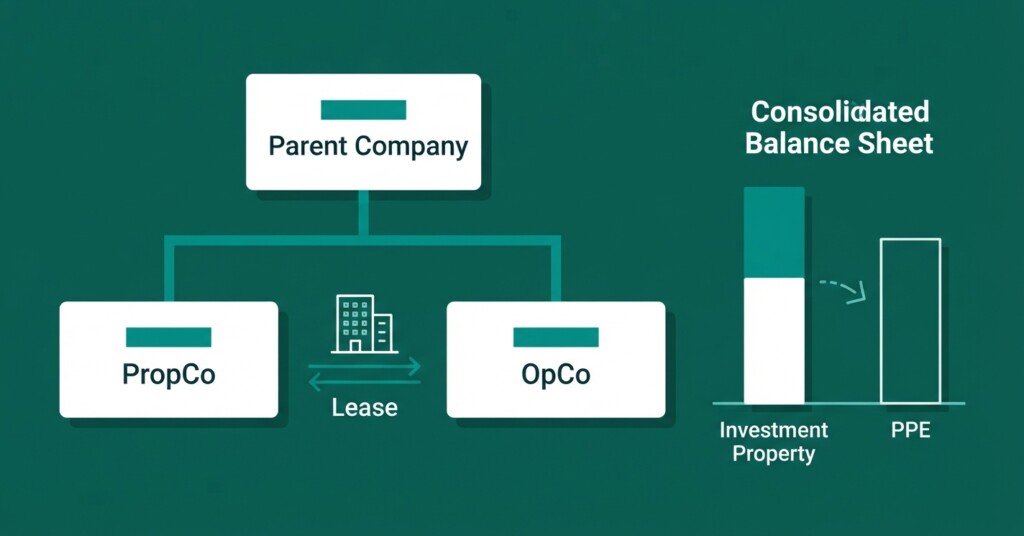
When a UK-based subsidiary holds property that functions as investment property for the group, the accounting standard applied at the subsidiary level can create significant — and sometimes surprising — differences in how that property appears in consolidated group accounts. For SME groups navigating the divide between IFRS and FRS 102, this is not a theoretical concern. It is a practical consolidation problem that surfaces at every financial close and demands careful, repeatable adjustments.
This article works through the specific mechanics: how investment property is recognised and measured under each standard, what adjustments are required on consolidation, how those adjustments interact with deferred tax, intercompany eliminations, and non-controlling interests, and where the workload tends to pile up for finance teams managing this manually.
The Core Accounting Difference: Fair Value vs Cost
Under IAS 40 (the IFRS standard for investment property), an entity can choose either the fair value model or the cost model. In practice, most groups applying IFRS choose fair value, because it gives users of the accounts a more current picture of property values. Under the fair value model, investment property is remeasured to fair value at each reporting date, and gains or losses go directly to profit or loss — not to other comprehensive income.
Stop building consolidations in spreadsheets.
BrizoConsol automates multi-entity consolidation — setup in minutes, reports the same day.
FRS 102, the standard most UK SME entities apply, takes a different approach. Under Section 16 of FRS 102, investment property is generally measured at fair value at each reporting date, with movements recognised in profit or loss and no depreciation charged. Unlike IAS 40, however, FRS 102 paragraph 16.4A provides an explicit accounting policy choice for property let to another group entity: the standalone entity can either measure it at fair value through profit or loss or transfer it to PPE and apply the cost model under Section 17.
Under both IFRS and FRS 102, property leased to another group entity can be classified as investment property only in the individual financial statements of the entity that holds it (unless under FRS 102 paragraph 16.4A the subsidiary elects the cost model). In the consolidated group accounts, that property must be reclassified as owner-occupied (PPE) because, from the group’s perspective, the property is being used in the group’s own operations — not rented to an external party.
This reclassification from investment property to PPE at the group level is the engine that drives a cascade of consolidation adjustments. The adjustments differ depending on whether the subsidiary prepares under FRS 102 or IFRS, because the carrying amounts, depreciation history, and deferred tax positions will differ.
A Practical Scenario: OpCo Leases a Building From PropCo
Consider a straightforward group structure: a UK parent company owns two subsidiaries — PropCo and OpCo. PropCo holds a commercial building and leases it to OpCo at a market rent. From PropCo’s perspective, the building is investment property. From the group’s perspective, the building is owner-occupied PPE, used in the group’s trading operations.
PropCo prepares its statutory accounts under FRS 102 and elects to account for the property at fair value under Section 16 rather than applying the intra-group cost model option in paragraph 16.4A. The building was acquired for £2,000,000 five years ago. At the current year-end, PropCo’s surveyor has valued it at £2,400,000. Under FRS 102 Section 16, PropCo records the building at £2,400,000, with no depreciation, and the £400,000 cumulative uplift has been recognised in profit or loss over the years it arose.
Step One: Reclassifying Investment Property to PPE on Consolidation
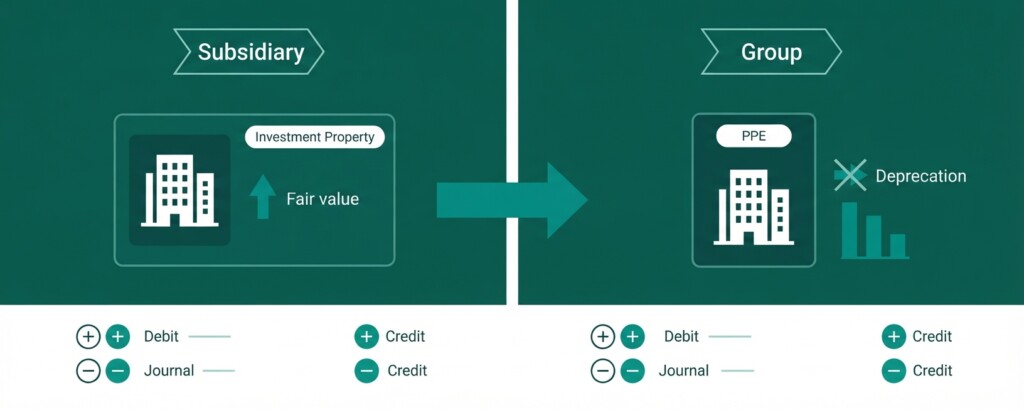
The first adjustment on consolidation is to reclassify the property from investment property to PPE. This is a presentational reclassification — the asset moves from one line of the balance sheet to another. But the reclassification immediately creates a measurement problem: PPE under both IFRS (IAS 16) and FRS 102 (Section 17) is normally held at cost less accumulated depreciation (unless the group elects the revaluation model for that class of PPE).
If the group consolidates under IFRS and does not apply the revaluation model for PPE, the building must be brought onto the consolidated balance sheet at its historical cost of £2,000,000, less accumulated depreciation that would have been charged had the building always been treated as PPE.
Assuming a 50-year useful economic life and straight-line depreciation, five years of depreciation on the £2,000,000 cost gives annual depreciation of £40,000 and accumulated depreciation of £200,000. The building’s carrying amount on the consolidated balance sheet under the cost model would therefore be £1,800,000.
| Original acquisition cost | £2,000,000 |
| Annual depreciation (£2,000,000 ÷ 50 years) | £40,000 |
| Accumulated depreciation over 5 years | £200,000 |
| Consolidated carrying amount (cost model PPE) | £1,800,000 |
| PropCo carrying amount (FRS 102 investment property at fair value) | £2,400,000 |
| Consolidation adjustment required (reduction in asset value) | £600,000 |
Step Two: Reversing Fair Value Gains Recognised in the Subsidiary
PropCo has recognised £400,000 of fair value gains in profit or loss over five years. On consolidation, these gains must be reversed, because the asset is being treated as cost-model PPE at the group level. The reversal affects retained earnings (for gains recognised in prior periods) and the current year income statement (for the current year movement).
Additionally, the consolidation must charge depreciation that PropCo never recorded. £200,000 of accumulated depreciation must be reflected, with the current year’s £40,000 charge going through the group income statement and the prior years’ £160,000 reducing retained earnings.
| Account | Dr | Cr |
|---|---|---|
| Retained earnings (prior year fair value gains reversal) | 320,000 | |
| Current year P&L — fair value gain reversal | 80,000 | |
| Investment property (reclassified to PPE) | 400,000 |
Reversal of cumulative FRS 102 fair value gains recognised in PropCo statutory accounts over 5 years (£80,000 per year assumed for illustration)
| Account | Dr | Cr |
|---|---|---|
| Retained earnings (prior year depreciation not charged) | 160,000 | |
| Current year P&L — depreciation charge | 40,000 | |
| Accumulated depreciation — PPE (buildings) | 200,000 |
Recognition of depreciation that would have been charged had the property always been classified as owner-occupied PPE in the consolidated accounts
Step Three: Intercompany Rent Elimination
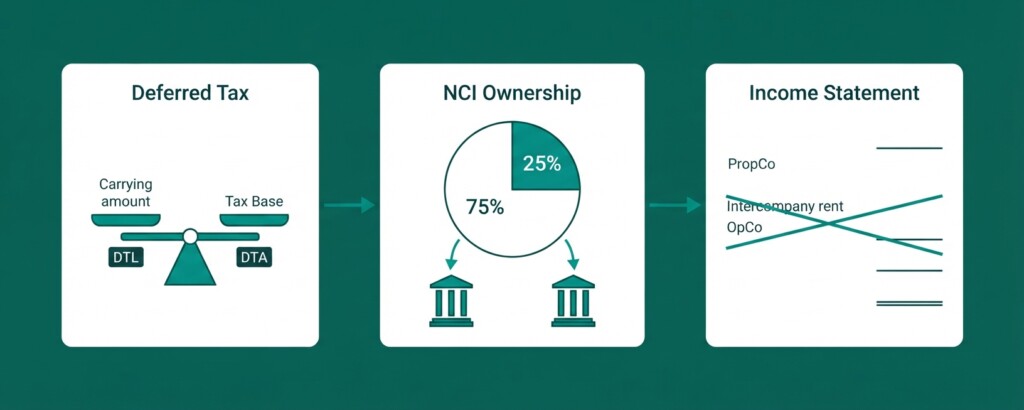
PropCo charges OpCo a market rent. In the consolidated accounts, this is an intercompany transaction and must be eliminated. The rental income in PropCo and the rental expense in OpCo cancel out. This is standard intercompany elimination, but it interacts with the investment property reclassification in a subtle way: the ‘investment’ rationale for the asset in PropCo’s books partly rests on the rental income it generates. Once that rental income is eliminated at group level, the property’s presentation as group PPE is even more clearly correct.
Step Four: Deferred Tax on the Consolidation Adjustments
Deferred tax on consolidation adjustments for investment property reclassifications is one of the most commonly missed items in SME group reporting. Where the consolidated carrying amount of PPE differs from the tax base, a deferred tax asset or liability must be recognised at the group level. Failing to do so will overstate or understate the group’s net assets and tax charge.
In this example, the consolidated PPE carrying amount is £1,800,000 and the tax base is £2,000,000 (assuming no capital allowances have been claimed for simplicity). In PropCo’s standalone accounts, the £400,000 fair value uplift was not immediately taxable under UK corporation tax rules, so PropCo recognised a deferred tax liability on that £400,000 taxable temporary difference. On consolidation, reversing the fair value uplift requires eliminating PropCo’s standalone deferred tax liability. Furthermore, because the consolidated carrying amount (£1,800,000) is now lower than the tax base (£2,000,000) due to group depreciation, a £200,000 deductible temporary difference arises, requiring the recognition of a deferred tax asset at the group level (subject to recoverability criteria).
What Changes If the Subsidiary Uses IFRS Instead of FRS 102?
If PropCo prepared its statutory accounts under IFRS and elected the fair value model under IAS 40, the starting position would look similar — but the technical details of the consolidation adjustment differ because IAS 40 and FRS 102 Section 16 handle fair value differently in some edge cases, and because a subsidiary reporting under IFRS is more likely to be part of a group consolidating under IFRS where the group accounting policies must be uniformly applied across all entities.
For groups consolidating under FRS 102 at the parent level, but with a subsidiary that has elected to apply IAS 40 (which is permitted in certain circumstances), the alignment of accounting policies becomes a consolidation adjustment in itself. The group must restate the subsidiary’s figures to the group policy before eliminations and other adjustments are applied.
Comparing the Two Frameworks: Key Differences at a Glance
| Area | FRS 102 Subsidiary / IFRS Group | IFRS Subsidiary / IFRS Group |
|---|---|---|
| Investment property measurement (subsidiary) | Fair value through P&L (unless cost model elected under para 16.4A) | Fair value model: gains through P&L, no depreciation (or IAS 40 cost model) |
| Consolidation reclassification required? | Yes — to PPE at cost less depreciation (if group uses cost model) | Yes — to PPE at cost less depreciation (unless group elects revaluation model for PPE) |
| Fair value gain reversal on consolidation | Required — reverse subsidiary P&L gains | Required — reverse subsidiary P&L gains |
| Depreciation catch-up adjustment | Required — charge depreciation not recorded by subsidiary | Required — charge depreciation not recorded by subsidiary |
| Deferred tax complexity | High — eliminate subsidiary deferred tax liability and recognise group deferred tax position | High — same complexity under IAS 12 |
| Policy alignment adjustment | May be needed if subsidiary applies different FV methodology or cost option | Less likely — both using IFRS framework |
| NCI impact | NCI share of consolidation adjustments must be calculated | NCI share of consolidation adjustments must be calculated |
Non-Controlling Interests and the Property Adjustment
Where PropCo is not wholly owned by the group — for example, the parent owns 75% and an external party owns 25% — the consolidation adjustments for the investment property reclassification must be allocated between the group and the NCI. The NCI’s share of the fair value gain reversal, the depreciation catch-up, and the resulting deferred tax impact all flow through to the NCI column on the consolidated balance sheet and income statement.
This is a detail that frequently causes errors in manually prepared consolidations. Finance teams working in Excel often apply the top-level group adjustment correctly but forget to split out the NCI share, leading to misstatements in both the group’s attributable equity and the NCI balance.
FX Translation: An Added Layer for Non-Sterling Subsidiaries
The scenario above assumes PropCo is a sterling-functional-currency entity. Where the property-holding subsidiary operates in a different functional currency — for example, a eurozone SPV holding UK property — FX translation adds another layer. The property is translated at the closing rate for balance sheet purposes, and translation differences on the historical cost and accumulated depreciation flow through other comprehensive income as part of the foreign currency translation reserve. The interaction between FX translation, the investment property-to-PPE reclassification, and the fair value gain reversal creates a compound adjustment that is genuinely difficult to manage without systematic tooling.
Why Manual Excel Consolidations Struggle With This
The adjustments described above are not exotic. They arise routinely in groups where one entity holds property used by another. But in practice, finance teams consolidating in Excel face several compounding problems: the consolidation workbooks must carry forward the historical cost and accumulated depreciation figures year after year; the deferred tax position must be recalculated at each period end; the NCI split must be manually computed; and any change in the group structure or the property’s fair value triggers a cascade of recalculations across multiple linked sheets.
The risk of error is high, particularly where the team preparing the consolidation changes, or where the adjustments were first set up by an external adviser who is no longer involved. A consolidation platform that holds entity-level trial balances, applies standing adjustments consistently each period, and tracks historical cost separately from fair value movements reduces both the manual effort and the risk of misstatement.
Practical Steps for Finance Teams Managing This Consolidation
- Document the group accounting policy for investment property clearly — whether cost model or revaluation model — and ensure it is applied consistently at the consolidated level regardless of what the subsidiary uses in its statutory accounts.
- Maintain a schedule of the property’s original cost, acquisition date, useful economic life, and accumulated depreciation on an ‘as if PPE’ basis, separate from the fair value carrying amounts in the subsidiary’s ledger.
- At each period end, calculate the adjustment required to move from the subsidiary’s carrying amount to the group carrying amount, and prepare the consolidation journal entries with supporting workings.
- Calculate deferred tax on the temporary difference between the consolidated PPE carrying amount and the tax base, ensuring the subsidiary’s standalone deferred tax liability on fair value gains is eliminated on consolidation.
- Eliminate intercompany rent in full, ensuring both the income in PropCo and the expense in OpCo are removed from the consolidated income statement.
- If NCI exists in the property-holding subsidiary, allocate the net consolidation adjustment between the group and NCI based on the ownership percentage.
- For non-sterling entities, apply the closing rate to the consolidated carrying amount and track translation differences in the foreign currency translation reserve.
- Review the adjustments at least annually with your auditors, particularly where property values are moving materially or where the group structure has changed.
The Bigger Picture for Group Reporting
Investment property held by a subsidiary is one example of a broader challenge in multi-entity consolidation: the same asset, the same transaction, or the same balance can look very different depending on the accounting standard applied at the entity level versus the group level. Getting this right requires a clear group accounting policy, consistent application of consolidation adjustments, and a disciplined approach to documentation.
For SME groups, where the finance team is often small and the consolidation may be prepared quarterly or even only annually, the risk of these adjustments being applied inconsistently or incompletely is real. Investing in the right processes — whether through structured consolidation software, well-documented Excel templates with clear version control, or working closely with a group reporting specialist — pays dividends when the audit arrives or when management needs reliable consolidated numbers quickly.
Automate Your Multi-Entity Consolidation
BrizoConsol is built for SME finance teams managing group consolidation, intercompany eliminations, and multi-standard reporting. See how it handles standing consolidation adjustments, deferred tax, and NCI calculations without manual Excel rework.