Transfer Pricing for Intercompany Component Sales in a Manufacturing Group: How to Set Arm’s-Length Prices and Eliminate the Margin at Consolidation
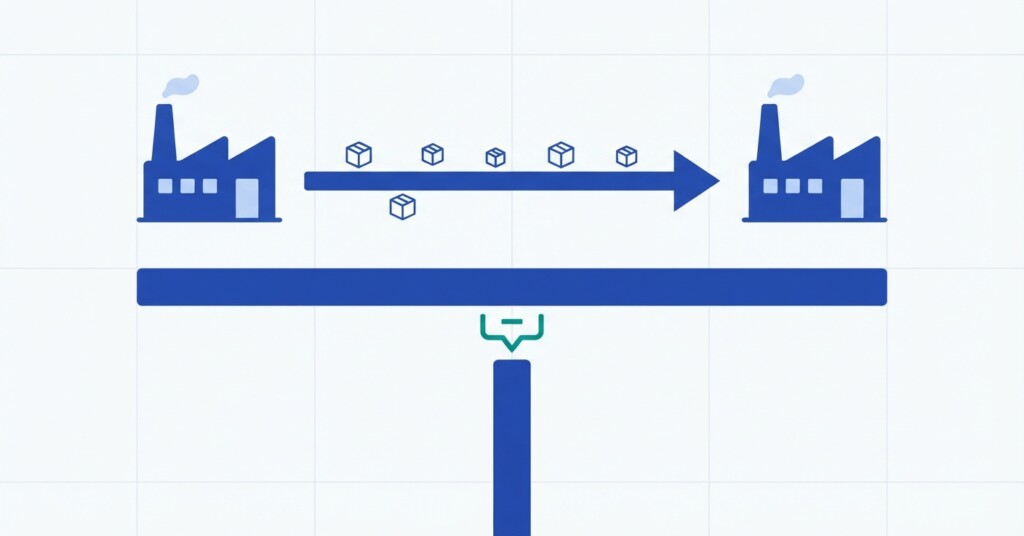
For manufacturing groups that operate across multiple legal entities, transfer pricing is one of the most consequential and least glamorous challenges in group accounting. When one entity manufactures components and sells them to a sister company that assembles the finished product, the price charged between those two entities shapes both the tax position of each legal entity and the integrity of your consolidated financial statements. Get it wrong and you face two distinct problems: a transfer pricing dispute with tax authorities, and a consolidation that overstates group profit. This article focuses on the accounting mechanics — how to set defensible arm’s-length prices for intercompany component sales, and how to correctly eliminate the intercompany margin when you prepare consolidated group accounts.
Why Intercompany Component Sales Create a Consolidation Problem
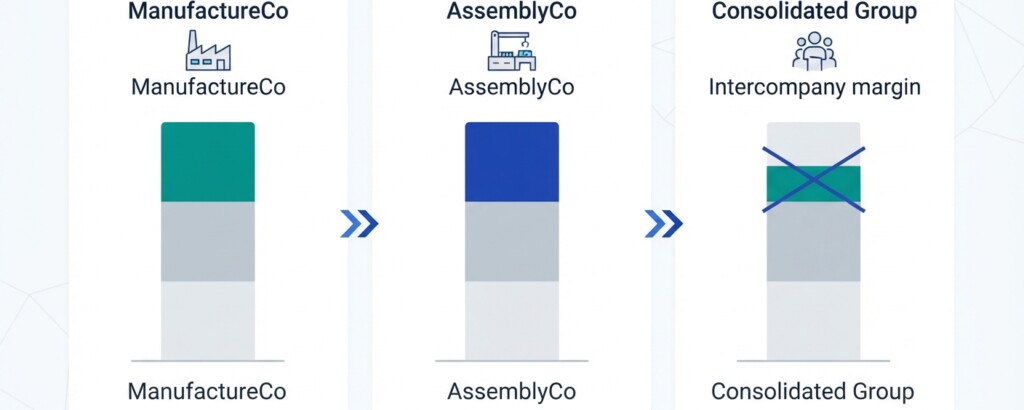
Imagine a manufacturing group with two subsidiaries: ManufactureCo, which produces electronic sub-assemblies, and AssemblyCo, which purchases those sub-assemblies, incorporates them into finished goods, and sells to external customers. From a legal-entity perspective, ManufactureCo books a sale and recognises a margin. AssemblyCo books a purchase at that same price and carries the sub-assemblies in inventory at cost — which includes ManufactureCo’s margin.
At consolidation, the group has not sold anything to an external party yet. The goods are still sitting inside the group — either in AssemblyCo’s raw material store or embedded in work-in-progress or finished goods. Any margin that ManufactureCo recognised on that intercompany sale is unrealised from the group’s perspective. If you do not eliminate it, your consolidated gross profit is inflated, and your consolidated inventory is overstated. This is the core mechanic that every controller in a manufacturing group needs to understand deeply.
Intercompany eliminations without the manual work.
BrizoConsol identifies and eliminates intercompany balances automatically at consolidation.
Setting Arm’s-Length Prices: The Practical Approaches
Transfer pricing rules in most jurisdictions require that intercompany transactions be priced as if they were conducted between independent parties — the arm’s-length principle. For component sales in a manufacturing group, three methods are most commonly applied in practice.
- Comparable Uncontrolled Price (CUP): If ManufactureCo sells the same or similar components to external customers, the external price is the most reliable benchmark. This is the preferred method when a genuine comparable exists.
- Cost Plus: ManufactureCo calculates its fully absorbed cost per unit and adds a mark-up that reflects the margin an independent contract manufacturer would earn. This is common when components are bespoke and no external market price exists.
- Resale Price Method (Resale Price Minus): Start from AssemblyCo’s external selling price, deduct AssemblyCo’s own gross margin (benchmarked against independent distributors or assemblers), and the residual is the arm’s-length transfer price. Less common for components because substantial value is added during assembly, but useful when the assembler’s margin is easier to benchmark.
For most SME manufacturing groups, Cost Plus is the most practical method. It anchors the transfer price to ManufactureCo’s actual cost base, makes the margin transparent, and produces a number that is straightforward to justify to tax authorities. The key is ensuring that ‘cost’ is consistently defined — typically full absorption cost including direct materials, direct labour, and an allocated share of manufacturing overhead — and that the mark-up is benchmarked against publicly available data on comparable contract manufacturers.
A Worked Example: Cost Plus Transfer Pricing
ManufactureCo produces 10,000 sub-assemblies in a month. Its cost structure per unit is set out below, alongside the arm’s-length mark-up and the resulting transfer price.
| Cost Component | Per Unit (£) | Basis |
|---|---|---|
| Direct materials | 18.00 | Actual BOM cost |
| Direct labour | 7.50 | Standard hours × rate |
| Manufacturing overhead (absorbed) | 9.50 | OAR applied to standard hours |
| Total absorption cost | 35.00 | |
| Arm’s-length mark-up (12%) | 4.20 | Benchmarked: contract manufacturer comparables |
| Transfer price per unit | 39.20 | Charged to AssemblyCo |
ManufactureCo invoices AssemblyCo £392,000 for 10,000 units (10,000 × £39.20). ManufactureCo records a sale at £392,000 with a cost of goods sold of £350,000, recognising £42,000 of gross profit. AssemblyCo records a purchase of £392,000 and holds the units in inventory at £39.20 per unit.
The Journal Entries: Entity Level and Consolidation
The legal-entity entries are straightforward. The consolidation elimination journals are where care is needed, particularly when some units remain in inventory at period end.
| Account | Dr | Cr |
|---|---|---|
| Intercompany Receivable (ManufactureCo) | 392,000 | |
| Intercompany Revenue (ManufactureCo) | 392,000 |
ManufactureCo records the intercompany sale of 10,000 sub-assemblies at £39.20 per unit.
| Account | Dr | Cr |
|---|---|---|
| Inventory — Sub-assemblies (AssemblyCo) | 392,000 | |
| Intercompany Payable (AssemblyCo) | 392,000 |
AssemblyCo records the intercompany purchase; inventory is carried at the transfer price.
| Account | Dr | Cr |
|---|---|---|
| Intercompany Revenue (elimination) | 392,000 | |
| Intercompany Cost of Goods Sold (elimination) | 350,000 | |
| Inventory — Unrealised Margin (elimination) | 42,000 |
Consolidation elimination: removes the intercompany sale and purchase, and strips the unrealised margin from inventory. Assumes all 10,000 units remain unsold in AssemblyCo at period end. If some units have been sold externally, only the margin on unsold units is eliminated from inventory; the remainder reduces consolidated COGS.
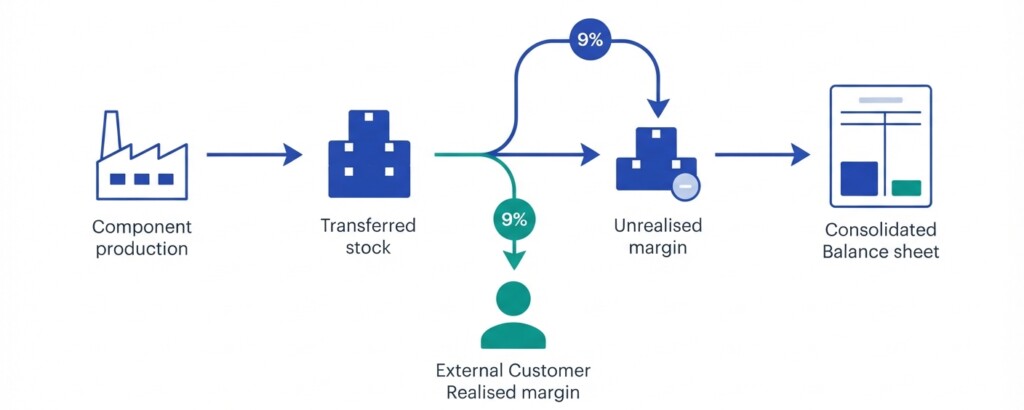
The third entry is the one most teams get wrong when they try to manage consolidation in spreadsheets. When units are partially sold, you need to track what proportion of the transferred inventory has moved to an external customer and what remains on hand. Only the margin on unsold units reduces consolidated inventory; the margin on sold units reduces consolidated COGS (because ManufactureCo’s profit on those goods has now been realised by the group through the external sale).
Calculating the Unrealised Profit in Closing Inventory
Suppose AssemblyCo sold 6,000 units externally during the month, incorporating the sub-assemblies into finished products. 4,000 units remain in inventory at month end — either as raw sub-assemblies or embedded in WIP or finished goods. The unrealised profit calculation works as follows.
| Total units transferred | 10,000 |
| Units sold externally by AssemblyCo | (6,000) |
| Units remaining in group inventory | 4,000 |
| Intercompany margin per unit (£39.20 − £35.00) | £4.20 |
| Unrealised profit in closing inventory | £16,800 |
This £16,800 must be eliminated from consolidated inventory and from consolidated profit. The £25,200 margin on the 6,000 sold units (6,000 × £4.20) has been realised through the external sale — meaning no inventory elimination is required for those units, and that profit correctly remains part of the group’s consolidated gross profit on those external sales.
FX Complications: When ManufactureCo and AssemblyCo Use Different Currencies
In a cross-border manufacturing group, ManufactureCo might report in euros and AssemblyCo in sterling. The transfer price is agreed in one currency — say euros — and AssemblyCo translates the invoice at the spot rate on the invoice date. At month end, the intercompany payable is retranslated at the closing rate, generating a foreign exchange gain or loss in AssemblyCo’s books. On consolidation, the intercompany balances must still eliminate to zero, but the FX movement creates an exchange difference that has to be explicitly managed.
The practical approach is to track intercompany balances in both currencies and reconcile them bilaterally before consolidation. Under accounting standards such as IAS 21 and FRS 102, trade receivables and payables are monetary items whose exchange differences reflect genuine group exposure to currency fluctuations. Consequently, when the intercompany balance sheet accounts are eliminated against each other, the resulting foreign exchange gain or loss must remain recognised in consolidated profit or loss — it cannot be eliminated or swept into equity as part of the currency translation adjustment reserve (a treatment reserved strictly for monetary items that form part of a net investment in a foreign operation). If you are carrying out this reconciliation in Excel across multiple entity pairs, the scope for error is significant — particularly when invoice dates, payment dates, and period-end retranslations generate different exchange differences across ledgers.
A common mistake in multi-currency manufacturing groups is eliminating intercompany balances at an average rate rather than confirming the rate that each entity actually used to record the transaction. If ManufactureCo invoiced in euros and AssemblyCo translated at the spot rate on the invoice date, the balance sheet elimination must work from both entities’ recorded amounts, with any residual FX difference recognised in consolidated profit or loss — not ignored or incorrectly dumped into the currency translation reserve. Leaving unreconciled FX differences in the consolidation pack distorts consolidated earnings and can misstate consolidated net assets.
Non-Controlling Interests and Transfer Pricing Margins
If ManufactureCo is not wholly owned by the group parent — say the parent owns 75% and an external investor holds 25% — then the elimination of unrealised profit affects the NCI calculation. When you eliminate the unrealised profit in inventory, you are reducing ManufactureCo’s recognised profit for the period. That reduction flows through to the NCI’s share of profit: the NCI absorbs 25% of the eliminated margin, not 0%. This is the correct treatment under IFRS 10 and FRS 102 for partial subsidiaries. In practice, many SME consolidation models allocate the full elimination against the parent’s equity and ignore the NCI impact — which is technically incorrect and can become material if margins are large or the NCI stake is significant.
Building a Repeatable Process for Month-End Close
The challenge for finance teams in manufacturing groups is not understanding the principles — it is executing the eliminations reliably every month when time is short and the data is spread across multiple ERP systems, spreadsheets, and entity trial balances. A robust process typically includes the following steps.
- Agree transfer prices at the start of the financial year and document the pricing methodology in a group transfer pricing policy. Avoid mid-year changes without contemporaneous documentation.
- Tag all intercompany transactions at source with a consistent intercompany identifier so they can be extracted cleanly at consolidation.
- Perform bilateral intercompany reconciliations between each entity pair before closing the period. Differences must be investigated and resolved, not carried forward.
- Track the inventory turnover rate for transferred components so you can calculate the proportion of intercompany margin that is realised versus unrealised each month.
- Prepare the elimination journals consistently from a defined template, with the margin percentage applied to closing inventory quantities confirmed from AssemblyCo’s records.
- Document and retain the elimination workings as part of the consolidation audit trail.
Teams that run this process in Excel typically spend a disproportionate amount of month-end time on steps 3 and 4 — chasing intercompany confirmations from entity finance teams and recalculating inventory proportions from scratch each month. When transfer volumes are high or the group has more than two or three manufacturing entities, this becomes the single biggest bottleneck in the financial close.
Where Automation Changes the Workload
Consolidation software that ingests trial balances directly from each entity’s ledger, applies pre-configured intercompany elimination rules, and tracks intercompany balances bilaterally can collapse the reconciliation and elimination work from days to hours. When the transfer pricing margin is stored as a parameter against the relevant intercompany account codes, the system can calculate the unrealised profit in closing inventory automatically once it knows the closing inventory quantity — which it can derive from the trial balance movement if inventory accounts are properly tagged.
The value is not just speed. It is consistency: the same elimination logic runs every month without the risk of a formula error in row 847 of a spreadsheet, and the audit trail is embedded in the system rather than reconstructed from email threads. For finance teams that close across four or five manufacturing entities with intercompany sales running in multiple directions and multiple currencies, the reduction in reconciliation effort alone justifies the move away from manual consolidation.
Practical Takeaways for Manufacturing Group Finance Teams
Transfer pricing for intercompany component sales sits at the intersection of tax compliance and consolidated accounting. The arm’s-length price you set for ManufactureCo’s invoices must be defensible to tax authorities in both jurisdictions, and the margin embedded in that price must be correctly tracked and eliminated at consolidation — with discipline about what is realised and what is not. Neither task is conceptually difficult, but both require rigour in execution and a process that can be repeated reliably every month without depending on institutional memory or heroic spreadsheet work from a single controller.
If your group is growing — adding new manufacturing entities, expanding into new markets, or dealing with increasing intercompany volumes — the moment to build a proper consolidation process is before the complexity makes the manual approach unmanageable, not after.
See How Consolidation Works in Practice
If your manufacturing group is managing intercompany eliminations, transfer pricing adjustments, and multi-currency consolidation in spreadsheets, explore how BrizoConsol handles these workflows in a connected consolidation environment.