UK Group Consolidation Exemptions: When a UK Group Is Not Required to Prepare Consolidated Accounts
The conversation happened in the third week of March. Sarah, group financial controller at a mid-sized professional services group with five subsidiaries and a turnover of around £11 million, had just sat down with the incoming audit partner for a pre-year-end review. The audit partner looked at her consolidation timetable — a detailed twelve-week workplan covering intercompany reconciliations, fair value adjustments, and a three-currency consolidation — and asked a simple question: “Has anyone checked whether you actually need to prepare consolidated accounts?”
Sarah had prepared consolidated accounts every year for four years. It had never occurred to her that she might not have to. The default assumption, shared by most finance teams, is that if you have subsidiaries, you consolidate. That assumption is wrong for a significant number of UK groups, and the April 2025 changes to company size thresholds — which increased the small group limits by roughly 50% — have brought thousands more UK groups within reach of an exemption they may not know they qualify for.
This post sets out the two main routes to exemption under UK law, the conditions that must all be satisfied, and the tests that tell you definitively whether your group qualifies. It also covers the circumstances in which individual subsidiaries can be excluded from an otherwise mandatory consolidation, and what you must disclose when claiming any exemption. None of what follows is a substitute for professional legal or accounting advice specific to your group’s circumstances, but it gives you the framework to have an informed conversation with your auditor before you commit to another year of consolidated accounts that may not be legally required.
Stop building consolidations in spreadsheets.
BrizoConsol automates multi-entity consolidation — setup in minutes, reports the same day.
This post covers requirements under UK company law and FRS 102 as at August 2026. Size thresholds and exemption conditions are subject to amendment by legislation. Always confirm the current position with your auditor or with reference to the latest version of the Companies Act 2006 and FRC guidance before relying on any exemption.
The Default Rule: Every UK Parent Must Consolidate
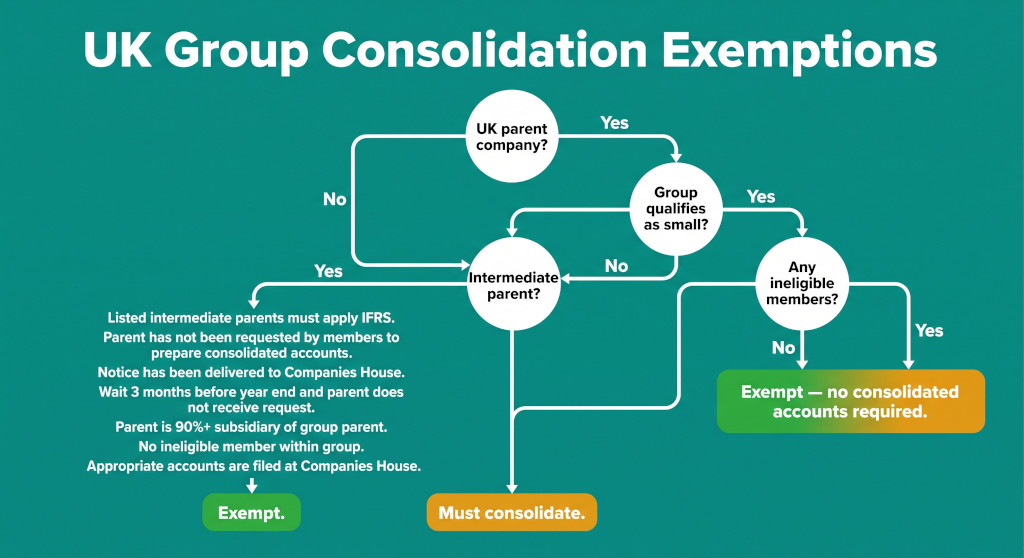
Section 399 of the Companies Act 2006 is the starting point. It states that if at the end of a financial year a company is a parent company, the directors must prepare group accounts — consolidated financial statements for the period — in addition to the company’s individual accounts. This is not a recommendation or best practice; it is a legal requirement imposed on every UK company that controls one or more subsidiaries.
The Companies Act’s definition of a parent-subsidiary relationship is broad. A company is a parent if it holds a majority of voting rights in another company, has the right to appoint or remove a majority of the board of directors, or exercises dominant influence or control. Most straightforward ownership structures where Company A owns more than 50% of Company B will fall clearly within the definition. Complex structures — joint ventures, contractual control arrangements, special purpose vehicles — can require more careful analysis. But the starting point is always the same: parent company, legal duty to consolidate.
The exemptions below are departures from this default. They must be earned, not assumed, and they must be reviewed each year because a group’s circumstances change.
Exemption 1: The Small Group Exemption (s.399)
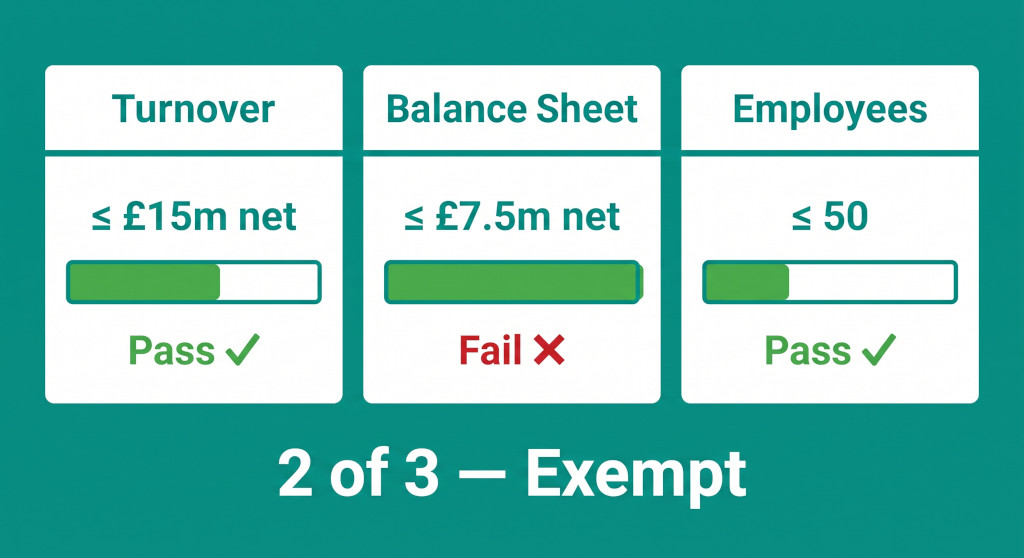
The most commonly applicable exemption is the small group exemption under section 399(2A). A parent company is not required to prepare consolidated accounts if the group it heads qualifies as a small group. A group qualifies as small if it meets at least two of the following three criteria, measured on an aggregate basis across all group members.
Current thresholds (accounting periods beginning on or after 6 April 2025)
| Criterion | Net figure (after eliminations) | Gross figure (before eliminations) |
|---|---|---|
| Aggregate turnover | £15 million or less | £18 million or less |
| Aggregate balance sheet total | £7.5 million or less | £9 million or less |
| Average number of employees | 50 or fewer | 50 or fewer |
The net figures apply after consolidation adjustments — intercompany sales are eliminated from aggregate turnover, intercompany balances from aggregate assets. The gross figures apply before such adjustments. Either basis can be used; you choose whichever is more favourable, provided you apply it consistently.
Previous thresholds (for periods beginning before 6 April 2025) were £10.2m / £12.2m for turnover and £5.1m / £6.1m for balance sheet, with employees at 50. The April 2025 increase was approximately 47%. Groups that narrowly failed the old thresholds may well qualify under the new ones.
A worked example
Sarah’s group has five subsidiaries. Here is the aggregate position for the year ended 31 March 2026:
| Criterion | Aggregate (gross) | Threshold (gross) | Result |
|---|---|---|---|
| Turnover | £11.4m | £18m | ✓ Pass |
| Balance sheet total | £9.8m | £9m | ✗ Fail |
| Average employees | 43 | 50 | ✓ Pass |
| Conclusion | Meets 2 of 3 criteria | Qualifies | |
The group exceeds the balance sheet threshold but passes on turnover and employees. Two out of three is sufficient. Subject to the ineligible group check below, Sarah’s group qualifies as small and is not required to prepare consolidated accounts for the year ended 31 March 2026.
The two-year rule
A group that qualifies as small in a given year retains the exemption. A group that fails to qualify — that breaches two or more of the criteria — loses the exemption, but only if it fails in two consecutive years. A single year of breach does not immediately remove the exemption; the group can still claim it in the first year of breach, but must consolidate from the following year if it fails again. Conversely, a group that has been consolidating can claim the exemption in its first qualifying year. Under the April 2025 transitional relief, groups may treat the new thresholds as having applied in the prior year as well, which means groups newly qualifying under the increased limits do not need to wait for a second consecutive qualifying year before claiming the exemption.
Ineligible Groups: When Size Doesn’t Matter
Qualifying as small in terms of size is necessary but not sufficient. Section 384 of the Companies Act 2006 lists types of company that cannot claim the small group exemption, regardless of how small the group is. If any group member falls into one of these categories, the entire group loses eligibility:
- Public companies (plc)
- Companies (or other bodies corporate) with transferable securities admitted to trading on a UK-regulated market — this includes companies listed on the London Stock Exchange Main Market or AIM
- Authorised insurance companies
- Banking companies (as defined by the Financial Services and Markets Act 2000)
- E-money issuers
- MiFID investment firms
- UCITS management companies
This is an all-or-nothing rule. One regulated entity anywhere in the group disqualifies all members. A professional services group with a single FCA-regulated subsidiary that provides investment advice — even a small one — cannot use the small group exemption. The group must consolidate in full.
Common assumption to check: Finance directors sometimes assume that a subsidiary which holds an FCA authorisation but does not actively use it is not a “banking company” or “MiFID investment firm” for these purposes. Whether a company is a regulated entity for s.384 purposes is a legal question, not a financial one. Confirm with legal counsel before treating any FCA-regulated entity as ineligible to disqualify the group.
Exemption 2: The Intermediate Parent Exemption (s.400 and s.401)
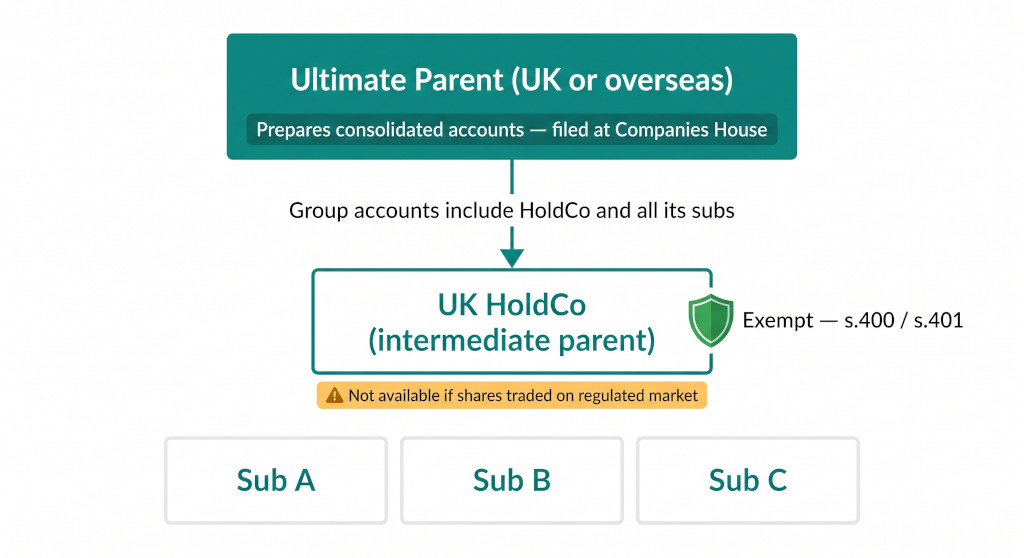
The second main exemption applies in a completely different scenario: not to a small group, but to any group where the UK parent company is itself a subsidiary of a larger parent that already prepares consolidated accounts covering the whole group. The logic is straightforward — if the UK holding company and all of its subsidiaries are already included in consolidated financial statements prepared by the ultimate parent, producing a second set of consolidated accounts at the UK level adds cost but no useful information to the world.
There are two sections, depending on where the parent is established:
Section 400 applies when the parent undertaking drawing up the higher-level consolidated accounts is itself established in the UK. The conditions that must all be met are: the company is a subsidiary undertaking included in UK group accounts prepared by that parent; those accounts are prepared under UK-adopted IFRS or give a true and fair view under the Companies Act; both the group accounts and the auditor’s report on them are delivered to the Registrar of Companies; and the company discloses the exemption in its own individual accounts.
Section 401 applies when the parent is established outside the UK. The conditions are similar but the group accounts must be prepared under UK-adopted international accounting standards, EU-adopted IFRS, or another framework that gives a true and fair view and is accompanied by an auditor’s report. The accounts must be made publicly available in a language accepted by Companies House, or translated, and the company must disclose sufficient information in its own accounts for shareholders to identify and access the higher-level group accounts.
The shareholder consent condition
For wholly-owned subsidiaries — where the UK parent is 100% owned by its parent — neither section requires shareholder consent. For partly-owned subsidiaries, the position is more nuanced. Minority shareholders holding in aggregate at least 5% of the shares in the company may, by written notice, require the company to prepare consolidated accounts notwithstanding the exemption. If such a notice is served within the relevant statutory period before the end of the financial year, the exemption does not apply. This right cannot be waived in the company’s articles.
For practical purposes: if your UK holding company is 80% owned by an overseas group and you intend to claim the s.401 exemption, check whether the 20% minority has been informed of this intention and whether any of them might exercise their right to require consolidation before the year-end.
One condition that is easy to miss: the higher-level accounts must actually be filed
The exemption under s.400 and s.401 is only available if the higher-level group accounts are “delivered to the Registrar of Companies” — i.e., filed at Companies House. For UK ultimate parents, this is a normal obligation. For overseas parents, however, the requirement can be a problem: some overseas holding companies do not file their group accounts in the UK at all, because they have no legal obligation to do so in their home jurisdiction. If the overseas parent’s consolidated accounts are not filed at Companies House, the s.401 exemption is not available, regardless of how clearly the UK subsidiary is included in them. Some overseas parents file voluntarily at Companies House precisely to enable their UK subsidiaries to claim the exemption; others do not, and the subsidiary must then consolidate.
The intermediate parent exemption is not available to any company that has transferable securities admitted to trading on a UK-regulated market. A UK holding company that is publicly listed cannot claim the exemption even if its own parent prepares consolidated accounts at a higher level.
Excluding Individual Subsidiaries From Consolidation
The exemptions above determine whether a UK parent must prepare any consolidated accounts at all. Even when consolidation is required, there are limited circumstances in which specific subsidiaries can be excluded from it. These are not exemptions from consolidation — the parent still prepares consolidated accounts — but they allow particular subsidiaries to be left out of the scope.
Under FRS 102 paragraph 9.9, a subsidiary may be excluded from consolidation on any of the following grounds:
Immateriality. A subsidiary may be excluded if its inclusion is not necessary for giving a true and fair view. However, two or more subsidiaries cannot be excluded on the basis that, taken together, they remain immaterial — the combined effect of multiple exclusions must also pass the materiality test. For a group with six subsidiaries where five are active and one is a dormant shell with no assets or liabilities, excluding the dormant shell on grounds of immateriality is straightforward. For a group with three subsidiaries where two are small, the materiality of their combined contribution must be assessed in the context of the consolidated picture.
Severe long-term restrictions. A subsidiary can be excluded if severe long-term restrictions substantially hinder the parent’s exercise of its rights over the subsidiary’s assets or management. This ground requires genuine, long-term impairment of control — not a temporary difficulty, not a regulatory requirement that constrains but does not eliminate management authority. It arises most commonly where a subsidiary is located in a jurisdiction that has imposed exchange controls preventing the repatriation of funds, or where a subsidiary is subject to an administration or receivership that has transferred effective management to a third party.
Held exclusively with a view to subsequent resale. A subsidiary acquired and held exclusively for resale — for example, a business acquired by a private equity group with immediate sale plans — can be excluded. The “exclusively” test is strict: the subsidiary must have been acquired with resale as the sole intention, and there must be evidence of active effort to sell it. A subsidiary that was originally acquired for operational reasons but which the group has since decided to divest does not qualify.
Where a subsidiary is excluded from consolidation under any of these grounds, it cannot simply be ignored. Under FRS 102, an excluded subsidiary is treated as a financial instrument in the consolidated accounts — measured at cost or fair value depending on classification. The accounting treatment and the reason for exclusion must both be disclosed.
Disclosure Requirements When Claiming an Exemption
Claiming an exemption is not the same as simply not filing consolidated accounts. The exemption must be explicitly stated in the company’s individual accounts, and the disclosure requirements differ depending on which exemption is being claimed.
For the small group exemption, the individual accounts must state that the company is entitled to the exemption from preparing group accounts under s.399 of the Companies Act 2006 and has taken advantage of it. No further detail is required by law, though it is good practice to confirm in a brief accounting policy note that the group qualified as small in the relevant year.
For the intermediate parent exemption (s.400 or s.401), the disclosure is more substantial. The individual accounts must identify the parent undertaking whose consolidated accounts include the company, give the registered address (or registered office) of that parent, and, if the parent is incorporated outside the UK, state the country in which it is incorporated. The company must also state where copies of those group accounts can be obtained by members of the public — which in practice means providing the Companies House filing reference if the parent files in the UK, or a website or address if the accounts are available only from an overseas registry.
What the April 2025 Changes Mean in Practice
The increase in small group thresholds from £10.2m / £5.1m (net) to £15m / £7.5m (net) is the most significant change to UK consolidation requirements in many years. Groups with aggregate turnover between £10.2m and £15m that previously had no choice but to consolidate may now qualify for exemption. The transitional relief — which treats the new thresholds as having applied in the prior year — means these groups can, in principle, claim the exemption for the first accounting period that begins on or after 6 April 2025, without waiting for a second consecutive qualifying year.
There is one important forward consideration. The FRC’s Periodic Review 2024 amendments to FRS 102, effective for accounting periods beginning on or after 1 January 2026, will bring operating leases onto the balance sheet for entities applying the updated standard. For groups currently just below the £7.5m (net) balance sheet threshold, the capitalisation of operating leases — particularly property leases — could push aggregate balance sheet totals above the limit. Finance teams should model the effect of the new lease rules on their balance sheet total when assessing whether the small group exemption will still be available once FRS 102’s lease provisions take effect.
Not sure whether your group needs to consolidate?
BrizoConsol works with UK groups of all sizes — from those just above the small group threshold to complex multi-entity structures. Start with a free trial to see what consolidated reporting looks like for your group. See It in Action
What Happens When Exemptions Don’t Apply
If your group does not qualify for either exemption — if it is too large for the small group test, lacks an eligible parent at a higher tier, or contains an ineligible member — consolidated accounts are legally required. The process involves combining all subsidiary trial balances, eliminating intercompany transactions and balances, translating foreign-currency subsidiaries at the correct rates, recognising goodwill on any acquisitions, and calculating non-controlling interests where subsidiaries are partly owned.
For a structured walkthrough of what UK GAAP consolidation under FRS 102 involves in practice, see a complete consolidation worked example from trial balances to consolidated financial statements. For the intercompany elimination process specifically, see intercompany eliminations: a complete guide for group consolidation. For groups that have acquired subsidiaries during the year, how to consolidate a new subsidiary acquired during the year covers the acquisition-date steps including goodwill and NCI calculations. For groups with subsidiaries that report under IFRS, see how to consolidate an IFRS subsidiary into a UK GAAP (FRS 102) parent.
Practical Checklist: Assessing Your Group’s Exemption Status
- Confirm whether the company is a parent at the year-end. Check the group structure. If the company holds a majority of voting rights, has the right to appoint or remove the majority of the board, or exercises dominant influence over any other entity, it is a parent and the default duty to consolidate applies.
- Test for small group qualification. Aggregate turnover, balance sheet total, and average employee count across all group members — using either net (post-elimination) or gross (pre-elimination) figures. If the group meets two of the three criteria, it qualifies as small in terms of size.
- Check for ineligible group members. Review whether any entity in the group is a plc, a company with listed securities, or a regulated financial services firm (bank, insurer, MiFID firm, e-money issuer, UCITS manager). One ineligible member disqualifies the whole group from the small group exemption.
- Apply the two-year rule. If the group qualified in the prior year and qualifies again this year, the exemption is available. If the group failed in the prior year, and fails again this year, the exemption is lost and consolidated accounts must be prepared. If the group is newly qualifying under the April 2025 thresholds, the transitional relief allows immediate use of the exemption without a prior-year track record.
- If the small group exemption is not available, check for an intermediate parent. Determine whether the company is included in consolidated accounts prepared by a parent undertaking at a higher tier. If so, confirm that those accounts are prepared under the relevant standard (UK-adopted IFRS or a true-and-fair-view framework), filed at Companies House, and that minority shareholders have not exercised their right to require consolidation.
- If consolidation is required, identify any subsidiaries that may be excluded. Check each subsidiary against the grounds in FRS 102 paragraph 9.9: immateriality (individually and in aggregate with other excluded entities), severe long-term restrictions, or held exclusively for resale. Document the basis for any exclusions.
- Make the required disclosures in the company’s individual accounts. For the small group exemption, state the s.399 exemption claim. For the intermediate parent exemption, identify the parent preparing higher-level accounts, its registered address, and where the accounts can be accessed.
- Review the position every year. Exemption status is not permanent. A significant acquisition, a new FCA-authorised subsidiary, or growth through either the turnover or balance sheet threshold can remove an exemption that applied the year before. Build the exemption assessment into your year-end reporting timetable, not as an afterthought.
Group consolidation made straightforward
When your group must consolidate, BrizoConsol connects to your accounting systems, handles intercompany eliminations, multi-currency translation, NCI, and goodwill, and produces consolidated P&L, balance sheet, and cash flow in hours instead of weeks. Start Free Trial