SFRS(I) 10 Consolidated Financial Statements: A Practical Guide for Singapore Groups
When Meridian Capital Group set up its fourth Singapore subsidiary in 2019, the group CFO made an assumption that seemed obvious at the time: they owned 45% of a publicly listed associate, so it was equity-accounted, not consolidated. Eighteen months later, an ACRA review flagged that the 45% stake came with de facto control — because the remaining 55% was split across more than three thousand retail shareholders who had never coordinated and rarely voted. The group had been presenting the associate’s assets and liabilities outside its consolidated balance sheet for the entire period. The restatement covered two years of accounts.
The error was not unusual. SFRS(I) 10, which Singapore adopted from 1 January 2018 as part of its transition to the SFRS(I) suite, replaced the old voting-rights-centred approach to consolidation with a single control model that requires judgment, not just arithmetic. Under the old SFRS 27, a 51% stake reliably meant consolidation. Under SFRS(I) 10, control can exist at 45% — and sometimes at much lower percentages when structured entities are involved.
This guide explains how SFRS(I) 10 works in practice: the three-element control test, how to apply it to common scenarios, the exemptions that release some parents from the consolidation requirement, the investment entity exception, and the consolidation procedure that follows once control is established. It is written for finance teams at Singapore-listed and private groups who need to understand what the standard actually requires, not just what it says.
Automate NCI calculations across all your entities.
BrizoConsol handles non-controlling interest automatically — no manual adjustments required.
SFRS(I) 10 is Singapore’s adoption of IFRS 10, effective for annual periods beginning on or after 1 January 2018 for listed entities and available from that date for non-listed entities. The standard is administered by the Accounting Standards Council (ASC). This post covers the standard as in force at mid-2026. Always confirm the current position with your auditor before finalising your control assessments.
What SFRS(I) Is and Who Applies It
SFRS(I) — Singapore Financial Reporting Standards (International) — is Singapore’s word-for-word adoption of IFRS as issued by the International Accounting Standards Board. Unlike some jurisdictions that adopt IFRS with carve-outs or modifications, SFRS(I) is substantially identical to IFRS, with minor differences limited to effective dates and Singapore-specific transitional provisions on first-time adoption.
Singapore Exchange (SGX)-listed companies were required to adopt SFRS(I) for annual periods beginning on or after 1 January 2018. Non-listed companies may elect to apply SFRS(I) or continue applying SFRS — the older Singapore standards that remain based on pre-IFRS 9, pre-IFRS 15, and pre-IFRS 16 versions of international standards. In practice, most Singapore groups with international investors, overseas subsidiaries, or plans to seek a listing apply SFRS(I) for comparability reasons.
For consolidation specifically, the key difference between SFRS(I) and old SFRS is significant. Old SFRS 27 used a majority-of-voting-rights primary test, supplemented by INT FRS 12 for special purpose entities using a risks-and-rewards model. SFRS(I) 10 replaced both with a single control framework that applies the same three-element test to all entities — from straightforward wholly-owned subsidiaries to opaque structured financing vehicles. If you have been applying SFRS(I) since 2018, this framework is your baseline. If you are transitioning from SFRS to SFRS(I), understanding what changed in the control assessment is the first practical step.
The Three-Element Control Test
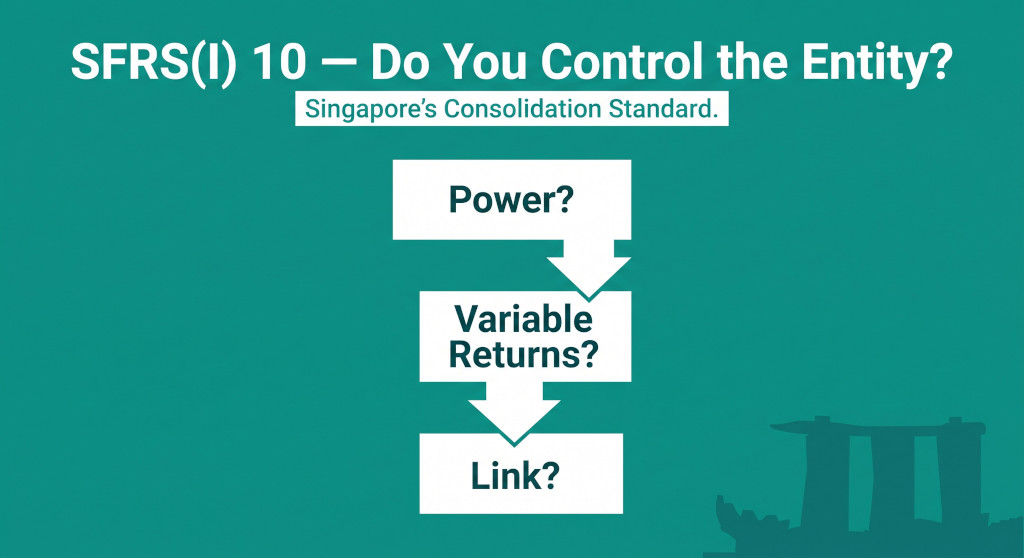
SFRS(I) 10 paragraph 7 states that an investor controls an investee when all three of the following elements are present simultaneously:
Power
The investor has existing rights that give it the current ability to direct the relevant activities of the investee
Variable Returns
The investor has exposure to, or rights to, variable returns from its involvement with the investee
The Link
The investor has the ability to use its power to affect those returns
All three must be present. Power without variable returns does not produce control — a contractual manager who directs a fund’s investments but has no entitlement to the returns is an agent, not a controller. Variable returns without power does not produce control — a passive investor who receives dividends has a return but no ability to direct the entity that generates it. The three elements must be tested together, and each must be assessed at the entity level, not the group level.
Element 1: Power
Power is the ability to direct “relevant activities” — the activities that significantly affect the investee’s returns. SFRS(I) 10 gives no fixed list of what constitutes a relevant activity; it is always entity-specific. In a manufacturing business, relevant activities are likely to include determining production volumes, pricing, distribution channels, and capital expenditure decisions. In a fund, relevant activities are investment selection and disposal decisions. In a structured finance vehicle, relevant activities may be limited to managing assets that are in default, because everything else is predetermined by the trust deed or transaction documents.
Power most commonly arises from voting rights. An investor holding more than 50% of the voting rights in an investee typically has power — subject to checking that those voting rights genuinely confer the ability to direct relevant activities (they do not, for example, if the relevant activities are directed by contract rather than shareholder vote). But power can also arise from contractual arrangements, the ability to appoint or remove key management personnel, call options on additional voting rights, or combinations of a smaller voting interest and other rights.
Potential voting rights must be considered if they are substantive — meaning the investor has the practical ability to exercise them when decisions about relevant activities need to be made. A call option that is deep in the money and exercisable immediately is likely to be substantive. A call option that is significantly out of the money, or exercisable only after a long notice period, may not be.
Element 2: Variable Returns
An investor has exposure to variable returns if its returns from involvement with the investee can vary according to the investee’s performance. Variable returns include dividends, interest, management fees, synergies available through combined operations, economies of scale, tax benefits, and access to future liquidity. Both positive returns and exposure to losses count — the definition is symmetric. An investor that guarantees the debts of an investee has a variable return in the downside direction even if it receives no upside participation.
The variability test is not a high bar. Almost any significant involvement with an investee produces some variability of return. Variable returns are rarely the determining element in control assessments; power and the link are where judgement is most often required.
Element 3: The Link — Investor or Agent?
The third element — the ability to use power to affect returns — is often where the most complex judgements arise. The key question is whether the investor is acting as a principal (directing activities in its own interests) or as an agent (acting on behalf of others). Agents exercise power, and they may have variable returns, but they do not control — because they are directing the entity on behalf of the principals whose interests the entity is designed to serve.
SFRS(I) 10 paragraphs B58–B72 set out factors that indicate agency rather than principal status:
- The scope of the decision-making authority is defined and limited by contract
- Other parties have substantive rights to remove the decision maker (removal rights held by a single independent party are usually sufficient)
- The decision maker’s remuneration is at market rates with no participation in the upside beyond its fee
- The decision maker holds only a small stake in the investee
A fund manager who earns a fixed management fee, can be removed by the majority of unit holders with reasonable notice, and holds no units in the fund is almost certainly an agent. A fund manager who earns a performance fee, has removal rights that require unanimous investor consent (effectively impossible to exercise), and holds 20% of the fund’s units is more likely to be a principal. In Singapore, this distinction is relevant to the many Singapore-domiciled fund managers that consolidate or do not consolidate the funds they manage.
De Facto Control: Where the Errors Happen
The most practically important shift from old SFRS 27 to SFRS(I) 10 is the explicit recognition of de facto control. Under old SFRS 27, holding less than 50% of voting rights generally meant an investee was an associate or a joint arrangement, not a subsidiary. SFRS(I) 10 requires a different question: even with less than 50%, does the investor have the practical ability to unilaterally direct relevant activities?
SFRS(I) 10 paragraph 40 addresses the situation where an investor holds significantly less than a majority of voting rights but those rights are sufficient to give practical ability to control. The assessment must consider the size of the investor’s holding relative to the size and dispersion of holdings of other vote holders, and any patterns from previous general meetings and other shareholder assemblies.
Worked example: de facto control at 45%
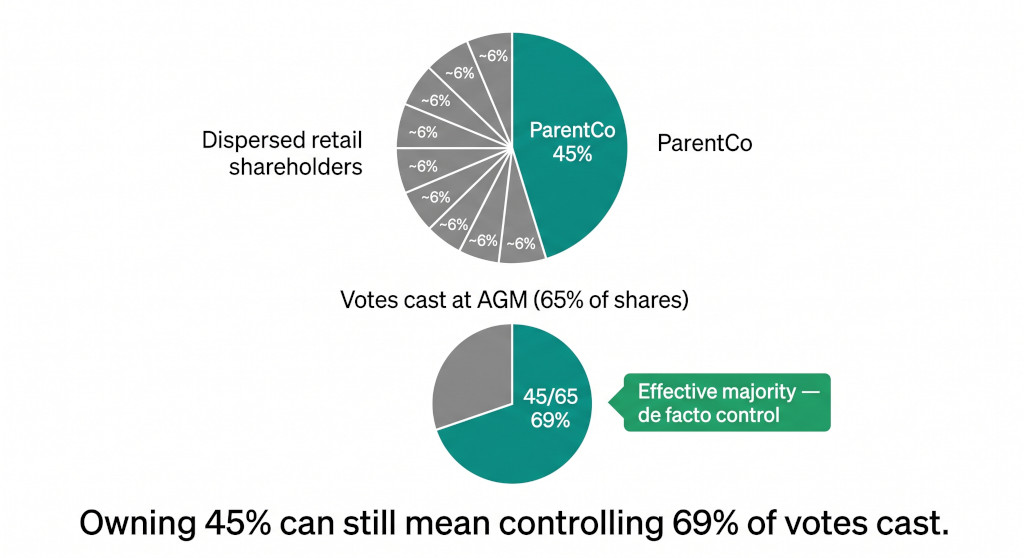
ParentCo (SGX-listed) holds 45% of the ordinary shares in PublicSubCo (also SGX-listed). The remaining 55% is held by approximately 3,800 retail and institutional investors, with no single holder above 3%. Analysis of the last four annual general meetings shows that between 63% and 68% of shares were represented (average 65%). ParentCo has voted in all four meetings. No other investor has appeared on the share register with a holding above 2%.
De facto control calculation
| ParentCo shares | 45% |
| Average shares represented at AGMs | 65% |
| ParentCo as % of votes typically cast (45 ÷ 65) | 69.2% |
ParentCo routinely commands 69% of votes cast at general meetings. No other investor has coordinated or collectively voted against ParentCo’s resolutions. On the evidence available, ParentCo has the practical ability to pass ordinary and special resolutions without the support of any other investor. This is de facto control under SFRS(I) 10. PublicSubCo must be consolidated in ParentCo’s group accounts.
The counter-analysis would be that a single institutional investor might accumulate sufficient shares to break this pattern in future periods. SFRS(I) 10 requires reassessment whenever facts and circumstances change. If a new investor acquires a significant block, the control assessment must be revisited. Control is not a one-time determination; it is an ongoing assessment made at each reporting date.
De facto control is not limited to listed companies. In private groups, it can arise where one shareholder routinely exercises the majority of votes because other shareholders never attend general meetings, or where a shareholders’ agreement effectively concentrates control in one party’s hands regardless of the formal voting percentages.
Structured Entities (SPVs): The Same Test, Greater Complexity
Under old SFRS, special purpose entities were assessed under INT FRS 12 using a risks-and-rewards model that asked essentially: who bears the risks and receives the rewards of the entity’s activities? SFRS(I) 10 abolished INT FRS 12 and replaced it with the unified three-element control test. The test is conceptually the same for structured entities as for operating subsidiaries — but applying it is harder because the relevant activities and the power to direct them are less obvious.
In a securitisation vehicle, for example, the assets and cash flows are contractually ring-fenced and managed according to a predetermined waterfall defined in the transaction documents. The “relevant activity” may be nothing more than managing defaulted assets, because everything else is automatic. The entity that holds the subordinated note or the residual interest — absorbing first losses and receiving excess returns — is most likely the one bearing the variable returns. Whether it also has power over the management of defaulted assets determines whether it controls the vehicle. This requires careful reading of the transaction documents and legal advice on the scope of each party’s authority.
Singapore groups that use SPVs for property financing, infrastructure projects, or trade receivables securitisations should specifically document their SFRS(I) 10 control assessment for each vehicle. The question “is this SPV on or off balance sheet?” is now answered by the three-element test, not by a risks-and-rewards short-cut.
Exemptions From Presenting Consolidated Financial Statements
SFRS(I) 10 paragraph 4 provides that a parent need not present consolidated financial statements if all of the following conditions are met:
- The parent is itself a subsidiary of another entity, and is either wholly owned, or its other shareholders have been informed and do not object to the parent not presenting consolidated accounts
- The parent’s debt or equity instruments are not traded in a public market (a domestic or foreign stock exchange or an over-the-counter market)
- The parent has not filed, and is not in the process of filing, its financial statements with a securities regulator for the purpose of issuing instruments to the public
- The ultimate parent, or any intermediate parent, produces consolidated accounts that comply with IFRS or SFRS(I) and that are available to the public
This exemption allows intermediate Singapore holding companies within a larger group — where the ultimate parent produces compliant consolidated accounts — to omit their own consolidation. The condition that the ultimate parent’s accounts are “available to the public” is typically satisfied if those accounts are filed with the relevant exchange or regulator. It is not satisfied merely by the accounts being internally circulated within the group.
For SGX-listed companies, the exemption is practically unavailable: the requirement that equity instruments are not traded on a public market rules out any listed entity. The exemption is most relevant to unlisted intermediate holding companies within Singapore-headquartered multinational groups.
The Investment Entity Exception
SFRS(I) 10 paragraphs 27–33 establish a special exception for investment entities. An investment entity that controls a subsidiary is not required to consolidate that subsidiary — instead, it measures the subsidiary at fair value through profit or loss. This is a departure from the general principle that control equals consolidation.
An entity is an investment entity if, and only if, it meets all three of the following criteria:
- It obtains funds from one or more investors for the purpose of providing those investors with investment management services
- It commits to its investors that its business purpose is to invest funds solely for returns from capital appreciation, investment income, or both
- It measures and evaluates the performance of substantially all of its investments on a fair value basis
Typical investment entities include private equity funds, venture capital funds, and hedge funds. The common thread is that the entity exists to generate investment returns, not to build operational businesses. It measures success by the fair value of its portfolio, not by the revenue or EBITDA of the underlying businesses.
There is one important carve-out to the investment entity exception: a subsidiary that provides investment-related services to the investment entity — for example, a fund administration subsidiary or an investment advisory subsidiary — must still be consolidated, even though the investment entity’s investment portfolio subsidiaries are not. This prevents investment entities from avoiding consolidation of operational entities simply by structuring them as subsidiaries.
A non-investment-entity parent that controls an investment entity must consolidate that investment entity in the normal way, but then measures the investment entity’s investment subsidiaries at fair value in the consolidated accounts (retaining the investment entity’s measurement basis for its portfolio). This layering — consolidate the investment entity, but carry its subsidiaries at fair value — is one of the more complex consolidation scenarios SFRS(I) 10 produces in practice.
Some Singapore holding companies operate in a way that looks like an investment entity — they hold stakes in multiple businesses, measure performance by value growth, and may not be operationally involved in the subsidiaries. These groups should formally assess whether they qualify as investment entities under SFRS(I) 10 before assuming standard consolidation applies to all subsidiaries.
The Consolidation Procedure Under SFRS(I) 10
Once control is established and no exemption applies, SFRS(I) 10 sets out the consolidation procedure. The standard itself contains relatively little procedural detail — the mechanics are supplemented by SFRS(I) 3 (Business Combinations), SFRS(I) 1-27 (Separate Financial Statements), and SFRS(I) 1-21 (The Effects of Changes in Foreign Exchange Rates) — but the core steps are clear.
Step 1: Ensure uniform accounting policies
All entities included in the consolidation must apply the same accounting policies. If a subsidiary uses a different measurement basis for, say, investment property (cost rather than fair value) or applies different lease policies, the subsidiary’s accounts must be adjusted before combining them with the rest of the group. This adjustment is a consolidation adjustment — it does not change the subsidiary’s own accounts. For Singapore groups with overseas subsidiaries that apply SFRS, US GAAP, or UK GAAP, the adjustment requirement can be substantial. See the guides on consolidating an IFRS subsidiary into an SFRS parent and consolidating a US GAAP subsidiary into an SFRS parent for worked examples of policy alignment adjustments.
Step 2: Ensure uniform reporting dates
SFRS(I) 10 paragraph B92 requires that the financial statements of the parent and all subsidiaries used in preparing the consolidated accounts are drawn up to the same date. If a subsidiary’s year-end differs from the parent’s, the subsidiary must prepare additional financial information as at the parent’s reporting date — or the subsidiary’s most recent financial statements are used with adjustments for significant transactions or events that occurred between the subsidiary’s year-end and the parent’s. The gap between the subsidiary’s year-end and the parent’s may not exceed three months.
Step 3: Combine and eliminate
The mechanics of consolidation under SFRS(I) 10 involve combining assets, liabilities, equity, income, and expenses of all group entities line by line, then eliminating:
- The parent’s investment in each subsidiary against the parent’s share of the subsidiary’s equity at the acquisition date (which gives rise to goodwill or a bargain purchase gain under SFRS(I) 3)
- Intragroup balances (intercompany receivables/payables, intercompany loans)
- Intragroup transactions and their related income and expenses (intercompany sales, management fees, interest)
- Unrealised profits on intragroup transactions (inventory, fixed assets) still held within the group at the reporting date
For a complete step-by-step walkthrough from individual entity trial balances to consolidated financial statements, see a complete consolidation worked example. For the intercompany elimination mechanics specifically, see the complete guide to intercompany eliminations.
Step 4: Recognise goodwill and non-controlling interest
Where the group acquires a subsidiary in a business combination, goodwill is recognised under SFRS(I) 3 as the excess of consideration transferred (plus any NCI at acquisition plus fair value of any previously held interest) over the fair value of identifiable net assets acquired. For step-by-step coverage of the acquisition accounting, see acquisition accounting in group consolidation: a step-by-step guide.
Non-controlling interest — the equity attributable to minority shareholders — must be presented separately within consolidated equity and allocated its share of the subsidiary’s profit or loss and OCI. SFRS(I) 3 allows two methods for measuring NCI at acquisition: fair value (Method A, which produces full goodwill) or proportionate share of the acquiree’s identifiable net assets (Method B, which produces partial goodwill). The choice is made transaction by transaction, not as a group-wide policy. For the detailed mechanics, see how to calculate non-controlling interest in financial consolidation.
Step 5: Translate foreign operations
Where a subsidiary has a different functional currency from the group’s presentation currency, SFRS(I) 1-21 requires translation using the closing rate for assets and liabilities, transaction-date rates (or average rates as an approximation) for income and expenses, and accumulation of the resulting differences in a cumulative translation adjustment (CTA) in other comprehensive income. For Singapore groups with foreign subsidiaries — which is the majority of mid-sized and large Singapore groups — the CTA is a material item that requires careful management at consolidation. See how to calculate the CTA in group consolidation for the mechanics.
Building your Singapore group consolidation?
BrizoConsol connects to your accounting systems, handles SFRS(I) 10 control-based consolidation, intercompany eliminations, multi-currency translation, and NCI — and closes in hours instead of weeks. See what it looks like for your group. See It in Action
What SFRS(I) 10 Requires at Each Reporting Date
SFRS(I) 10 paragraph 8 requires investors to reassess whether they control an investee when facts and circumstances indicate a change. The following events typically trigger reassessment:
- A change in the investor’s ownership percentage (acquisition of additional shares, disposal, dilution from new share issuance)
- A change in the investee’s ownership structure (a new significant shareholder enters)
- A change in the rights attached to shares or contractual rights
- A change in voting patterns at general meetings (other shareholders begin coordinating)
- A change in the investee’s purpose (restructuring that changes what the relevant activities are)
- A change in the investor’s involvement with the investee (for example, taking on operational management that constitutes direction of relevant activities)
Reassessment is not the same as annual recalculation. If nothing has changed, the prior-period conclusion carries forward. But if any of the above events occur, the assessment must be formally re-performed and the conclusion documented. For large Singapore groups with investment portfolios of minority stakes, building a systematic trigger-based review into the annual reporting cycle is essential — particularly for stakes between 30% and 55% where the de facto control question is live.
Common Pitfalls for Singapore Groups Under SFRS(I) 10
Based on common patterns in SFRS(I) 10 application, Singapore groups most frequently encounter difficulties in the following areas.
Treating 50% as the bright line. SFRS(I) 10 contains no 50% threshold. A 45% stake can be controlling (de facto control). A 60% stake may not be controlling if the investor has no meaningful ability to direct relevant activities (for example, because key decisions require supermajority votes that the 60% holder cannot achieve alone). The percentage of voting rights is evidence for the control assessment; it is not the answer to it.
Not reassessing when share registers change. In Singapore’s active capital markets, significant shareholding changes can happen quickly. A 45% stake that produced de facto control last year may not produce it this year if a new fund has accumulated 15%. Trigger-based reassessment protocols are essential.
Consolidating investment entity subsidiaries when the exception applies. Some Singapore holding companies that manage portfolios consolidate their investee companies out of habit, when SFRS(I) 10’s investment entity exception would permit (and arguably require) fair-value measurement instead. The investment entity classification carries its own assessments — particularly for the “fair value basis” measurement criterion — but groups that qualify should apply it, as consolidation of complex investment structures often produces accounts that are less informative than fair value presentation.
Missing the uniform accounting policies adjustment. For Singapore groups with subsidiaries applying SFRS (not SFRS(I)), the policy differences can be significant — particularly around leases (SFRS does not require IFRS 16-style on-balance-sheet lease recognition) and financial instruments. Groups that combine SFRS and SFRS(I) entities without policy alignment adjustments are producing a hybrid that is neither SFRS nor SFRS(I) compliant. See SFRS vs IFRS: key differences for Singapore groups for a breakdown of the major policy divergences.
Treating year-end gaps of more than three months as acceptable. SFRS(I) 10 is clear: if the gap between a subsidiary’s year-end and the parent’s exceeds three months, the subsidiary must draw up financial statements to the parent’s date. Using a subsidiary’s 31 December accounts in a 31 August group consolidation — an eight-month gap — is not compliant. In practice this requires subsidiary management to produce off-cycle accounts at the parent’s date, which is a significant operational burden that some groups resolve by aligning subsidiary year-ends.
Inadequate documentation of the control conclusion. SFRS(I) 10’s judgment-based model requires contemporaneous documentation of the control assessment, particularly for de facto control conclusions and structured entity conclusions. ACRA and auditors expect to see the assessment papers, not just the conclusion. “We own 45% and we control it” is not sufficient documentation.
SFRS(I) 10 and Non-Wholly Owned Groups
For Singapore groups where the parent owns less than 100% of a subsidiary, the consolidation presents additional complexity beyond the control assessment itself. When ownership is between 51% and 99%, the minority shareholders hold a non-controlling interest in the subsidiary. How that NCI is measured at the acquisition date, how it moves through the life of the investment, and how it interacts with intercompany eliminations between the parent and a partly-owned subsidiary — particularly upstream sales from subsidiary to parent, where only the NCI-adjusted portion of the unrealised profit is eliminated — requires careful attention. For a full treatment of consolidation with NCI, see how to consolidate a subsidiary when ownership is less than 100%. For the downstream/upstream NCI elimination mechanics, see intercompany eliminations when there is a non-controlling interest.
Entities Below the Control Threshold: Associates and Joint Arrangements
Where the investor’s assessment concludes that it does not control an investee, the investee is not consolidated. It may instead be accounted for as an associate under SFRS(I) 1-28 (equity method), as a joint venture under SFRS(I) 11 (equity method), as a joint operation (proportionate recognition of assets, liabilities, revenues, and expenses), or as a financial instrument at fair value if none of the above apply.
The boundary between an associate (significant influence, equity method) and a subsidiary (control, full consolidation) is one of the most consequential accounting judgements a group makes — it determines whether an investee’s assets and liabilities appear on the consolidated balance sheet at all. For groups in Singapore’s active investment and private equity environment, where stakes between 20% and 50% are common, the distinction matters enormously for reported leverage ratios, working capital, and consolidated revenue. The equity method and its mechanics are covered in equity method accounting in group consolidation.
Group consolidation for Singapore-based groups
From SFRS(I) 10 control-based consolidation to intercompany eliminations, NCI accounting, CTA, and multi-currency — BrizoConsol handles the full consolidation workflow. Start with a free trial and see your group accounts come together in hours, not weeks. Start Free Trial