How to Prepare Consolidated Financial Statements for a Group With Multiple Currencies
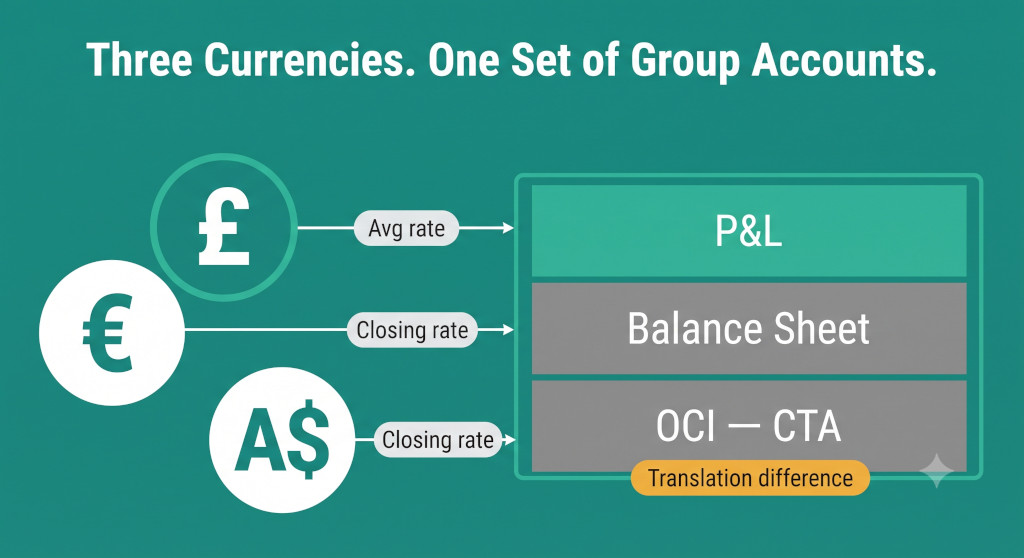
Yusuf had read the rules. P&L at the average rate. Balance sheet at the closing rate. The difference goes to other comprehensive income as the cumulative translation adjustment. He understood the principle. What he couldn’t do was make the consolidated balance sheet balance.
Every time he translated his German subsidiary’s accounts into sterling and added them to the UK parent, the equity side of the group balance sheet came out short by a number that changed every period and seemed to bear no obvious relationship to anything. The CTA, he was told, should explain the difference. But his CTA calculation didn’t produce the right number either — or more precisely, it produced a number and he wasn’t sure whether it was right because he didn’t know what “right” should look like.
This is the standard first encounter with multi-currency consolidation. The rate rules are simple; the application is not. The gap between knowing that assets translate at the closing rate and knowing why a rate change on opening net assets from prior periods creates a translation difference in the current year — that gap is where most of the confusion lives. This post closes it, step by step, with a full three-currency worked example showing all three financial statements.
Automate NCI calculations across all your entities.
BrizoConsol handles non-controlling interest automatically — no manual adjustments required.
The Translation Framework: Three Rates, Three Places
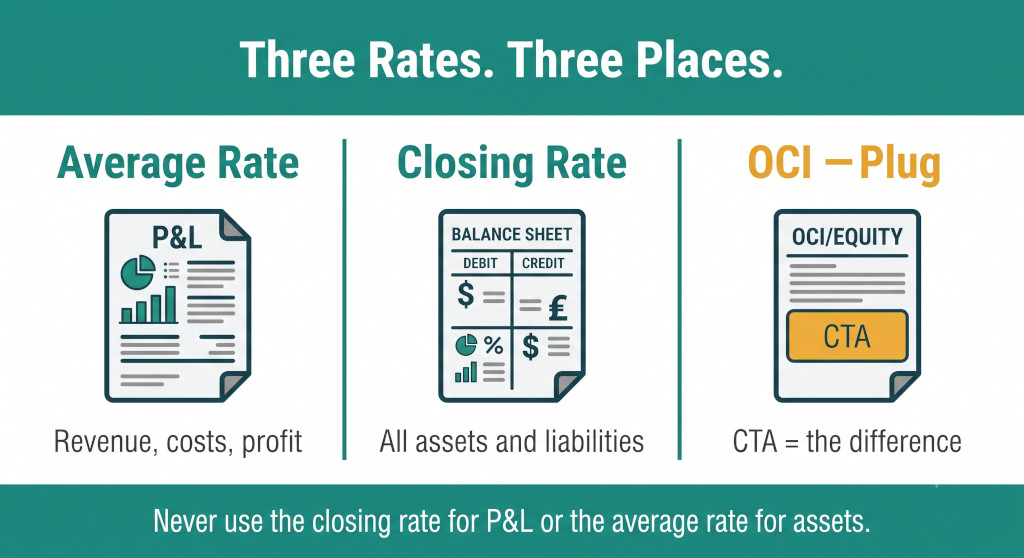
The starting rule is simple and non-negotiable under IAS 21 (and its equivalents under ASC 830 and FRS 102): every foreign subsidiary’s financial statements are translated into the group’s presentation currency using specific rates for specific items. There are three rates in use at any time:
The average rate for the period (typically the twelve-month average of daily or monthly mid-market rates) is used to translate all P&L items — revenue, cost of sales, operating expenses, finance costs, and the tax charge. Using the average rate for P&L items approximates the rate at which each transaction occurred during the year, which is the theoretically correct rate under IAS 21.
The closing rate (the spot rate on the last day of the reporting period) is used to translate all balance sheet items — every asset and every liability — at their period-end value. Share capital and retained earnings from prior periods are translated at the rates that applied when those items arose (historical rates), but in practice most groups use the closing rate for all equity components for simplicity, adjusting through the CTA.
The CTA itself is not a rate — it is a residual. It is the difference between the balance sheet translated at the closing rate and the equity position implied by the P&L translation plus opening equity. It goes into other comprehensive income (OCI), not into profit or loss. It is not an error; it is an arithmetically necessary consequence of using different rates for different items.
The reason different rates must be used for different items is that they represent different things. A balance sheet asset represents a stock of value at a point in time — its value in the presentation currency depends on the rate at that point in time, which is the closing rate. A P&L item represents a flow of transactions throughout the year — its average value in the presentation currency depends on rates throughout the year, which is approximated by the average rate. Applying the same rate to both would misstate one or the other.
Step 1: Translate Each Foreign Subsidiary’s P&L at the Average Rate
The first step is mechanical. Take the subsidiary’s income statement in its functional currency and multiply every line by the period average exchange rate to convert it into the presentation currency. Revenue, gross profit, EBITDA, EBIT, finance costs, and the tax charge all translate at the same rate. The resulting translated profit figure — profit after tax in the presentation currency — is what flows into the consolidated income statement and from there into consolidated retained earnings.
One complication: the average rate should be the rate for the twelve-month period that corresponds to the subsidiary’s income statement. For a group where all entities have the same year-end this is straightforward. For a group using the three-month rule for a non-coterminous subsidiary, the P&L translates at the average rate for the subsidiary’s own year, which may differ from the group’s year. In that case an additional step is needed to convert the subsidiary’s average-rate translation into an approximation of the group period — typically a judgment call that is discussed with auditors.
For significant individual transactions — large asset disposals, acquisitions of subsidiaries, major financing events — IAS 21 requires translation at the exchange rate on the date of the transaction rather than the period average. In practice this is usually only material for transactions that are both large in size and occur when the average rate differs significantly from the transaction-date rate. Most groups apply the average rate as a practical expedient for all P&L items and disclose this policy.
Step 2: Translate Each Foreign Subsidiary’s Balance Sheet at the Closing Rate
The second step translates the subsidiary’s period-end balance sheet. Every asset — property, inventories, receivables, cash — and every liability — borrowings, payables, provisions — translates at the rate on the last day of the reporting period. The result is the subsidiary’s balance sheet expressed in the presentation currency.
The equity section of the translated balance sheet requires separate treatment. Share capital translates at the historical rate (the rate when the capital was originally subscribed). The retained earnings figure is not independently translated — it is derived as the accumulated total of each prior year’s translated P&L, carried forward. In practice, most groups work with the closing rate for all equity components and use the CTA as the balancing mechanism that absorbs the resulting rate differences. This is technically an approximation but is universally accepted in practice.
Common mistake: Translating the subsidiary’s closing retained earnings at the closing rate. Retained earnings represent accumulated profits from multiple prior periods, each translated at that period’s average rate. Translating the cumulative balance at the current closing rate misstates the retained earnings and displaces the error into the CTA — making the CTA wrong rather than obviously wrong. Retained earnings in GBP is a calculated figure, not a translated one: it equals the prior year’s GBP retained earnings plus the current year’s GBP profit (translated at average rate) less any GBP dividends paid.
Step 3: Calculate the CTA and Understand Why It Exists
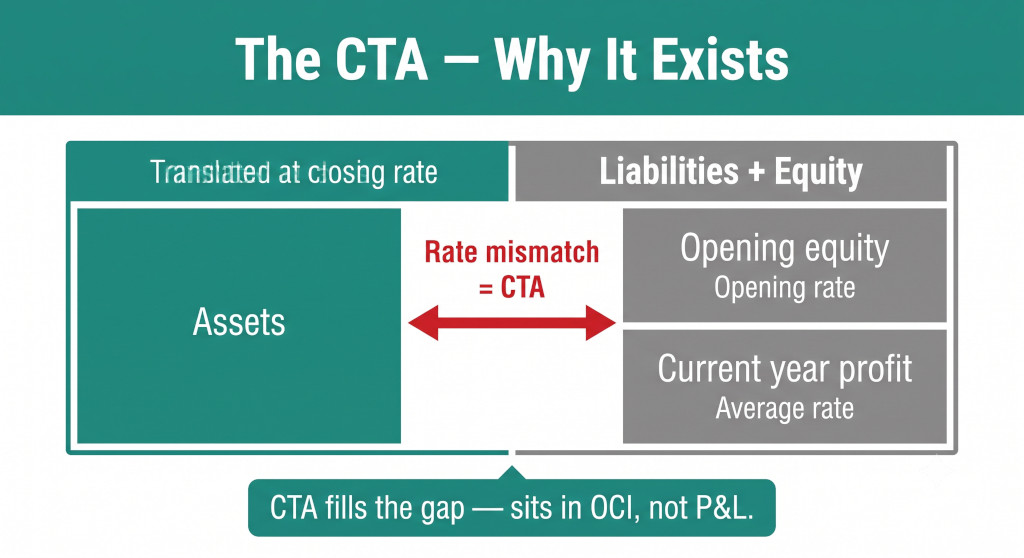
The CTA arises because the same pool of net assets has been valued using different exchange rates at different points. A subsidiary’s opening net assets were translated at last year’s closing rate. The current year’s profit has been translated at this year’s average rate. The closing net assets are translated at this year’s closing rate. These three rates are never the same, so the opening-plus-profit calculation never equals the closing balance when expressed in the presentation currency — unless the exchange rate was perfectly constant throughout the year.
The CTA is calculated as the balancing item that makes the translated balance sheet balance:
CTA for the current year: Closing net assets (functional currency) × closing rate = £A Opening net assets (functional currency) × prior closing rate = £B Current year profit (functional currency) × average rate = £C Dividends paid (functional currency) × rate at payment date = £D ──────────────────────────────────────────────────────────────── CTA = £A − (£B + £C − £D)
A positive CTA means the foreign currency strengthened against the presentation currency during the year (the subsidiary’s assets are worth more in GBP than the P&L translation implied). A negative CTA means it weakened. Neither is a profit or loss — it is a unrealised translation difference that sits in OCI until the subsidiary is disposed of, at which point it is recycled to the income statement. For the precise calculation mechanics and a worked derivation of the CTA balance, see How to Calculate the Cumulative Translation Adjustment in Group Consolidation.
Step 4: Aggregate and Eliminate
Once every foreign subsidiary’s accounts have been translated into the presentation currency, the consolidation proceeds in exactly the same way as a single-currency group: add together the parent and all translated subsidiaries, then eliminate intercompany transactions and balances.
The one multi-currency complication in this step is that intercompany balances may show translation differences even when both entities agree on the underlying amount. If the parent has a sterling receivable from the German subsidiary, and the German subsidiary has a euro payable to the parent, the two balances are denominated in different currencies and translate to different sterling amounts at the closing rate — even if the underlying commercial amount is identical and both parties agree on it. This mismatch is an intercompany translation difference: it is not an error in either entity’s books, but it prevents the standard elimination from working cleanly.
The correct treatment is to eliminate the intercompany balances using the same closing rate for both sides, and to recognise any resulting difference as a foreign exchange gain or loss in the parent’s income statement (if the intercompany loan is a monetary item not forming part of the net investment in the subsidiary). If the intercompany balance is treated as part of the net investment in the subsidiary — which requires a specific policy election and meeting the conditions in IAS 21 — the exchange difference goes to OCI and is included in the CTA rather than the P&L. For a detailed discussion of why intercompany balances fail to agree in a multi-currency context, see Why Your Intercompany Balances Never Match Even When Both Companies Agree.
Step 5: The Cash Flow Statement — Effect of Exchange Rates on Cash
As discussed in our guide to intercompany eliminations, the consolidated cash flow statement under the indirect method includes a specific line for the effect of exchange rates on cash and cash equivalents. In a multi-currency group this line is not optional — it is a required reconciling item without which the cash flow statement cannot balance.
The FX effect on cash is the difference between: (a) the opening cash balances of all foreign subsidiaries translated at the prior year closing rate; and (b) those same opening balances retranslated at the current year closing rate. If sterling strengthened during the year, the foreign subsidiaries’ opening cash holdings are worth less in sterling at year-end than they were at the start — a negative FX effect on cash. This is not a cash outflow; it is a translation difference that explains why the consolidated cash and cash equivalents change between periods even when no actual cash moved in or out of the group.
Worked Example: Three-Currency Group — Complete Statements
The following example shows the full multi-currency consolidation for a group with a UK parent (GBP presentation currency), a German subsidiary (EUR functional), and an Australian subsidiary (AUD functional). All figures are in thousands of pounds unless otherwise stated.
Exchange rates used:
EUR/GBP AUD/GBP Opening rate (prior year close) 0.870 0.535 Average rate (current year) 0.856 0.528 Closing rate (current year) 0.841 0.521
Both EUR and AUD weakened against GBP during the year (closing rates are lower than opening rates), so both subsidiaries will generate negative CTAs — translation losses in OCI.
Consolidated Income Statement
| Line Item | UK Parent £’000 | Germany €’000 | Rate | Germany £’000 | Australia A$’000 | Rate | Australia £’000 | Group £’000 |
|---|---|---|---|---|---|---|---|---|
| Revenue | 3,200 | 1,200 | 0.856 | 1,027 | 600 | 0.528 | 317 | 4,544 |
| Cost of sales | (1,800) | (620) | 0.856 | (531) | (340) | 0.528 | (180) | (2,511) |
| Gross profit | 1,400 | 580 | 496 | 260 | 137 | 2,033 | ||
| Operating expenses | (480) | (196) | 0.856 | (168) | (108) | 0.528 | (57) | (705) |
| Finance costs | (60) | (24) | 0.856 | (21) | (12) | 0.528 | (6) | (87) |
| Profit before tax | 860 | 360 | 307 | 140 | 74 | 1,241 | ||
| Income tax | (215) | (90) | 0.856 | (77) | (35) | 0.528 | (18) | (310) |
| Profit for the year | 645 | 270 | 230 | 105 | 56 | 931 | ||
| Other comprehensive income: | ||||||||
| CTA — German subsidiary | (58) | |||||||
| CTA — Australian subsidiary | (12) | |||||||
| Total comprehensive income | 861 |
CTA Calculations — Proving the Numbers
The two CTA figures (£58k loss for Germany, £12k loss for Australia) are calculated as follows:
German subsidiary CTA: Opening net assets: €1,800k × 0.870 (prior closing) = £1,566k Current year profit: €270k × 0.856 (average) = £ 231k Expected closing: = £1,797k Actual closing net assets: €2,070k × 0.841 (closing) = £1,741k (€1,800k opening + €270k profit = €2,070k closing) ──────────────────────────────────────────────── CTA = £1,741k − £1,797k = −£56k ≈ −£58k (rounding)
Australian subsidiary CTA: Opening net assets: A$800k × 0.535 (prior closing) = £428k Current year profit: A$105k × 0.528 (average) = £ 55k Expected closing: = £483k Actual closing net assets: A$905k × 0.521 (closing) = £471k (A$800k opening + A$105k profit = A$905k closing) ──────────────────────────────────────────────── CTA = £471k − £483k = −£12k
Both CTAs are negative because EUR and AUD both weakened against GBP during the year (closing rates lower than opening rates). The subsidiaries’ net assets are worth less in sterling at year-end than the combination of their opening translated value and their translated annual profit implied. This translation loss sits in OCI and will accumulate in the foreign currency translation reserve within equity until the subsidiaries are disposed of, at which point it will be recycled to the income statement. For the recycling mechanics, see Recycling the CTA on Disposal of a Foreign Subsidiary.
Consolidated Balance Sheet (Simplified)
| Item | UK Parent £’000 | Germany £’000 (at closing rate) | Australia £’000 (at closing rate) | Group £’000 |
|---|---|---|---|---|
| Non-current assets | 4,800 | 1,260 | 380 | 6,440 |
| Current assets | 1,420 | 481 | 91 | 1,992 |
| Total assets | 6,220 | 1,741 | 471 | 8,432 |
| Total liabilities | (1,840) | (?) | (?) | (2,220) |
| Net assets | 4,380 | 1,741 net | 471 net | 6,212 |
| Equity: | ||||
| Share capital and reserves | 4,380 | |||
| Retained earnings (incl. 100% of subsidiaries’ profits) | 1,902 | |||
| Foreign currency translation reserve (CTA) | (70) | |||
| Total equity | 6,212 | |||
The foreign currency translation reserve of £(70k) is the sum of the two CTAs for the current year (£(58k) + £(12k) = £(70k)), assuming this is the group’s first year of multi-currency consolidation. In subsequent years the CTA reserve accumulates: the prior year balance plus the current year movement. The reserve is a negative balance here because both foreign currencies weakened against sterling during the year.
Multi-currency consolidation without the rate-matching headache
BrizoConsol applies average and closing rates automatically for each entity, calculates the CTA, and positions it correctly in OCI — so you get the right numbers in the right place, every close.See It In Action
Groups With Partially-Owned Foreign Subsidiaries
When a foreign subsidiary has a non-controlling interest, the CTA must be split between the portion attributable to the parent’s shareholders and the portion attributable to the NCI. This follows directly from the same logic that splits the subsidiary’s profit: the NCI owns a percentage of the subsidiary, so it owns the same percentage of every item that moves in the subsidiary’s equity — including the CTA.
If the German subsidiary in the example above were 75% owned (25% NCI), the £(58k) CTA would be split: £(43.5k) to the parent’s foreign currency translation reserve and £(14.5k) to the NCI balance in equity. The NCI balance in the consolidated balance sheet would therefore move not only for the NCI’s share of profit and dividends but also for the NCI’s share of the CTA each period. For the full mechanics of the NCI/CTA split, including how it flows through the consolidated statement of changes in equity, see NCI and Currency Translation Adjustments.
Common Errors in Multi-Currency Consolidation
Beyond the retained-earnings translation error already flagged, four further mistakes appear consistently in first-time multi-currency consolidations.
Using the closing rate for P&L items. This is the most common error and produces a consolidated income statement that is internally consistent but wrong relative to what actually happened during the year. If sterling strengthened sharply in the final month of the year, using the closing rate for P&L will understate the foreign subsidiary’s translated revenue and profit compared to the average rate. The CTA will be incorrect as a result, and the two sides of the comprehensive income statement will not add up correctly.
Recalculating the CTA instead of rolling it forward. The CTA is a cumulative balance, not a current-year-only figure. The current year’s CTA movement is added to the prior year’s closing CTA reserve balance. Groups that recalculate the CTA each year from scratch, without adding it to the prior year balance, will show the right current-year movement but the wrong cumulative reserve — leading to an equity reconciliation that is wrong by the entire prior year CTA balance.
Translating intercompany eliminations at the wrong rate. When eliminating an intercompany balance that spans two currencies (sterling receivable in the parent, euro payable in the subsidiary), the elimination must be performed at the closing rate applied consistently to both sides. If the two sides are eliminated at different rates — for example, using the rate implicit in the original transaction for one side and the closing rate for the other — the elimination entry will leave a residual balance that appears as an unexplained intercompany difference. For a comprehensive approach to intercompany differences in a multi-currency context, see Currency Translation Under IAS 21, ASC 830 and FRS 102.
Omitting the effect of exchange rates on cash from the cash flow statement. As described in Step 5, a multi-currency group’s consolidated cash flow statement must include the FX effect on cash as a separate line. Omitting it produces a statement that does not reconcile to the balance sheet cash movement — usually by the same magnitude as the opening cash balances of the foreign subsidiaries retranslated at the rate movement for the year. The statement may appear to balance internally, but the closing cash figure will not agree to the consolidated balance sheet.
Practical Checklist: Multi-Currency Consolidated Financial Statements
- Establish exchange rates for the period before the close begins. Average rate, opening rate (prior year closing rate), and current year closing rate for every functional currency in the group. Document the source of each rate.
- Translate each foreign subsidiary’s P&L at the average rate. Every income and expense line — no exceptions. Significant individual transactions at their transaction-date rate where material.
- Translate each foreign subsidiary’s balance sheet at the closing rate. All assets and liabilities at the closing rate. Do not independently translate closing retained earnings — derive it as opening retained earnings (in GBP) plus current year profit (translated at average rate).
- Calculate the CTA for each foreign subsidiary. Closing net assets at closing rate, less (opening net assets at prior closing rate + current year profit at average rate − dividends at payment rate). Post the resulting CTA to OCI, not to P&L.
- Roll the CTA forward. The current year CTA movement is added to the prior year’s closing CTA reserve balance. The consolidated balance sheet should show the cumulative CTA reserve, not just the current year movement.
- Eliminate intercompany balances using the closing rate for both sides. Accept any resulting intercompany translation difference as a foreign exchange gain or loss in the P&L (unless the balance qualifies as part of the net investment in the subsidiary, in which case it goes to OCI).
- Include the FX effect on cash in the cash flow statement. Calculate as the opening cash balances of all foreign subsidiaries translated at the current closing rate minus the same balances translated at the prior closing rate. This line makes the cash flow statement balance to the consolidated balance sheet.
- Split the CTA between parent equity and NCI for partially-owned foreign subsidiaries. The NCI’s percentage share of the subsidiary’s CTA reduces the parent’s translation reserve and increases (or decreases) the NCI balance in equity.
- Verify the balance sheet balances. The equity section (share capital + retained earnings + CTA reserve) must equal net assets. If it doesn’t, the error is almost always either a retained earnings translation error or a missing CTA roll-forward.
- Disclose the exchange rates and the CTA movement in the notes. IAS 21 requires disclosure of the exchange rates used, the CTA movement for the period, and the policy for determining whether intercompany balances form part of the net investment. These disclosures are routinely reviewed by auditors and should be drafted alongside the statements, not added at the last minute.
The multi-currency consolidation is the point at which many groups’ spreadsheet-based processes encounter their hardest structural test. The rate logic is consistent and derivable — but it requires maintaining separate rate records for each subsidiary, tracking the CTA roll-forward across years, and handling the intercompany translation difference as a distinct item from the standard elimination. For a comparison of how different accounting standards (IAS 21, ASC 830, FRS 102) handle these requirements and where they diverge, see Currency Translation Under IAS 21, ASC 830 and FRS 102: What Changes Across Standards. For the precise CTA calculation methodology in detail, including the treatment of dividends and the net investment election, see How to Calculate the Cumulative Translation Adjustment.
Let BrizoConsol handle the rate maths
Connect your foreign subsidiaries, set your exchange rates once per period, and BrizoConsol produces translated and consolidated P&L, balance sheet, and cash flow — with the CTA calculated and positioned correctly in OCI. Start free today. Start Free Trial