FRS 102 vs AASB: How Investment Property and Goodwill Rules Force Different Consolidation Adjustments When an Australian Subsidiary Reports to a UK Parent

When a UK parent company consolidates an Australian subsidiary, the process involves far more than translating AUD figures into GBP. The two accounting frameworks — FRS 102 (the UK’s Financial Reporting Standard applicable in the UK and Republic of Ireland) and the Australian Accounting Standards Board (AASB) standards, which are largely IFRS-aligned — treat certain assets and transactions in fundamentally different ways. Two areas where this divergence causes real consolidation headaches are investment property measurement and goodwill amortisation. Getting these wrong creates material errors in group accounts, failed audit sign-offs, and last-minute close delays.
This article walks through the specific adjustments a UK parent’s consolidation team must make, why they arise, and how to structure the journal entries and elimination workings so that the group financial statements comply with FRS 102 — even when the Australian subsidiary has prepared its local accounts under AASB 140 and AASB 3.
Understanding the Core Framework Differences
FRS 102 is a single, self-contained standard used by most UK entities that are not required to apply full IFRS (i.e., non-listed UK groups below the IFRS-mandatory threshold). AASB standards are effectively adopted IFRS, meaning Australian entities largely follow IAS 40 for investment property and IFRS 3 for business combinations. On the surface, UK FRS 102 and Australian AASB appear similar, but two structural differences create significant consolidation adjustments.
Full or partial goodwill — set per acquisition.
Measure NCI at fair value or at its proportionate share; BrizoConsol calculates goodwill and retranslates it each month.
| Topic | FRS 102 (UK Parent) | AASB / IFRS (Australian Sub) |
|---|---|---|
| Investment Property | Fair value model mandatory through P&L; cost model not permitted for third-party property | Accounting policy choice: fair value model (P&L) or cost model under AASB 140 |
| Goodwill | Capitalised and amortised over useful life (max 10 years if not reliably estimated) | Not amortised; subject to annual impairment testing under AASB 136 |
| Goodwill impairment | Systematic charge via amortisation reduces carrying value; test only on indicators | Impairment-only approach; carrying value stays at cost unless impaired annually |
| NCI measurement | Proportionate share of identifiable net assets only (partial goodwill mandated) | Policy choice: full goodwill (fair value) or proportionate share under AASB 3 / IFRS 3 |
| FX on consolidation | Closing rate for balance sheet; average rate for P&L; differences to OCI | Same mechanism under IAS 21 / AASB 121 |
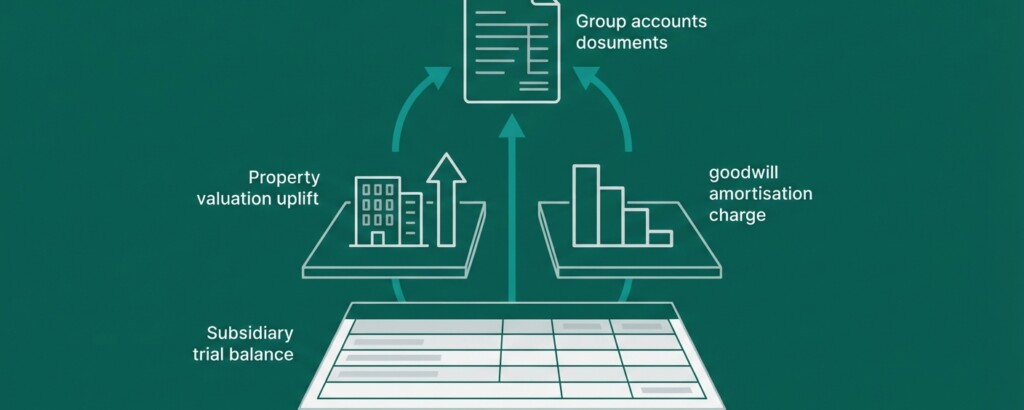
At first glance, both frameworks accommodate fair value through P&L for investment property, but AASB 140 also permits a cost model option that FRS 102 Section 16 prohibits for third-party properties. Meanwhile, goodwill accounting represents a permanent structural divergence. When the UK parent acquired the Australian subsidiary, goodwill was recognised solely in the group accounts. Under FRS 102, that goodwill must be amortised systematically over its useful economic life in the group accounts, whereas under AASB standards it would remain unamortised and subject only to impairment testing. This means the consolidation team must book a recurring amortisation charge that exists nowhere in the subsidiary’s local trial balance.
Investment Property: When the Subsidiary Uses a Different Valuation Basis
Suppose the Australian subsidiary owns a commercial property in Melbourne carried at fair value under AASB 140. The property was valued at AUD 4,200,000 at the previous year end and has been revalued upward to AUD 4,500,000 at the current reporting date. The gain of AUD 300,000 runs through the Australian subsidiary’s profit and loss account — which is consistent with how FRS 102 Section 16 also handles investment property under the mandatory fair value model.
So long as the Australian subsidiary elects the fair value model under AASB 140, no adjustment is needed in respect of measurement policy — both frameworks align on fair value through profit or loss. The consolidation challenge here is FX translation: the asset balance is translated at the closing rate, while the revaluation gain is translated at the average rate for the period (or the transaction-date spot rate), producing an exchange difference recognised in Other Comprehensive Income.
Where investment property creates an accounting policy consolidation adjustment is when the Australian subsidiary elects the cost model under AASB 140 in its local accounts. Because FRS 102 Section 16 mandates the fair value model for third-party investment property, the UK parent cannot adopt the cost model in its consolidated accounts. The group must post a consolidation adjustment uplifting the property from depreciated cost to fair value and recognising the fair value movement in group P&L.
| Investment property — fair value required under FRS 102 Section 16 | AUD 4,500,000 |
| Less: cost-model carrying value in Australian subsidiary accounts | AUD 3,600,000 |
| Cumulative fair value uplift required on group consolidation | AUD 900,000 |
| Translated at closing GBP/AUD rate of 0.5200 | GBP 468,000 |
| Current period fair value uplift recognised in group P&L (translated at average rate) | GBP 153,000 |
This GBP 153,000 fair value gain increases the group’s consolidated profit for the period to reflect the mandatory FRS 102 valuation basis. It lives entirely in the consolidation workings — the Australian subsidiary’s trial balance, quite correctly under its local AASB election, carries the property at depreciated cost. This is precisely the type of adjustment that gets lost in manual Excel consolidations, particularly when the FX rate used to translate the gain differs from the rate applied to the asset balance, creating a secondary currency translation difference that must be routed to Other Comprehensive Income.
Goodwill Amortisation: The Recurring Adjustment That Never Appears in the Subsidiary’s Books
This is the more structurally persistent problem. When the UK parent acquired the Australian subsidiary three years ago, goodwill of AUD 1,800,000 arose on consolidation. Under FRS 102 Section 19, goodwill must be amortised over its useful economic life. The group has assessed this at 10 years, giving an annual amortisation charge. The Australian subsidiary’s own accounts carry no goodwill at all — goodwill only exists at the group consolidation level.
Every month (or at minimum, every year-end), the consolidation team must post a charge in the group workings. Because the goodwill was initially measured in AUD at acquisition, the question of which FX rate to use for ongoing amortisation is also non-trivial. Under FRS 102 Section 30 and the supporting guidance aligned with IAS 21, goodwill is treated as an asset of the foreign operation and translated at the closing rate, with the amortisation charge translated at the average rate for the period.
| Account | Dr | Cr |
|---|---|---|
| Goodwill amortisation — group P&L (AUD 180,000 × 0.5150 avg rate) | 92,700 | |
| Foreign currency translation reserve — OCI (balancing FX difference) | 900 | |
| Accumulated amortisation on goodwill — group balance sheet (AUD 180,000 × 0.5200 closing rate) | 93,600 |
Annual goodwill amortisation in consolidation workings for AUD-denominated goodwill translated to GBP. The difference between the average rate (P&L expense of GBP 92,700) and the closing rate (balance sheet movement of GBP 93,600) creates a balancing GBP 900 debit translation difference routed to OCI.
After three years, the accumulated amortisation balance in the group workings has grown. Each year, the closing rate changes, producing a different translation difference. These translation differences accumulate in equity within the Foreign Currency Translation Reserve. Notably, under FRS 102 Section 30, cumulative translation reserves are not reclassified (recycled) to profit or loss on disposal of the subsidiary — a significant distinction from full IFRS and IAS 21.
A common error is to translate goodwill amortisation at the closing rate rather than the average rate, and to ignore the resulting FX difference. This overstates or understates the P&L charge and misclassifies the translation effect. Auditors reviewing group accounts prepared under FRS 102 will scrutinise the goodwill amortisation note and the movement in the translation reserve closely. Ensure the opening goodwill balance in each comparative period is retranslated at the comparative closing rate, and that the roll-forward reconciles.
Non-Controlling Interests and How Policy Choices Compound the Adjustment
If the UK parent owns 80% of the Australian subsidiary, an NCI of 20% exists. Under FRS 102 paragraph 19.14A, there is no accounting policy choice: the group must measure NCI at acquisition at its proportionate share of identifiable net assets (the partial goodwill method). The full goodwill method permitted under AASB 3 and IFRS 3 is not permitted under FRS 102.
Because FRS 102 mandates the proportionate method, the goodwill and subsequent amortisation charges in consolidation workings relate exclusively to the parent’s share. The NCI’s share of the subsidiary’s profit (calculated from the subsidiary’s AASB-compliant accounts) does not include any deduction for goodwill amortisation, because goodwill belongs solely to the parent interest. This means the group’s NCI profit allocation reflects 20% of the subsidiary’s local net profit, while the goodwill amortisation charge is borne entirely by parent equity.

Intercompany Eliminations in a Cross-Border Context
Intercompany transactions between the UK parent and the Australian subsidiary also create FX complexity at elimination. If the parent has made a GBP-denominated loan to the subsidiary, the subsidiary records an AUD liability translated at the closing rate, while the parent holds a GBP asset. The elimination must remove both sides — but if GBP/AUD has moved during the year, the subsidiary will have recognised a foreign exchange gain or loss on its AUD-translated loan balance. This must be identified and eliminated appropriately in the group accounts, or it creates a spurious gain or loss in consolidated P&L from what is ultimately an internal funding arrangement.
Intercompany trading — for example, management fees charged by the UK parent to the Australian subsidiary — must also be eliminated. The UK parent recognises GBP income; the Australian subsidiary recognises AUD expense. The elimination requires consistency in the rate used to translate both sides, and any timing difference in recognition between the two entities creates an intercompany mismatch that must be resolved before the trial balances can be combined.
Practical Steps for the Consolidation Team
- Obtain the Australian subsidiary’s trial balance in AUD and translate to GBP using closing rates for balance sheet items and average rates for P&L items — document each rate used and its source.
- Apply group accounting policy adjustments at the consolidation level: if the subsidiary elected the cost model under AASB 140, uplift investment property to fair value through P&L to comply with FRS 102 Section 16; or confirm no policy adjustment is needed if the subsidiary applied fair value.
- Post the annual goodwill amortisation journal in the consolidation workings, translating the AUD charge at the average rate and the balance sheet movement at the closing rate, with the debit balancing difference to OCI.
- Identify all intercompany balances between UK parent and Australian subsidiary: loans, trade payables/receivables, management fees, dividends. Confirm these agree (after FX translation) and eliminate on consolidation.
- Calculate NCI: allocate 20% of the subsidiary’s profit per its local accounts (before group goodwill amortisation, which is borne solely by the parent) and present separately in group P&L and equity.
- Prepare the Foreign Currency Translation Reserve roll-forward: opening balance retranslated at comparative closing rate, plus current year translation differences on net assets and goodwill (noting that under FRS 102, reserves are not recycled to P&L on disposal).
- Reconcile the group equity waterfall from opening retained earnings through comprehensive income to closing equity, checking that NCI, translation reserve, and parent equity all balance to the consolidated net assets.
Where Manual Processes Break Down
For finance teams managing this in Excel, the combination of recurring goodwill amortisation at two different FX rates, cumulative investment property adjustments, intercompany loan eliminations with FX gains embedded in them, and NCI calculations that differ from a simple percentage of subsidiary profit creates a workbook that rapidly becomes difficult to audit or update when rates change. A single rate input error can propagate through multiple sheets, and version control across multiple preparers working on the same close is a significant operational risk.
Consolidation software that maintains a persistent record of goodwill by subsidiary, applies FX translation rules at the account level, stores intercompany matching by transaction, and calculates NCI automatically from entity ownership structures eliminates the majority of manual re-keying risk. The group accountant’s role shifts from rebuilding formulas each period to reviewing outputs and investigating genuine variances — a significantly more valuable use of time at month-end.
A Note on Comparative Periods and Prior Year Restatement
If an Australian subsidiary changes its local accounting policy on investment property under AASB 140, or if an accounting error in applying FRS 102 Section 16 is corrected, FRS 102 Section 10 requires retrospective restatement of comparatives. This means the consolidation adjustments for prior years must be recalculated under the correct policy, with the cumulative effect recognised in opening equity. In a cross-border scenario with FX translation, this involves retranslating the restated comparative balance sheet at the prior year closing rate and recalculating the comparative translation reserve. Groups that have documented their consolidation adjustments carefully will find this manageable; those relying on an undocumented Excel workbook from the previous controller will find it extremely difficult.
Key Takeaways for CFOs and Group Controllers
- FRS 102 goodwill amortisation is a group-level-only adjustment — it never appears in the Australian subsidiary’s books and must be manually maintained in the consolidation workings each period.
- FRS 102 Section 16 mandates the fair value model for third-party investment property — if an Australian subsidiary elects the cost model under AASB 140, an alignment adjustment to fair value is required on consolidation.
- FX translation of goodwill amortisation creates a balancing difference that accumulates in OCI — and under FRS 102 Section 30, translation reserves are not recycled to P&L on disposal.
- Under FRS 102, NCI must be measured using the proportionate share method at acquisition; goodwill amortisation is charged entirely to the parent’s equity rather than reducing NCI profit.
- Intercompany loan eliminations in cross-border groups carry embedded FX gains or losses in the subsidiary’s books that must be identified and treated correctly in the group elimination.
How BrizoConsol handles this
BrizoConsol is built around the specific mechanics this scenario involves: maintaining consolidation-level adjustments that have no counterpart in any subsidiary’s trial balance, applying FX translation at the account level, and tracking NCI under a single mandated method. For a UK parent with an Australian subsidiary, the workflow is straightforward.
Full or partial goodwill — set per acquisition.
Measure NCI at fair value or at its proportionate share; BrizoConsol calculates goodwill and retranslates it each month.