AASB 128 Investments in Associates and Joint Ventures: A Practical Guide for Australian Multi-Entity Groups
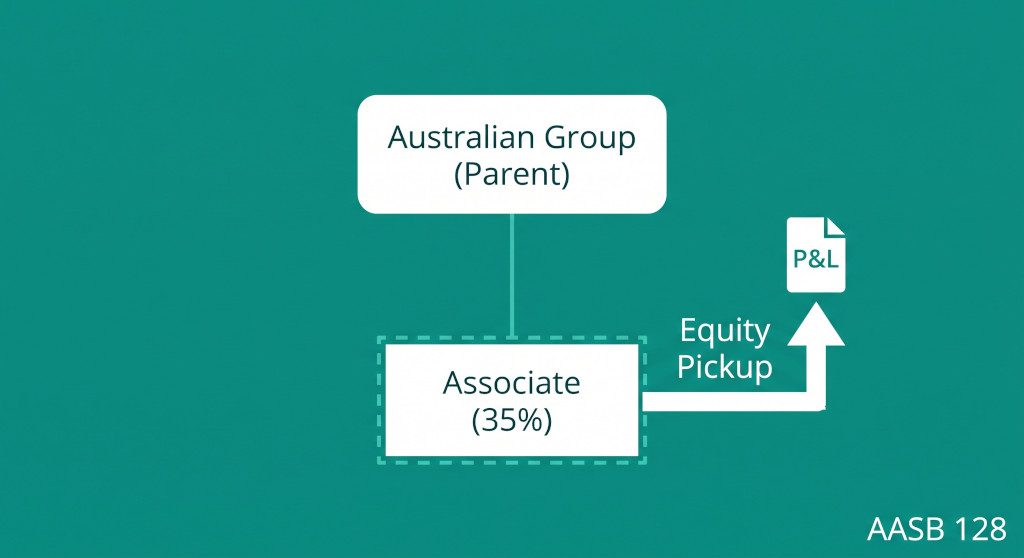
Helena is the group financial controller for a Sydney-based hospitality group. Eighteen months ago, the group acquired a 35% stake in Coastal Dining Pty Ltd, a restaurant joint venture, for $1.1 million. Since then, Helena has left the investment sitting on the consolidated balance sheet at exactly that figure — $1,100,000 — because that is what the group paid. When the external auditor reviews the draft consolidated accounts and asks “Where is the equity pickup for Coastal Dining?”, Helena has no answer ready.
Coastal Dining had a $85,000 net loss in its first year and a $320,000 net profit in its second. Dividends of $50,000 were paid during the second year. None of those movements have reached the consolidated P&L. The balance sheet shows a frozen asset — the cost of the investment unchanged since acquisition — which is precisely what AASB 128 prohibits.
This guide explains what AASB 128 actually requires, why the cost method is not permitted in consolidated financial statements, and how to apply the equity method correctly — including the initial recognition, the annual journals, the loss suspension rules, and the key Australian disclosure requirements. Helena’s situation is more common than most groups realise, and the correction is straightforward once you know the mechanics.
Stop building consolidations in spreadsheets.
BrizoConsol automates multi-entity consolidation — setup in minutes, reports the same day.
Why the Cost Method Is Not Permitted Under AASB 128
Many groups confuse how an associate investment is measured in the entity financial statements versus the consolidated financial statements. In the parent’s own separate financial statements (prepared under AASB 127), investments in associates may be carried at cost, fair value, or using the equity method — the entity has a choice. In the consolidated financial statements, there is no choice. AASB 128 mandates the equity method.
Carrying an associate at cost in consolidated accounts means the consolidated balance sheet does not reflect the group’s growing or shrinking economic interest in that business, and the consolidated P&L shows nothing of the associate’s performance. That misrepresents the group’s financial position. From the moment the group first publishes consolidated financial statements after acquiring significant influence, the equity method must apply.
Common mistake: The cost method is only appropriate in the parent entity’s own separate financial statements under AASB 127. Once you consolidate, AASB 128.16 requires the equity method for all associates — no exceptions for size, materiality of ownership, or how long the investment has been held.
Significant Influence: When AASB 128 Applies
AASB 128 applies when a group (or an entity) has significant influence over another entity but does not control it. Control (AASB 10) triggers full line-by-line consolidation. Joint control (AASB 11) triggers either proportionate consolidation for joint operations or equity method for joint ventures. Significant influence without control — typically a stake of 20% to 50% — triggers AASB 128 and the equity method.
AASB 128.5 establishes a rebuttable presumption: holding 20% or more of the voting rights of an investee means significant influence is presumed, unless it can be clearly demonstrated otherwise. Conversely, holding less than 20% is presumed not to confer significant influence, unless there is clear evidence to the contrary.
Indicators of significant influence at any ownership level include representation on the board or governing body of the investee, participation in policy-making processes, material intercompany transactions, interchange of managerial personnel, and provision of essential technical information. In practice, Australian groups most frequently apply AASB 128 to stakes in the 25%–49% range, but the standard can apply at lower percentages where these indicators are present.
AASB 128 does not apply to associates held by venture capital organisations, mutual funds, unit trusts, or similar entities where those interests are designated at fair value through profit or loss in accordance with AASB 9. For most Australian SME groups, this exemption does not apply.
Initial Recognition: What Makes Up the Opening Carrying Value
Under AASB 128.10, an investment in an associate is initially recognised at cost — that is, the total consideration paid to acquire the stake, including directly attributable transaction costs. This differs from the treatment of a subsidiary acquisition under AASB 3 Business Combinations, where transaction costs are expensed through profit or loss. For an associate, they go into the carrying value.
Embedded within that initial carrying value is an implicit goodwill-like element — the excess of the purchase price over the group’s share of the fair value of the associate’s net assets at acquisition. AASB 128 does not require this excess to be recognised separately as goodwill; it stays inside the investment balance on the balance sheet. It is, however, subject to impairment testing and does not attract an annual amortisation charge.
For Helena’s group, the opening calculation looks like this:
| Purchase price paid for 35% of Coastal Dining | $1,100,000 |
| Fair value of 35% of Coastal Dining’s net assets at acquisition (35% × $2,800,000) | $980,000 |
| Implicit goodwill embedded in carrying value | $120,000 |
The $120,000 embedded goodwill is not a separate line item. It sits inside the $1,100,000 investment balance and will remain there — reducing it if impaired — but does not get amortised. If you are finding that your equity pickup does not match the associate’s reported results, the most likely cause is unadjusted fair value differences at acquisition. The detail is explored in Why Your Equity Pickup Is Wrong After Acquiring an Associate.
Applying the Equity Method: Helena’s Worked Example
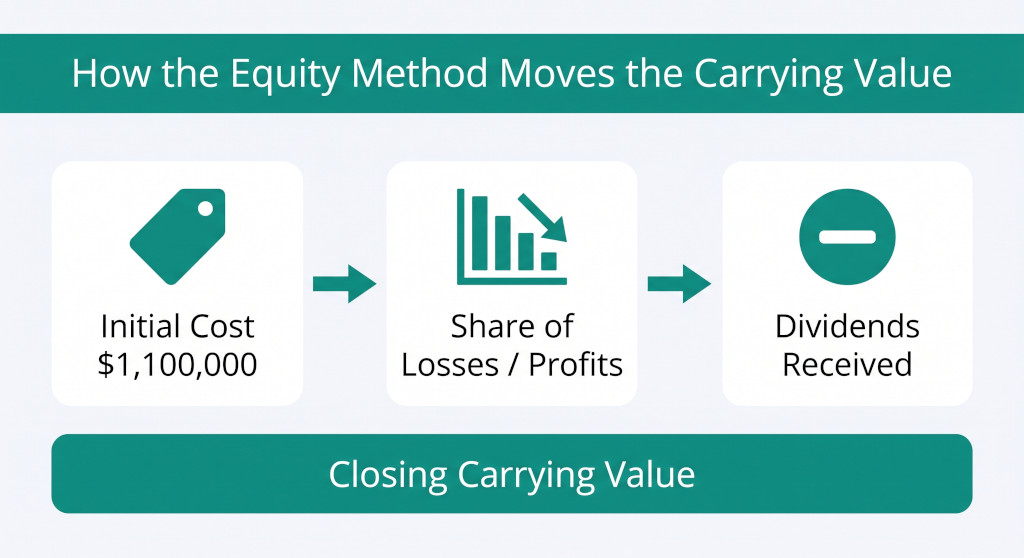
The equity method adjusts the carrying value of the investment each period by the investor’s share of the associate’s net profit or loss and other comprehensive income, and reduces it by dividends received. The formula is straightforward:
Closing carrying value = Opening carrying value + Share of profit/(loss) + Share of OCI − Dividends received
Helena’s group has never applied the equity method. For the correction, Year 1 results are treated as a prior-period error under AASB 108, adjusted through opening retained earnings. Year 2 results flow through the current-year consolidated P&L.
Prior-period correction — Year 1 (share of associate’s loss)
| Account | Dr | Cr |
|---|---|---|
| Retained earnings — opening balance (prior period error) | $29,750 | |
| Investment in Coastal Dining Pty Ltd | $29,750 |
35% × $85,000 net loss for Year 1. Because the group should have recognised this loss in Year 1 but did not, it is corrected retrospectively through opening retained earnings in Year 2 comparatives under AASB 108.
Current-year entries — Year 2 (share of profit and dividend)
| Account | Dr | Cr |
|---|---|---|
| Investment in Coastal Dining Pty Ltd | $112,000 | |
| Share of associate’s profit — Coastal Dining (P&L) | $112,000 |
35% × $320,000 net profit for Year 2. This flows through the consolidated income statement as “Share of profit of associate”.
| Account | Dr | Cr |
|---|---|---|
| Cash / Intercompany dividend receivable | $17,500 | |
| Investment in Coastal Dining Pty Ltd | $17,500 |
35% × $50,000 dividend paid by Coastal Dining. A dividend from an associate reduces the carrying value of the investment — it is a return of previously-recognised equity, not income in the consolidated accounts.
After these entries, the investment balance reconciles as follows:
| Movement | Amount | Carrying Value |
|---|---|---|
| Initial cost (acquisition) | — | $1,100,000 |
| Year 1: Share of loss (35% × $85,000) — prior period | ($29,750) | $1,070,250 |
| Year 2: Share of profit (35% × $320,000) | $112,000 | $1,182,250 |
| Year 2: Dividend received (35% × $50,000) | ($17,500) | $1,164,750 |
| Closing carrying value — what AASB 128 requires | $1,164,750 | |
Helena’s balance sheet currently shows $1,100,000 — an understatement of $64,750. After the prior-period correction and the Year 2 entries above, the investment balance is brought up to $1,164,750 and the consolidated P&L correctly includes $112,000 of share of associate profit for the year.
When the Associate Keeps Losing Money: AASB 128.38 Loss Suspension
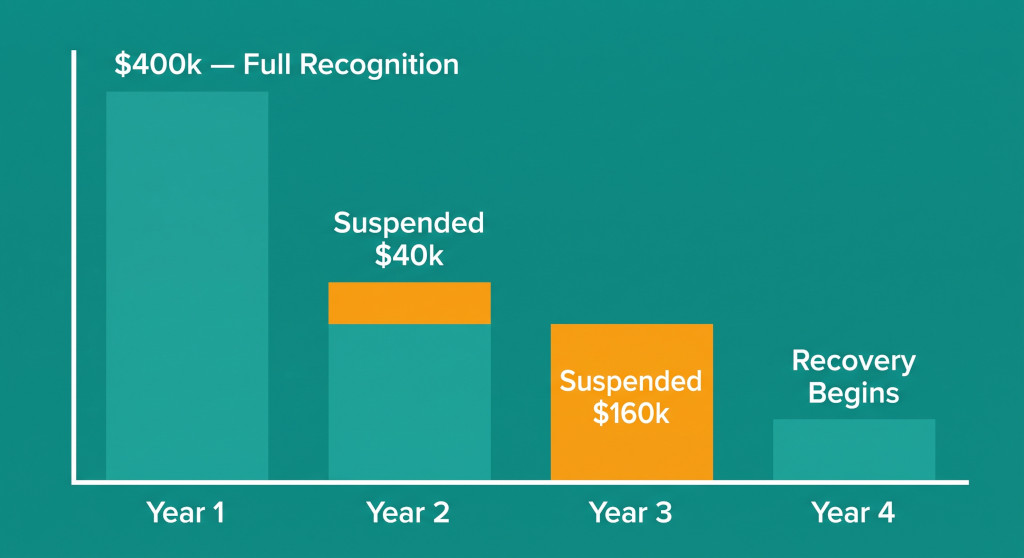
AASB 128.38 contains a rule that catches many groups by surprise: the group must stop recognising its share of an associate’s losses once the carrying value of the investment reaches zero. You cannot carry an associate at a negative carrying value on the consolidated balance sheet — unless the group has legal obligations or has made payments on behalf of the associate, in which case a liability must be recognised for those amounts.
To see this in practice, consider a different associate: Nexus Logistics Pty Ltd, 40% held, with an initial carrying value of $400,000.
| Period | Associate net loss | 40% share | Recognised in P&L | Suspended (unrecognised) | Carrying value |
|---|---|---|---|---|---|
| Opening | — | — | — | — | $400,000 |
| Year 1 | ($600,000) | ($240,000) | ($240,000) | Nil | $160,000 |
| Year 2 | ($500,000) | ($200,000) | ($160,000) | $40,000 | $0 |
| Year 3 | ($300,000) | ($120,000) | Nil | $120,000 | $0 |
| Total unrecognised losses carried forward | $160,000 | $0 | |||
In Year 2, the group can only bring the carrying value down to zero — it cannot go negative. The remaining $40,000 of the loss is suspended and tracked off-balance-sheet. In Year 3, the full $120,000 share of loss is suspended because the carrying value is already at zero.
When Nexus Logistics eventually returns to profit, the group resumes picking up its share of income — but only after the accumulated unrecognised losses ($160,000) have been fully absorbed. If the group’s share of profit in Year 4 is $100,000, none of it is recognised in P&L; the $160,000 suspended losses reduce to $60,000. Only in Year 5, once the suspended losses are exhausted, does income flow through again.
Watch out: Groups sometimes continue picking up the full share of associate losses below zero — especially when the equity method accounting is done manually in Excel. The result is a negative “Investment in Associate” balance on the consolidated balance sheet, which is incorrect. Check that your process has a floor at zero and tracks suspended losses in a separate schedule. For a detailed treatment of this rule and its recovery mechanics, see When Your Associate Keeps Losing Money.
Managing Associates in Your Australian Group?
BrizoConsol handles equity method accounting automatically — picking up your share of associate profits, dividends, and OCI movements at each period close, and applying the AASB 128.38 loss suspension floor without manual tracking. See It In Action
Eliminating Unrealised Profits on Transactions With the Associate
AASB 128 requires the group to eliminate its proportionate share of any unrealised profits arising from transactions between the group and its associates. This applies in both directions: downstream transactions (group sells goods or assets to the associate) and upstream transactions (associate sells goods or assets to the group).
For example, if the group’s subsidiary sells inventory to the associate at a 30% mark-up, and the associate has not yet sold that inventory to external customers, the group must eliminate its 35% share of the unrealised profit from the consolidated P&L and reduce the carrying value of the investment accordingly. This is not a full elimination (as it would be for a subsidiary) — only the investor’s proportionate share is removed.
The same logic applies to asset sales. If the group transfers a fixed asset to the associate at a gain, and the associate still holds that asset, the group’s share of the unrealised gain is deferred until the asset is eventually sold externally or consumed through depreciation. The mechanics of upstream, downstream, and asset transactions are covered in depth in Eliminating Unrealised Profits on Associate Transactions.
Accounting Policy Alignment: A Requirement Often Overlooked
AASB 128.35 requires that, where the associate uses accounting policies that differ from those of the group, the group should make adjustments to align the associate’s results before applying the equity method. In practice, many Australian groups skip this step — particularly for smaller associates where full management accounts are not shared and only statutory accounts are available.
The most common policy mismatches for Australian associates involve depreciation rates, revenue recognition timing, and lease capitalisation (if the associate does not apply AASB 16). Where the differences are material, alignment adjustments should be made to the associate’s share of profit before the equity pickup is posted. Where information is not available to make those adjustments, that limitation must be disclosed. The broader principles of policy alignment across a group are explored in Accounting Policy Alignment Before Consolidation.
Impairment of the Investment Under AASB 136
The equity method carrying value is subject to impairment testing under AASB 136. The investment in associate is treated as a single cash-generating unit for impairment purposes — the embedded goodwill is not separated and tested independently. AASB 128.40–42 require the group to assess at each reporting date whether there is objective evidence of impairment, including:
- The associate has experienced significant financial difficulty
- The associate’s results have been persistently below forecast and there is no recovery plan
- There are observable indications that the associate’s net assets have declined materially below the carrying value of the investment
- The group’s stake has been diluted without proportionate consideration
If impairment is indicated, the recoverable amount of the investment is compared with its carrying value. Any impairment loss is recognised in the consolidated P&L within the “share of profit/(loss) of associates” line. Impairment losses on associates cannot be reversed in subsequent periods under Australian standards.
Presentation in the Consolidated Financial Statements
Associates are presented as a single line item in the consolidated balance sheet under non-current assets: “Investments in associates” or “Investments accounted for using the equity method.” There is no line-by-line aggregation of the associate’s assets and liabilities — that is the difference between equity method accounting and full consolidation. The group’s consolidated balance sheet only sees one number: the carrying value of its investment.
In the consolidated income statement, the group’s share of the associate’s net profit or loss appears as a single line: “Share of profit/(loss) of associates accounted for using the equity method.” Depending on the group’s presentation choices, this may sit above or below the operating result — but it must be distinguished from revenue and operating profit generated by the group itself.
If the associate has other comprehensive income (for example, foreign currency translation differences or fair value movements on financial instruments), the group picks up its proportionate share of those OCI items and presents them in its own consolidated statement of other comprehensive income. These items must be disaggregated by nature where material.
Note what the equity method does not produce: no revenue from the associate flows into consolidated revenue, no assets or liabilities of the associate appear on the consolidated balance sheet, and no intercompany eliminations of the type used for subsidiaries are required. The equity method is a single-line summary of the group’s economic interest in the associate’s net performance.
Key AASB 128 Disclosures Australian Groups Must Include
AASB 128 disclosure requirements are more extensive than many preparers appreciate. The following are mandatory for each material associate:
- Nature of the relationship: Name of the associate, principal place of business (or country of incorporation), proportion of ownership interest, and proportion of voting rights held if different from ownership interest.
- Accounting method: Confirmation that the equity method has been applied and explanation of any departure from the 20% presumption.
- Summarised financial information: For material associates, the group must disclose summarised financial information about the associate itself — total assets, total liabilities, revenue, profit or loss, and OCI. This is the associate’s own figures, not the group’s share.
- Fair value: If the associate has a quoted market price, the fair value of the investment must be disclosed.
- Unrecognised losses: If the group has suspended loss recognition under AASB 128.38, the cumulative amount of unrecognised losses and the period’s unrecognised share must be disclosed.
- Commitments and contingent liabilities: Any commitments to the associate or contingent liabilities incurred jointly with the associate must be disclosed.
Australian groups with interests in joint ventures under AASB 11 have parallel disclosure requirements. AASB 12 Disclosure of Interests in Other Entities sits alongside AASB 128 and imposes additional disclosures about how the group’s interests in associates expose it to risk and how management exercises judgement in assessing significant influence.
Practical Checklist: AASB 128 Compliance at Each Reporting Date
- Confirm the classification. For each investee, verify that the ownership percentage and the indicators of significant influence (board representation, intercompany transactions, policy participation) still support associate status rather than subsidiary or simple financial asset.
- Obtain the associate’s accounts. Collect profit or loss, OCI, dividends declared, and balance sheet movements for the period. If the associate’s year-end differs from the group’s by more than three months, additional procedures apply under AASB 128.33.
- Align accounting policies. Identify any material policy differences between the associate and the group and make the necessary adjustments before calculating the equity pickup.
- Post the equity pickup entry. Dr/Cr Investment in Associate for the group’s share of profit/(loss) and OCI. Reduce the investment balance for dividends received from the associate.
- Apply the loss suspension floor. Confirm the investment carrying value has not been taken below zero. Track any suspended losses in a dedicated schedule.
- Test for impairment. Review the indicators listed above. If any are present, perform a recoverable amount calculation under AASB 136 for the investment as a whole.
- Eliminate unrealised profits. Identify any open transactions between the group and the associate where profit has been recognised in either party’s accounts but the underlying goods or assets have not been sold externally. Eliminate the group’s proportionate share.
- Prepare disclosures. Draft the notes required by AASB 128 and AASB 12, including summarised financial information for material associates, any suspended losses, and the nature of the relationship.
Groups that are moving from cost accounting to the equity method — like Helena’s group — should also prepare a catch-up schedule that segregates prior-period errors (corrected through opening retained earnings) from current-period adjustments (through the P&L), and document the calculations supporting each journal entry. This documentation will be the first thing your external auditor requests.
If your group has an associate that is approaching loss suspension, or has recently acquired a stake that requires the equity method for the first time, the posts on loss recognition and recovery and partial disposal of an associate will be directly relevant. If the stake increases to the point where the group acquires control, the rules change entirely — see Step Acquisition Accounting for how the transition from equity method to full consolidation works.
Ready to Automate Your Equity Method Accounting?
BrizoConsol handles equity method accounting for Australian groups — calculating the annual pickup, applying the AASB 128.38 loss floor, and producing the disclosure schedules you need for audit. Start your free trial and connect your entities today. Start Free Trial