How to Consolidate a Hotel Group Where Each Property Operates Through a Separate OpCo Leasing From a Central PropCo in a Different Currency
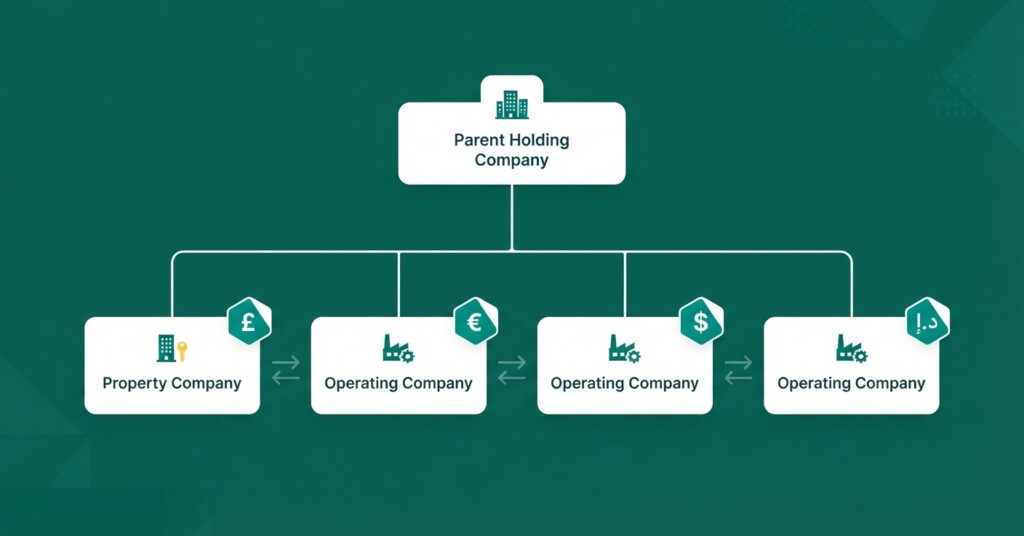
Hotel groups frequently adopt a PropCo/OpCo structure for sound commercial and tax reasons: a central property company (PropCo) owns the real estate and leases it to individual operating companies (OpCos), each of which runs a single hotel. The structure protects assets, separates operational risk, and can optimise financing. But for the finance team responsible for consolidated group accounts, it creates a layered set of accounting challenges — intercompany lease eliminations, FX translation across multiple functional currencies, non-controlling interests (NCI) where ownership is shared, and the sheer mechanics of pulling it all together at month-end without drowning in spreadsheets.
This article walks through the practical consolidation workflow for exactly this scenario, using a worked example of a UK-based hotel group whose PropCo holds assets in GBP, while three OpCos operate in EUR, USD, and AED respectively. The aim is to give finance managers and controllers a concrete playbook — not a textbook summary.
Understanding the Group Structure Before You Consolidate
Before writing a single journal, map the ownership and currency structure explicitly. In our example, HotelGroup Holdings Ltd (UK, GBP) owns 100% of PropCo UK Ltd (GBP) and holds varying stakes in three OpCos:
Stop building consolidations in spreadsheets.
BrizoConsol automates multi-entity consolidation — setup in minutes, reports the same day.
| Entity | Role | Functional Currency | Group Ownership | NCI |
|---|---|---|---|---|
| PropCo UK Ltd | Property owner / lessor | GBP | 100% | 0% |
| OpCo Paris SAS | Hotel operator — Paris | EUR | 80% | 20% |
| OpCo New York LLC | Hotel operator — New York | USD | 100% | 0% |
| OpCo Dubai LLC | Hotel operator — Dubai | AED | 75% | 25% |
PropCo holds the freehold or long leasehold interests and charges each OpCo a market-rate lease. Each OpCo records a right-of-use (ROU) asset and lease liability under IFRS 16 (or the equivalent local standard). At the group level, these intercompany leases must be eliminated entirely — the ROU asset, the lease liability, the depreciation on the ROU asset, the interest on the lease liability, and the rental income and expense that flow between entities.
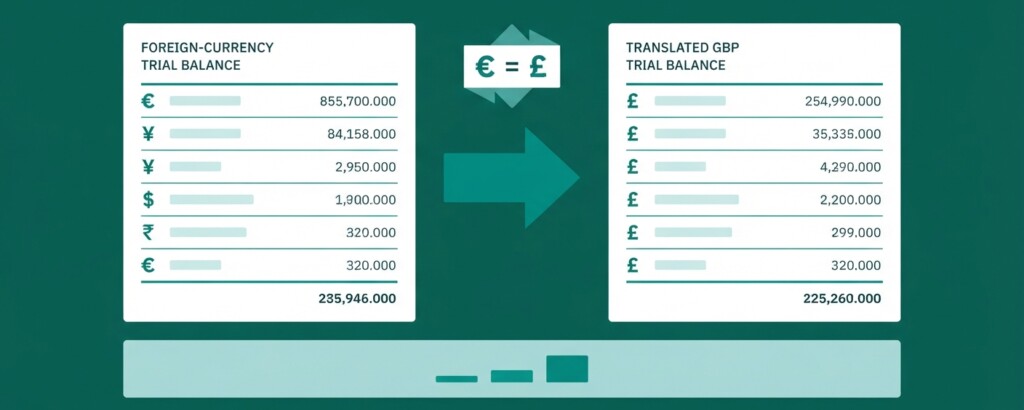
Step 1 — Translate Each Entity Into the Group Presentation Currency
The group presents its consolidated accounts in GBP. Each OpCo prepares its statutory accounts in its own functional currency. Before any eliminations can happen, every foreign entity must be translated using the method required under IAS 21.
IAS 21 Translation Rules for a Foreign Operation: Assets and liabilities are translated at the closing rate on the balance sheet date. Income and expenses are translated at the transaction rate or an appropriate average rate for the period. The resulting difference goes to Other Comprehensive Income (OCI) as a Foreign Currency Translation Reserve (FCTR), not through profit or loss.
For OpCo Paris SAS reporting in EUR, assume the following rates apply for the month of March:
| Opening EUR/GBP rate (1 Mar) | 0.8520 |
| Closing EUR/GBP rate (31 Mar) | 0.8610 |
| Average EUR/GBP rate (Mar) | 0.8565 |
| OpCo Paris revenue (EUR) | €420,000 |
| OpCo Paris revenue translated at average (GBP) | £359,730 |
| OpCo Paris total assets (EUR) | €3,100,000 |
| OpCo Paris total assets translated at closing (GBP) | £2,669,100 |
The same process applies to OpCo New York (USD) and OpCo Dubai (AED). Each entity produces a translated trial balance in GBP before the consolidation adjustments begin. The translation difference for each entity is accumulated in the FCTR within equity — it is not a P&L item and must not be mixed up with transactional FX gains or losses that do flow through profit or loss.
A common mistake is applying a single average rate to balance sheet items, or using the closing rate for income statement lines. This will produce an incorrect FCTR and misstate both equity and OCI. Ensure your translation template locks the rate selection by financial statement line type, not by entity.
Step 2 — Eliminate the Intercompany Lease Transactions
This is where the PropCo/OpCo structure adds the most complexity. Under IFRS 16, each OpCo recognises a lease on its balance sheet. From PropCo’s perspective, it has lease receivables (finance lease) or simply rental income (operating lease) depending on lease classification. In either case, the group must eliminate everything that crosses the intercompany boundary.
Assume all three leases are classified as operating leases from the lessor (PropCo) perspective. PropCo records rental income; each OpCo records an ROU asset, a lease liability, depreciation on the ROU asset, and interest expense on the lease liability, plus a cash payment of rent. Here is the consolidation journal to eliminate one month of the Paris lease, expressed in GBP after translation:
| Account | Dr | Cr |
|---|---|---|
| Rental Income (PropCo — intercompany) | £28,500 | |
| Lease Expense / ROU Depreciation (OpCo Paris — intercompany) | £22,100 | |
| Interest Expense on Lease Liability (OpCo Paris — intercompany) | £6,400 |
Elimination of intercompany operating lease income and associated IFRS 16 charges for March. PropCo rental income £28,500 is eliminated against the combined P&L cost in OpCo Paris (ROU depreciation £22,100 plus lease interest £6,400). Figures are post-translation at average rate.
| Account | Dr | Cr |
|---|---|---|
| Intercompany Lease Liability (OpCo Paris balance sheet) | £1,240,000 | |
| ROU Asset (OpCo Paris balance sheet) | £1,240,000 |
Elimination of the ROU asset and corresponding lease liability on the consolidated balance sheet. These arise solely from the intercompany lease and have no substance at group level. Figures translated at closing rate 0.8610.
This same set of journals must be prepared for OpCo New York and OpCo Dubai, each in their respective translated GBP amounts. Because PropCo accounts for the leases as operating leases, it holds the underlying property asset and does not carry a long-term lease receivable matching OpCo’s lease liability — both the ROU asset and lease liability reside on OpCo’s balance sheet and are eliminated on consolidation. Any regular intercompany balances for unsettled rent (rent receivable in PropCo versus rent payable in OpCo) must agree before elimination; any transactional foreign exchange gain or loss arising from retranslating these short-term monetary balances at closing rates flows to profit or loss under IAS 21, rather than FCTR.
Step 3 — Account for Non-Controlling Interests
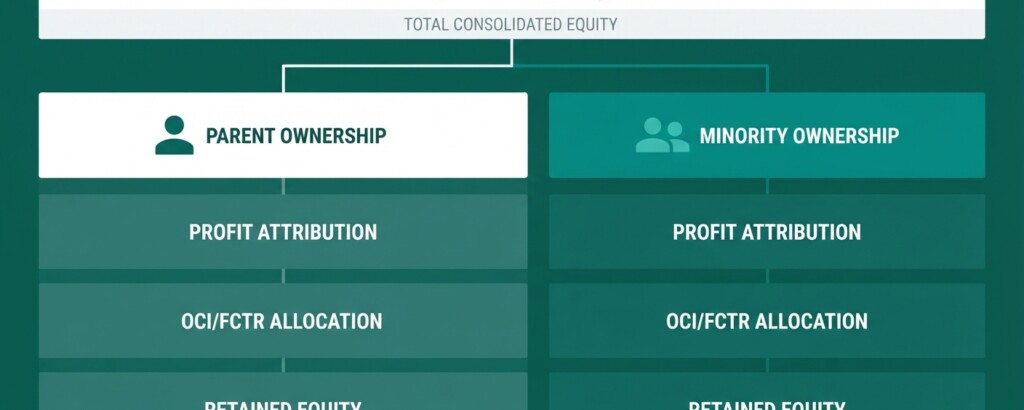
OpCo Paris (80% owned) and OpCo Dubai (75% owned) have external minority shareholders. Under IFRS 10, the group consolidates 100% of each subsidiary’s assets, liabilities, income, and expenses, then presents the portion attributable to minority shareholders as NCI — separately within equity on the balance sheet, and as a separate allocation line within profit or loss.
For OpCo Paris, assume translated post-tax profit for March is £38,400. The NCI allocation is straightforward:
| OpCo Paris post-tax profit (translated GBP) | £38,400 |
| NCI share (20%) | £7,680 |
| Profit attributable to owners of the parent | £30,720 |
NCI also receives its share of the OCI items, including the FCTR arising on translation of OpCo Paris. If the FCTR for March is a gain of £14,200, then £2,840 (20%) is allocated to NCI and £11,360 (80%) to the parent’s equity. This allocation is frequently omitted in manual Excel consolidations and causes the equity reconciliation to fail.
Step 4 — Eliminate Intercompany Balances Beyond the Lease
Beyond the lease itself, the group will typically have other intercompany flows: management fees charged by the holding company to the OpCos, intercompany loans (perhaps PropCo lent capital to an OpCo at formation), and cash pooling arrangements. Each of these must be identified and eliminated.
- Match intercompany receivables and payables by entity pair. Any unmatched balances after FX translation must be investigated — small residuals from translation differences are expected but should be disclosed.
- Eliminate management fee income in the holding company against management fee expense in each OpCo.
- Eliminate intercompany loan balances (principal and any accrued interest) between PropCo and OpCos.
- Eliminate intercompany dividends paid by OpCos to the parent — these eliminate dividend income recognised by the parent against the subsidiary’s distributions, ensuring intragroup dividends do not inflate group profit.
- Check for intercompany profit in inventory or fixed assets if any entity has sold assets to another — rare in a hotel group but possible if FF&E (furniture, fixtures and equipment) is centralised through PropCo.
Step 5 — Build the Consolidated Trial Balance and Reporting Pack
Once translation and eliminations are complete, the consolidation workbook should produce a single consolidated trial balance in GBP. From this, the group income statement, balance sheet, statement of changes in equity (including NCI), and cash flow statement can be derived.
The group cash flow requires additional attention in a multi-currency hotel structure. Under IAS 7, cash flows of foreign operations are translated at transaction-date rates (or appropriate average rates), whereas balance sheet movements reflect closing rates. In an indirect-method cash flow, balance sheet movements must be adjusted to remove non-cash currency translation differences (FCTR effects on assets and liabilities), and the effect of exchange rate fluctuations on cash and cash equivalents held must be presented as a separate reconciling line at the bottom of the statement.
Practical Tip — Intercompany Agreement Log: Keep a central register of every intercompany agreement (lease terms, management fee rates, loan terms, interest rates). When intercompany balances mismatch at month-end, this register lets you identify the source quickly rather than chasing each entity’s finance team for explanations. In a cross-currency group, also record the currency of each agreement and which entity bears the FX risk.
Where Manual Processes Break Down in This Structure
The PropCo/OpCo hotel group is one of the more demanding consolidation scenarios for SME finance teams precisely because it combines several hard problems at once: recurring IFRS 16 eliminations that must be re-run monthly with updated translated amounts, NCI allocations across P&L and OCI, and FX translation mismatches that are genuine accounting differences rather than errors but still need to be explained and signed off.
In practice, a group with four entities, three currencies, two NCI positions, and a full set of intercompany eliminations will generate dozens of consolidation journals each month. When this is managed in Excel, the risks are significant: formula errors in translation rate lookups, journals that eliminate the wrong line, NCI percentages hard-coded and not updated after a capital event, and no audit trail linking a consolidation adjustment back to the underlying intercompany agreement. Month-end close for a group of this size can easily stretch to two or three weeks when the process is manual.
NCI percentages must be updated immediately following any change in ownership — a partial acquisition, a dilution event, or a buy-out of minority interest. If the NCI percentage in your consolidation model lags behind the legal ownership structure, your consolidated equity will be wrong, and restating prior periods is painful. Treat the ownership table as a controlled input, not an assumption buried in a formula.
Consolidation software that connects directly to each entity’s accounting system — pulling trial balances automatically, applying stored translation rates, running pre-configured elimination journals, and allocating NCI based on a maintained ownership table — can compress this cycle significantly. The finance team moves from building the consolidation to reviewing it, which is a fundamentally different and more valuable activity.
A Note on Group Reporting Beyond the Statutory Numbers
For a hotel group, management reporting often needs to go further than GAAP consolidated financials. Hotel-specific KPIs — RevPAR (Revenue per Available Room), GOPPAR (Gross Operating Profit per Available Room), and occupancy rates — need to be reported by property and then rolled up to group level. These metrics sit alongside, but are not part of, the statutory consolidation. A well-designed group reporting structure separates the two: the statutory consolidation feeds audited numbers, while the management pack pulls from the same source data but adds operational metrics by entity.
Where the two views share a common data foundation — the same trial balance, the same chart of accounts structure — the risk of management accounts and statutory accounts telling different stories is much reduced. This is one of the strongest arguments for connected, entity-level accounting data feeding into both the consolidation and the reporting layer simultaneously.
Summary — The Consolidation Checklist for a PropCo/OpCo Hotel Group
- Document the ownership structure and functional currency of every entity before the first consolidation period.
- Translate each foreign OpCo using closing rates for balance sheet items and average rates for P&L items; post the difference to FCTR in OCI.
- Eliminate the intercompany lease in full: ROU asset, lease liability, rental income, ROU depreciation, and lease interest.
- Eliminate all other intercompany balances: management fees, intercompany loans, accrued interest, and intercompany dividends.
- Allocate NCI its share of post-tax profit and OCI (including FCTR) based on the current ownership percentage.
- Reconcile the consolidated equity movement: opening balance plus profit attributable to parent plus OCI attributable to parent minus dividends paid to parent shareholders.
- Prepare the consolidated cash flow with explicit adjustment for exchange rate effects on cash held.
- Document every consolidation journal with a reference to the underlying intercompany agreement or accounting policy.
Automate Your Hotel Group Consolidation
If your team is managing a multi-entity hotel group consolidation in Excel — with intercompany lease eliminations, FX translation across currencies, and NCI allocations — BrizoConsol is built for exactly this workflow. Connect your entity-level accounting systems, configure your eliminations once, and produce a consolidated trial balance and reporting pack each month without rebuilding the model from scratch.
Stop building consolidations in spreadsheets.
BrizoConsol automates multi-entity consolidation — setup in minutes, reports the same day.