Redeemable NCI: How to Account for Put Options on Non-Controlling Interests
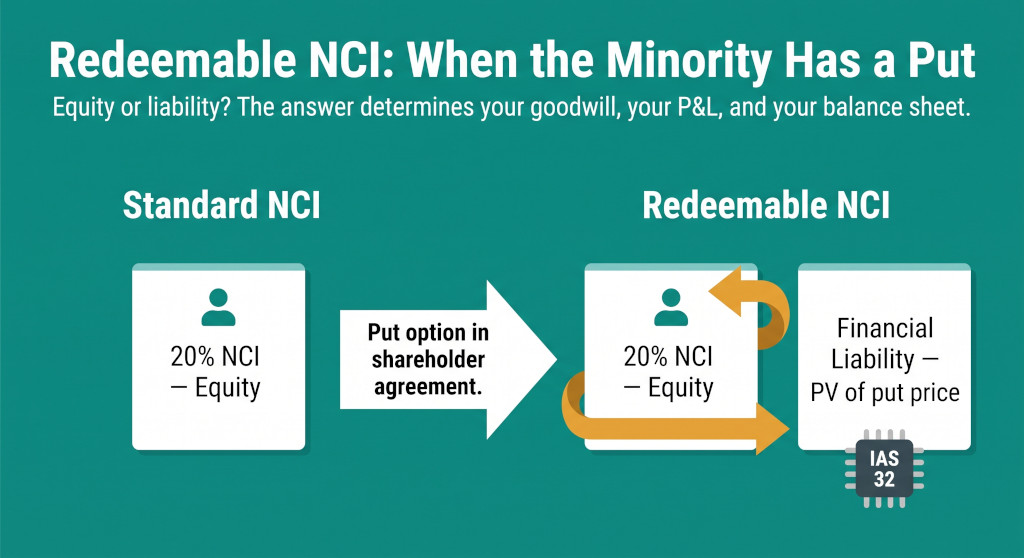
A non-controlling interest does not always sit quietly in equity. When the minority shareholder holds a contractual right to sell their shares back to the parent — a put option — the group has a present obligation to deliver cash if the put is exercised. Under IAS 32, a contractual obligation to deliver cash is a financial liability, not equity. The result is a head-on conflict between IFRS 10 (which says NCI is equity) and IAS 32 (which says the put obligation is a liability).
This conflict has not been resolved by the IASB. No single prescribed treatment exists. Two approaches are in use in practice, and entities must choose one, disclose it, and apply it consistently. But whether a group uses the derecognise-and-reclassify approach or the present access method, the mechanics are demanding: goodwill is affected at acquisition, the liability accretes over time, and the P&L treatment of the NCI profit share changes fundamentally.
This guide explains both approaches, works through a complete example of the more widely used approach — the anticipated acquisition method — from acquisition date through settlement, and addresses the FRS 102 position for UK GAAP groups. If your group has a minority shareholder with a put right in the shareholder agreement, or if the NCI shares are mandatorily redeemable at a fixed date, this is the accounting framework you need.
Automate NCI calculations across all your entities.
BrizoConsol handles non-controlling interest automatically — no manual adjustments required.
What Creates a Redeemable NCI
A redeemable or puttable NCI arises in two situations. The first is a put option granted to the minority shareholder: the parent writes the NCI holder a right to sell their shares back to the parent at a specified price (fixed, formula-based, or fair value) at a future date or within a window. If the minority exercises, the parent must pay cash. The second is mandatorily redeemable shares: the minority’s shares contain terms requiring redemption at a fixed date or on a specified event — for example, shares that automatically convert to a cash payment at the end of a joint venture term.
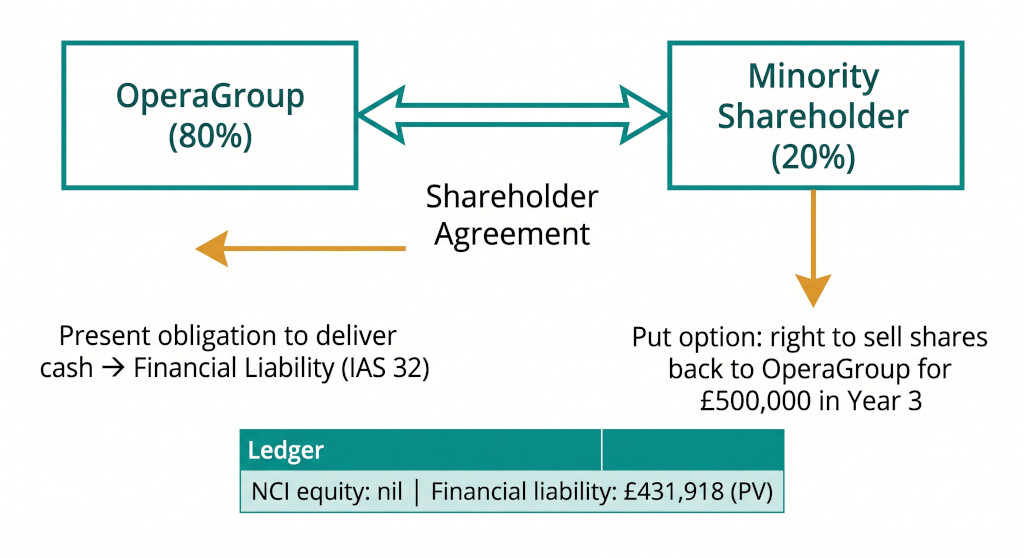
Put options on NCI shares are common in private equity transactions, family business acquisitions where the founding family retains a minority, and joint ventures where one party has an agreed exit mechanism. They appear in shareholder agreements, articles of association, or subscription agreements — often alongside drag-along and tag-along rights. The accounting question arises at consolidation: the parent consolidates the subsidiary but must also assess how to present the obligation to buy out the minority at the group level.
The Standards Conflict
IFRS 10 paragraph 22 is clear: the non-controlling interest is presented in consolidated equity, separately from the equity of the owners of the parent. The NCI is the third-party stake in the subsidiary; in the consolidated accounts it is part of equity because the group’s equity includes both the parent shareholders’ equity and the minority equity.
IAS 32 paragraph 11 defines a financial liability as any liability that is a contractual obligation to deliver cash or another financial asset to another entity. If the parent has written a put option to the NCI holder, the parent has a contractual obligation to deliver cash if the put is exercised. That obligation meets the IAS 32 definition of a financial liability — regardless of how the NCI shares themselves are classified in equity.
The IASB’s Financial Instruments with Characteristics of Equity (FICE) project has been examining this conflict for over a decade. As of the time of writing, no amendment to resolve the tension has been finalised. Entities preparing IFRS consolidated accounts must therefore select an accounting policy that is consistent with both frameworks as far as possible, apply it consistently, and disclose it.
Two Approaches in Practice
Anticipated Acquisition Method (derecognise NCI)
- NCI equity is derecognised at acquisition
- A financial liability is recognised for the PV of the put price
- Goodwill is adjusted to reflect the full anticipated acquisition cost
- No NCI allocation in the consolidated P&L
- Liability accretes to the redemption amount over time
- More widely adopted in practice
- FRS 102 outcome aligns with this approach
Present Access Method (retain NCI in equity)
- NCI equity is retained in consolidated equity as normal
- A financial liability is also recognised for the put obligation
- Debit for the liability is taken against retained earnings (not goodwill)
- NCI continues to be allocated profit share in consolidated P&L
- Liability movements go through equity (retained earnings)
- Less widely used
- Results in a larger equity section (NCI + liability offset)
The two methods produce the same total equity in the consolidated balance sheet but different presentations of it — and different goodwill figures at acquisition. The rest of this guide works through the anticipated acquisition method in full, as this is the more commonly applied treatment. A brief note on the present access method appears after the worked example.
Worked Example: OperaGroup and StageSubsidiary
OperaGroup acquires 80% of StageSubsidiary on 1 January 2026 for £1,800,000. The fair value of StageSubsidiary’s identifiable net assets at acquisition is £2,000,000.
As part of the shareholder agreement, the 20% NCI holders have the right to put their shares back to OperaGroup in three years’ time for £500,000 (a fixed, guaranteed exit price). OperaGroup uses a 5% discount rate as its pre-tax cost of the put obligation.
PV of the put obligation at acquisition date
| Fixed put price (exercisable at end of Year 3) | £500,000 |
| Discount factor: 1 ÷ (1.05)³ = 1 ÷ 1.157625 | 0.86384 |
| Present value of put obligation at 1 Jan 2026 | £431,918 |
1 Goodwill Calculation Under the Anticipated Acquisition Method
The group treats itself as acquiring 100% from day one — the put price replaces NCI at FV in the goodwill calculation
Under the anticipated acquisition method, the parent is treated as if it already owns (or will own) 100% of the subsidiary. The goodwill calculation uses the PV of the put price in place of the normal NCI fair value:
Goodwill calculation — anticipated acquisition method
| Consideration paid by OperaGroup (80%) | 1,800,000 |
| PV of put obligation (effective cost of remaining 20%) | 431,918 |
| Total effective acquisition cost | 2,231,918 |
| Less: FV of identifiable net assets | (2,000,000) |
| Goodwill at acquisition | 231,918 |
2 Acquisition Journal — Two Steps
Step A: normal acquisition journal. Step B: reclassify NCI equity to financial liability.
Journal A — acquisition (as if standard consolidation)
| Account | Dr (£) | Cr (£) |
|---|---|---|
| Net identifiable assets of StageSubsidiary (at FV) | 2,000,000 | |
| Goodwill (as calculated above) | 231,918 | |
| Cash (consideration paid) | 1,800,000 | |
| NCI equity (20% × £2,000,000 = £400,000 proportionate — placeholder) | 431,918 |
Note: Under the anticipated acquisition method, the NCI is never recorded at proportionate FV. The £431,918 credit is the PV of the put obligation — it is recorded as a liability from the outset, not as NCI equity. Some entities record NCI at FV (£400,000) and then immediately reclassify. The net result is the same; using a single journal avoids the intermediate step.
Journal B — financial liability recognition (if using two-step approach)
| Account | Dr (£) | Cr (£) |
|---|---|---|
| NCI equity (derecognised) | 400,000 | |
| Goodwill (additional — PV exceeds NCI FV) | 31,918 | |
| Financial liability — NCI put option | 431,918 |
Journal B assumes NCI equity of £400,000 was recorded in Journal A. The PV of the put (£431,918) exceeds the NCI FV (£400,000), so additional goodwill of £31,918 arises — the group has committed to pay more than the NCI’s current fair value. Total goodwill after both journals: £200,000 (partial goodwill on the 80% stake: £1,800,000 − 80% × £2,000,000) + £31,918 = £231,918. This agrees to the single-step goodwill calculation above.
The consolidated balance sheet at 1 January 2026 shows: no NCI equity, a financial liability of £431,918 on the balance sheet, and goodwill of £231,918. The balance sheet reflects the economic reality that OperaGroup has an obligation to pay £500,000 for the remaining 20% — it is simply discounted to present value today.
3 Subsequent Measurement: Liability Accretion
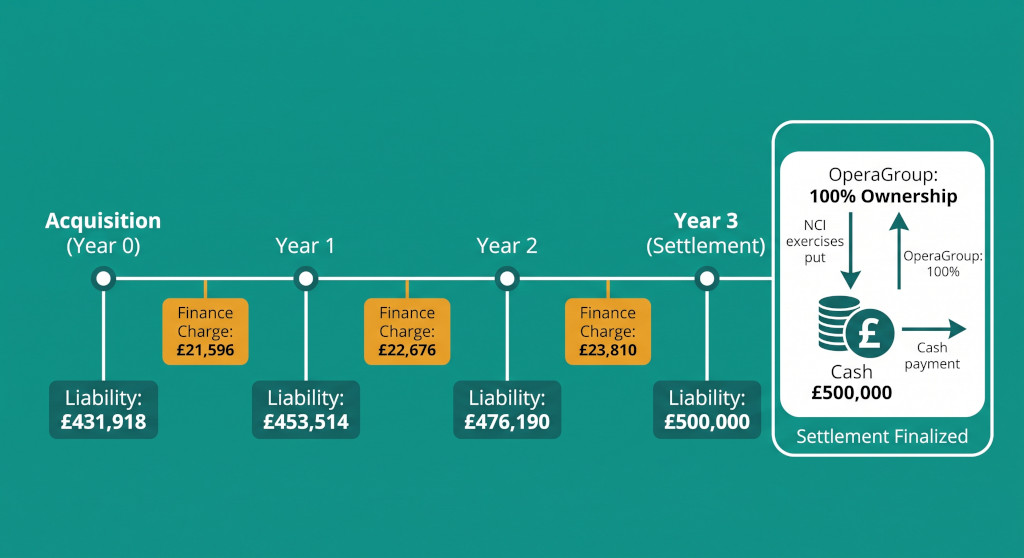
The financial liability accretes from £431,918 to £500,000 over three years, with the accretion charged as a finance cost in the consolidated P&L.
If the put price is fixed (£500,000), the financial liability is measured at amortised cost using the effective interest method. Each year, a finance charge is recognised for the unwinding of the discount:
| Period | Opening Liability (£) | Finance Charge @ 5% (£) | Cash Paid (£) | Closing Liability (£) |
|---|---|---|---|---|
| Year 1 (2026) | 431,918 | 21,596 | — | 453,514 |
| Year 2 (2027) | 453,514 | 22,676 | — | 476,190 |
| Year 3 (2028) | 476,190 | 23,810 | — | 500,000 |
| Settlement (end of Year 3) | 500,000 | — | (500,000) | — |
Journal — Year 1 finance charge (accretion of put liability)
| Account | Dr (£) | Cr (£) |
|---|---|---|
| Finance cost (P&L) | 21,596 | |
| Financial liability — NCI put option | 21,596 |
This finance charge appears in the consolidated income statement under finance costs. It represents the passage of time — the group is “getting closer” to paying the £500,000. Repeat for Years 2 and 3 using the relevant annual charge from the accretion table above.
4 NCI Profit Allocation Under the Anticipated Acquisition Method
No NCI appears in the consolidated P&L — the parent is treated as owning 100% from day one
Because the NCI has been derecognised from equity, there is no NCI balance to credit with SubCo’s share of profit. Under the anticipated acquisition method, the consolidated income statement presents SubCo’s results at 100% with no minority deduction. The legal reality is that the minority shareholder still owns 20% of SubCo and is entitled to dividends — but in the consolidated accounts, this economic interest has been reclassified to a liability position. The minority’s economic return is captured in the put price (£500,000 at exercise) rather than through ongoing profit allocations.
In practice: if StageSubsidiary earns £300,000 PAT in Year 1, the consolidated income statement shows the full £300,000 as attributable to OperaGroup shareholders — no “20% NCI deduction” line. Finance costs of £21,596 (the put accretion) appear separately below operating profit.
If the minority also receives dividends: any dividend paid to the NCI holder during the put period reduces the financial liability (or is charged to P&L, depending on the terms of the put — whether the put price adjusts for dividends paid). Review the shareholder agreement carefully. A put with a fixed price that does not reduce for dividends paid means the group effectively bears the cost of those dividends twice — once in cash flow and once in the obligation building to £500,000.
5 Settlement — NCI Exercises the Put
End of Year 3: NCI exercises, OperaGroup pays £500,000 — group is now 100% owner
Journal — settlement (NCI exercises put option)
| Account | Dr (£) | Cr (£) |
|---|---|---|
| Financial liability — NCI put option | 500,000 | |
| Cash | 500,000 |
The liability is extinguished and cash is paid. OperaGroup now holds 100% of StageSubsidiary with no further consolidation complications. Goodwill is not adjusted at settlement — it was correctly measured at acquisition to reflect the full 100% anticipated cost. No gain or loss arises on settlement under the anticipated acquisition method (the accretion has already been expensed through finance costs over the three years).
What if the NCI does not exercise the put?
If the put option lapses without exercise — for example, the three-year window closes and the NCI chooses not to sell — the financial liability is derecognised. The NCI returns to being a standard minority equity interest. At the lapse date: derecognise the liability and reinstate NCI equity at the NCI’s share of SubCo’s net assets at that date. The difference between the liability balance and the reinstated NCI equity balance is recognised in retained earnings (not in P&L — this is an equity transaction). From the lapse date, the group reverts to normal NCI accounting: profit allocation, dividends, and presentation in the SoCE all apply as for any standard NCI.
The Present Access Method (Brief Summary)
Under the present access method, the NCI is not derecognised. The approach instead recognises two items simultaneously: the NCI equity in the normal way (allocated profit share, equity balance), and a separate financial liability for the put obligation debited against retained earnings in equity. The total equity in the group’s balance sheet is therefore:
- NCI equity (positive) — allocated profit, OCI, etc. as normal
- Contra entry (negative) — the debit against RE when the liability was initially recognised
- Net effect on total equity is the same as the anticipated acquisition method
The goodwill calculation under this method uses the NCI at FV (not at PV of put price) — so goodwill is lower and the excess of put PV over NCI FV is recorded directly in retained earnings. Liability movements go through equity rather than P&L, and the NCI continues to be allocated profits in the consolidated income statement. The present access method is less widely adopted but is permitted where an entity’s accounting policy choices support it.
Variable Put Prices: Fair Value Measurement
If the put price is not fixed but is based on a formula — for example, a multiple of EBITDA at the exercise date — the financial liability cannot be measured at amortised cost. Instead, it is classified as a financial liability at fair value through profit or loss (FVTPL). The liability is remeasured to fair value at each reporting date, and the movement is recognised in the consolidated P&L (typically within finance costs or within a separate line for fair value movements).
Variable-price puts are common in private equity structures and management buyout agreements where the exit price is tied to business performance. The accounting consequence is ongoing P&L volatility from the liability remeasurement — the group’s reported profit fluctuates with changes in its own subsidiary’s expected performance, which auditors scrutinise closely. The fair value of the put liability requires an underlying business valuation at each reporting date, adding both cost and complexity to the year-end close process.
A key audit focus: if the put price formula contains a floor (e.g., the NCI will receive the higher of £X or Y × EBITDA), the floor may itself be a separate financial guarantee liability that must be recognised and measured independently of the EBITDA-linked component.
Goodwill Impairment and Redeemable NCI
Under the anticipated acquisition method, goodwill is calculated as if the group owns 100%, and the value-in-use calculation for impairment testing must be conducted on a 100% basis — consistent with the goodwill carrying amount. This is straightforward because no NCI goodwill was separated out (unlike the full goodwill method applied to a standard NCI, where the NCI’s share of goodwill must be grossed up for impairment testing purposes under IAS 36). The goodwill is tested as part of the cash-generating unit that comprises the acquired subsidiary, including the 20% economic interest that is still legally owned by the minority but economically captured in the liability.
For guidance on goodwill impairment mechanics, see goodwill in group consolidation: calculation, impairment, and common errors.
FRS 102 Treatment
Under FRS 102 (UK GAAP), the treatment is more prescriptive. FRS 102 Section 22 (Liabilities and Equity) applies the same fundamental distinction: if a financial instrument gives the holder a contractual right to receive cash, it is a financial liability. A put option granted to an NCI holder is therefore a financial liability in the FRS 102 consolidated accounts.
In practice, FRS 102 groups apply a treatment consistent with the anticipated acquisition method: the NCI with a put right is not presented in equity; instead, a financial liability is recognised for the present value of the expected redemption amount. The liability is subsequently measured at amortised cost (fixed price) or fair value (variable price) in line with FRS 102 Section 11 or Section 12.
The revised FRS 102 (effective 1 January 2026, with early adoption permitted) aligns the financial instruments standards more closely with IFRS 9, but the classification outcome for NCI put obligations is unchanged: contractual obligation to deliver cash = financial liability. Groups transitioning to the revised FRS 102 should confirm that their existing NCI put liability accounting remains appropriate under the updated standard. For a broader comparison of the two frameworks, see IFRS vs UK GAAP: key differences in financial reporting.
Disclosure Requirements
Under IFRS 7, the financial liability for the NCI put obligation must be disclosed in the financial instruments note. Required disclosures include the carrying amount of the liability by category, the fair value (if different from carrying amount), the maturity profile (the put is expected to be exercised in Year 3), and the interest rate / discount rate applied. Under IFRS 12, the parent must disclose the nature and extent of significant restrictions on the group’s ability to use assets or settle liabilities, which includes the put obligation as a contingent outflow. The accounting policy for the treatment of the redeemable NCI must be stated clearly — particularly the choice between the anticipated acquisition method and the present access method, since both are permitted and the financial statements are not comparable between groups that have made different choices.
Practical Checklist: Redeemable NCI
- Review the shareholder agreement at acquisition. Identify any put options, call options, drag-along rights, or mandatory redemption provisions. Determine whether a financial liability must be recognised at the consolidation date.
- Determine the put price structure. Is the price fixed (amortised cost measurement) or variable / formula-based (FVTPL measurement)? Variable prices create P&L volatility at each reporting date.
- Calculate the PV of the put obligation at acquisition. Select an appropriate discount rate — typically the pre-tax cost of borrowing for the obligation, consistent with the credit risk of the group.
- Select and document the accounting policy. Anticipated acquisition method or present access method. Document the choice and apply it consistently to all NCI put obligations in the group.
- Recalculate goodwill. Under the anticipated acquisition method, goodwill uses the PV of the put price (not NCI at FV) as the effective cost of the minority interest. Confirm the goodwill is correctly stated.
- Set up the liability accretion schedule. Calculate the finance charge for each period from acquisition date to the earliest exercise date. Schedule it into the close calendar.
- Stop allocating NCI profit in the P&L. Under the anticipated acquisition method, no NCI deduction appears in the consolidated income statement — 100% of the subsidiary’s result is attributable to the parent group.
- Monitor the put exercise window. Track the exercise period and be prepared to update the liability measurement if the NCI gives notice of intent to exercise. If the window passes without exercise, derecognise the liability and reinstate NCI equity.
- Assess impairment on a 100% basis. The goodwill impairment test must be consistent with the goodwill carrying amount — conducted on a 100% basis if the anticipated acquisition method was used.
- Prepare IFRS 7 and IFRS 12 disclosures. The NCI put liability must be fully disclosed including carrying amount, fair value, maturity, and the discount rate applied. The accounting policy must be stated.
Further Reading
Redeemable NCI sits in the NCI lifecycle that covers acquisition, subsequent measurement, and the statement of changes in equity. For the standard NCI calculation at acquisition and subsequent measurement, see how to calculate non-controlling interest (NCI) in financial consolidation. For the NCI column in the statement of changes in equity — including how the absence of an NCI balance under the anticipated acquisition method simplifies the SoCE — see NCI in the consolidated statement of changes in equity. For the acquisition accounting that generates goodwill and NCI at the acquisition date, see acquisition accounting in group consolidation: a step-by-step guide to IFRS 3.
Group consolidation for complex ownership structures
BrizoConsol handles multi-entity groups with varying ownership percentages, minority interests, and put obligations — tracking the consolidation journals, liability balances, and NCI equity movements that complex structures generate. See how it works for your group. See It in Action