What Is a Subsidiary? How Groups Determine Control Under IFRS 10, FRS 102, and ASC 810
Before a group can begin consolidating, it must know which entities to consolidate. This sounds like a straightforward question — you consolidate your subsidiaries — but establishing which entities are subsidiaries requires applying a control test, and that test works differently depending on which financial reporting framework the group prepares its accounts under.
Under IFRS 10, control is a three-part qualitative test built around power, exposure to variable returns, and the ability to use that power to affect those returns. Under FRS 102, control is defined as the power to govern an entity’s financial and operating policies. Under ASC 810, US GAAP separates entities into two categories — voting interest entities and variable interest entities — and applies a different consolidation test to each. The same entity, assessed against the same ownership facts, can produce different consolidation conclusions under each framework.
This post explains how the control test works under each of the three major frameworks, where they converge, and where they diverge — so that a reader working under any of the three standards knows how to assess a borderline entity before deciding whether to include it in consolidation scope.
Stop building consolidations in spreadsheets.
BrizoConsol automates multi-entity consolidation — setup in minutes, reports the same day.
The Investment Hierarchy: Where Subsidiaries Sit
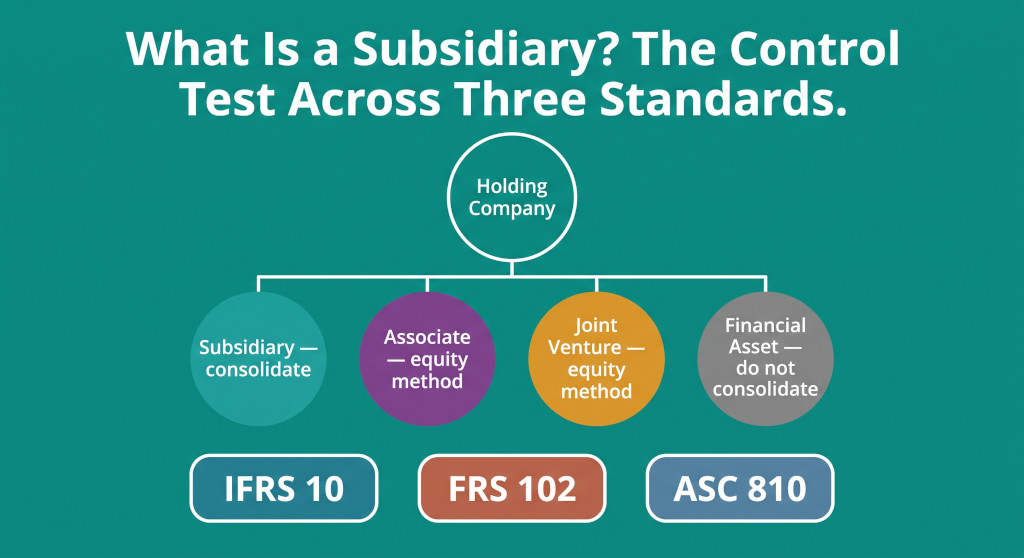
Every entity in which a group holds an interest is placed into one of four categories. The category determines the accounting treatment — specifically whether the entity is consolidated line by line, accounted for under the equity method, proportionately consolidated, or treated as a financial asset:
The control test is the gate at the top of this hierarchy. Everything else — intercompany eliminations, goodwill, NCI — only becomes relevant after control has been established. An entity that fails the control test is either an associate or a financial asset, and consolidation mechanics do not apply to it.
IFRS 10: The Three-Part Control Model
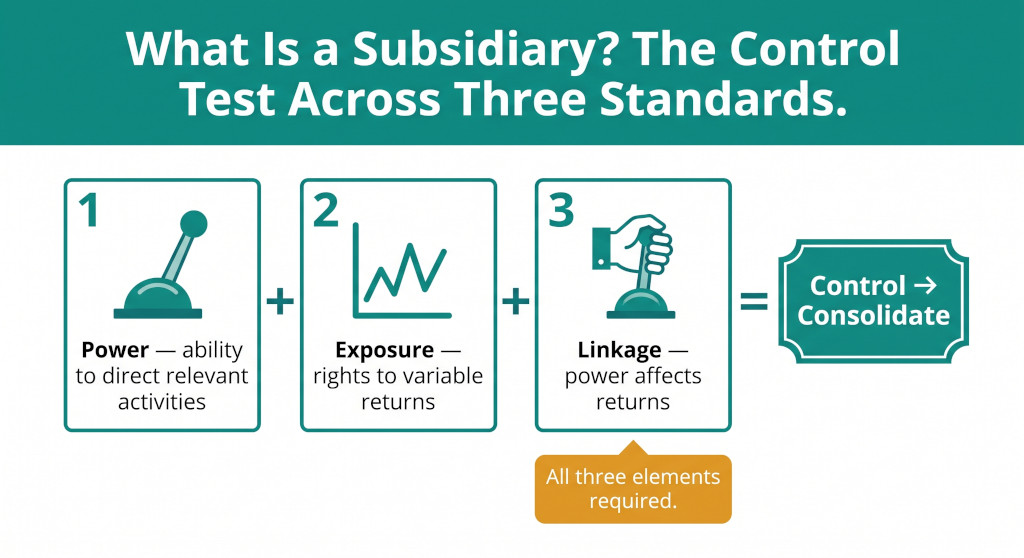
IFRS 10 replaced IAS 27’s consolidation guidance in 2013 with a single, principles-based control model that applies to all investees — operating companies, structured entities, investment funds, and special purpose vehicles — without exception. The central requirement is that all three elements of control must be present simultaneously.
The investor has existing rights that give it the current practical ability to direct the relevant activities of the investee — those activities that most significantly affect the investee’s returns. Rights can come from voting shares, contractual arrangements, or a combination. The key word is “current” — the ability must be exercisable now, not only in a future event.
The investor is exposed to, or has rights to, returns that can vary as a result of the investee’s performance. Variable returns include dividends, interest on loans where default risk affects the return, changes in the value of the investment, management fees contingent on performance, and residual interests in structured entities. Returns must be variable — not fixed regardless of performance.
There must be a link between the investor’s power (element 1) and the variable returns it receives (element 2). The investor can use its power to direct the relevant activities in a way that affects the magnitude of those returns. This linkage test prevents consolidation in cases where an investor technically has rights but cannot use them to influence its own financial outcomes.
De Facto Control Under IFRS 10
IFRS 10 explicitly accommodates de facto control — the situation where a minority shareholder controls an entity in practice, even though no single entity holds more than 50% of the voting rights. An investor with 40% of the voting rights may have power if the remaining 60% is dispersed among a large number of shareholders who historically do not organise or coordinate their votes. In that situation, the 40% holder can direct relevant activities without needing majority support, because the other shareholders do not exercise their voting rights in a coordinated way.
The assessment of de facto control is fact-specific and requires evidence: historical attendance and voting patterns at shareholder meetings, the relative size of shareholding blocks, whether other shareholders have any incentive to vote collectively, and whether any formal or informal agreements govern how votes are cast.
Protective Rights vs Substantive Rights
IFRS 10 distinguishes between protective rights — which do not confer power — and substantive rights that give current ability to direct relevant activities. A lender’s right to approve capital expenditure above a threshold, a minority shareholder’s right to block a sale of the business, or a regulator’s right to restrict certain transactions are all protective rights. They protect the holder’s interest but do not give the holder the ability to direct the investee’s day-to-day operations. Only substantive rights — those that give the holder genuine operational direction — contribute to power under IFRS 10.
FRS 102: The Governance-Based Definition
FRS 102 Section 9 defines a subsidiary as an entity that is controlled by a parent. Control is defined in paragraph 9.4 as “the power to govern the financial and operating policies of an entity so as to obtain benefits from its activities.” This is the older IAS 27-style definition — governance-focused rather than the IFRS 10 three-part model — and it remains the operative definition for UK GAAP groups reporting under FRS 102.
The FRS 102 definition establishes a rebuttable presumption that control exists when a parent owns more than half the voting power of an entity. The presumption can be rebutted if there is clear evidence that ownership does not translate into governance control — for example, where a shareholder agreement gives operational control to another party regardless of share ownership.
Control can also exist without majority ownership under FRS 102 in four situations identified in paragraph 9.4:
- Voting agreement: power over more than half the voting rights by virtue of an agreement with other investors.
- Statute or agreement: power to govern the financial and operating policies under a statute or an agreement.
- Board appointment: power to appoint or remove the majority of the members of the board of directors (or equivalent governing body).
- Casting votes: power to cast the majority of votes at meetings of the board (or equivalent).
The FRS 102 model is less granular than IFRS 10’s three-part test. It does not formally separate “power” from “returns” in the way IFRS 10 does. For most straightforward corporate structures — where majority equity ownership comes with the right to appoint directors and govern operations — the two standards reach the same conclusion. The differences emerge in structured entities, SPVs, and contractual arrangements where the link between equity ownership and operational governance is not clean.
ASC 810: Two Models in One Standard
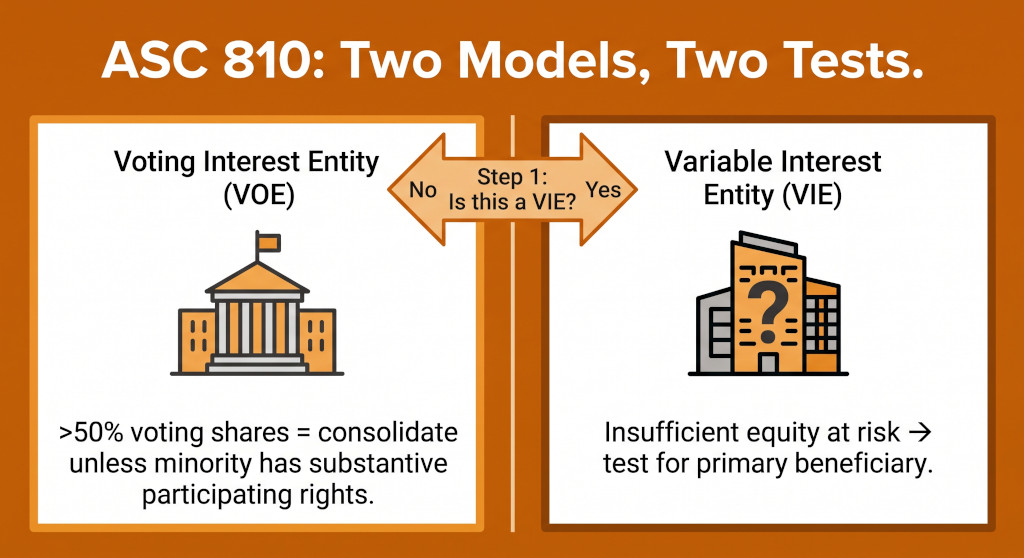
US GAAP takes a structurally different approach. ASC 810 contains two consolidation models that operate in parallel, and the first task in any US GAAP consolidation assessment is determining which model applies to the entity being evaluated.
Model 1: Voting Interest Entities (VOE)
For a typical corporate entity — one where the equity holders collectively possess the power to direct the entity’s activities — the voting interest model applies. The primary test is simple: does any single investor hold a majority of the outstanding voting interests? If yes, that investor generally consolidates the entity.
However, majority ownership does not automatically produce consolidation if the minority shareholders have substantive participating rights — rights that give them the genuine ability to block or participate in significant operating and financing decisions. If minority shareholders can effectively veto decisions such as capital expenditure above a threshold, entering new lines of business, or issuing additional equity, they may have participating rights substantive enough to overcome the majority holder’s presumption of control. This is the most common US GAAP nuance in structures where a 51% holder’s effective control is limited by contractual protections given to the 49% minority.
Model 2: Variable Interest Entities (VIE)
The VIE model is the distinctive US GAAP concept with no direct equivalent in IFRS or FRS 102. It targets entities that are structured in a way that separates economic exposure from voting rights — so that looking only at who holds voting shares would miss who actually bears the risks and receives the rewards of the entity’s activities.
An entity is a VIE if either of the following is true:
- Insufficient equity at risk: the entity does not have enough equity investment to finance its activities without additional subordinated financial support from other parties. The equity is a nominal amount relative to the entity’s activities — the entity is primarily financed by debt, guarantees, or other forms of support rather than genuine equity at risk.
- Equity holders lack control characteristics: the equity investors as a group do not have the power to direct the entity’s activities through voting or similar rights, or they do not absorb the expected losses, or they do not receive the expected residual returns — the three defining characteristics of a controlling equity interest.
If the entity is a VIE, the consolidation question shifts from “who holds the majority vote?” to “who is the primary beneficiary?” The primary beneficiary is the party that has both: (a) power to direct the activities that most significantly affect the VIE’s economic performance, and (b) the obligation to absorb losses or the right to receive benefits that could potentially be significant to the VIE. That party consolidates the VIE, regardless of how much equity it holds.
SPVs used in securitisation, structured finance vehicles, real estate entities with thin equity, leveraged buyout structures, and franchise entities are all commonly assessed under the VIE model. For a detailed walkthrough of how ASC 810 applies to multi-entity groups more broadly, see the US GAAP consolidation practical guide.
Cross-Standard Comparison: Where the Standards Agree and Diverge
| Scenario | IFRS 10 | FRS 102 | ASC 810 |
|---|---|---|---|
| Simple majority: investor holds >50% voting shares, no restrictions | Consolidate ✓ (power + returns present) | Consolidate ✓ (rebuttable presumption confirmed) | Consolidate ✓ (VOE majority-ownership test) |
| 40% ownership, dispersed remaining 60%, no organised bloc | Likely consolidate (de facto control analysis) | Possibly consolidate (governance-based, fact dependent) | Unlikely under VOE; VIE model may apply |
| 51% ownership, minority holds substantive veto rights on key decisions | Consolidate (minority rights are protective, not power) | Consolidate (majority ownership presumption) | May not consolidate (substantive participating rights override) |
| 0% equity, SPV structured to pass all risks and rewards to one party | Consolidate (power + variable returns + linkage) | Likely consolidate (governance via contractual arrangement) | Consolidate (VIE primary beneficiary) |
| 50/50 joint venture, equal voting and governance | Joint control → equity method (not consolidation) | Joint venture → equity method | VOE: neither party has majority; VIE: test required |
| 30% with board seat and day-to-day management contract | Depends on scope of management rights — may have power | Power to govern may arise from management contract | VIE test likely; primary beneficiary if power + returns |
The Practical Decision Flowchart
IFRS 10: Determining Control
ASC 810: Determining Consolidation
Edge Cases That Require Careful Assessment
| Scenario | What to Look For |
|---|---|
| Minority stake with a management contract | A party holding 30% equity but also holding a management contract that gives it day-to-day operational control (hiring, pricing, capital decisions) may have power under IFRS 10. Review the scope of the management contract against the relevant activities of the investee. If the management contract covers the activities that most significantly affect returns, power may reside with the manager, not the majority shareholder. |
| Call options and potential voting rights | Under IFRS 10, potential voting rights — such as call options that are in-the-money and currently exercisable — must be considered in the power assessment. An investor with 45% of current voting rights plus a currently exercisable call option over another 10% may have power. The option must be substantive (real economic incentive to exercise) to count. |
| Trust or foundation as intermediate holding entity | Structures where a trust or foundation holds shares on behalf of beneficiaries require analysis of who, in substance, has the practical ability to direct the trust’s exercise of its shareholder rights. The legal holder of the shares may not be the party with power — the party with the ability to instruct the trustee may control the investee. |
| 50/50 with a casting vote | Where two parties each hold 50% and one party holds a casting vote or tie-breaking right at board level, that party may have power. The casting vote must be substantive — regularly applicable, not only in extreme deadlock situations — to be considered power rather than a protective right. |
| Investment fund with fund manager | IFRS 10 paragraphs B58–B72 address the principal-agent question: is the fund manager acting as an agent (directing on behalf of investors, who are the principals) or as a principal (with its own exposure to variable returns)? A fund manager with significant variable performance fees and co-investment may be consolidating investees as a principal. A straightforward fee-for-service manager with removal rights held by investors is typically an agent and does not consolidate. |
Where Control Ends: The Boundary Between Subsidiaries and Associates
The line between control and significant influence matters as much as the existence of control itself. An entity where the group has significant influence but not control is an associate — accounted for under the equity method, not consolidated. Significant influence is presumed when a party holds 20–50% of the voting rights, although like the control test, the threshold is rebuttable in either direction: a 15% holder with a board seat and veto rights may have significant influence; a 25% holder with no governance participation may have neither control nor significant influence.
The equity method and the full consolidation treatment produce fundamentally different financial statements. Under full consolidation, the group’s revenue, assets, and liabilities are grossed up by the subsidiary’s 100% figures (with NCI deducted); under the equity method, only a single line appears on the balance sheet (the investment carrying amount) and a single line in P&L (the share of profit or loss). A misclassification — treating an entity as an associate that should be a subsidiary, or vice versa — is not a presentation error; it changes the reported shape of the entire group. For the equity method mechanics, see equity method accounting in group consolidation.
The classification question matters again each time there is a change in ownership. Acquiring additional shares that push ownership above the control threshold triggers IFRS 3 and the step acquisition accounting — remeasurement of the previously-held interest, OCI recycling, and a fresh goodwill calculation. Disposing of shares below the control threshold removes the entity from consolidation scope and triggers a disposal gain or loss calculation. The control boundary is not static; it must be reassessed whenever the group’s ownership percentage or governance arrangements change. For acquisition accounting under IFRS 3 and for consolidating a subsidiary where ownership is less than 100%, see the linked guides.
Currency: Which Standard Governs the Control Assessment?
A group prepares its consolidated financial statements under one reporting framework — the framework mandated by its jurisdiction or chosen by its board. The framework that governs the group’s consolidated accounts is the framework whose control test applies. If the group reports under IFRS, IFRS 10 governs consolidation scope regardless of the framework the individual subsidiaries use for their own statutory accounts. A subsidiary that prepares its entity accounts under FRS 102 is still assessed for consolidation under IFRS 10 if the parent reports under IFRS.
For the practical accounting required when entity-level and group-level standards differ — including conversion journals and currency translation — see the cross-GAAP consolidation guides covering combinations such as FRS 102 subsidiary into an IFRS parent and currency translation across IAS 21, ASC 830, and FRS 102.
Once consolidation scope is confirmed — the entities that pass the control test are identified — the mechanics of the consolidation begin: intercompany eliminations, goodwill and NCI recognition at acquisition, and the month-end close process. For a full worked example from entity trial balances through to completed consolidated financial statements, see a complete consolidation worked example. For special-form entities that require additional scoping analysis before the standard model applies, see consolidating an LLP into a corporate group.
Once scope is confirmed, consolidation starts here
BrizoConsol handles consolidation once you know which entities are in scope — connecting to their source systems, mapping accounts, eliminating intercompany transactions, and producing consolidated statements across IFRS, FRS 102, and US GAAP groups. See It in Action