AASB 3 Business Combinations: A Practical Guide for Australian Multi-Entity Groups
When Sophie’s Melbourne-based consulting group acquired a smaller competitor for $2.8 million, the deal took six months of negotiation and four weeks of due diligence. The accounting entry took her bookkeeper about twenty minutes: debit Goodwill $2.2 million, credit Cash $2.8 million, and credit the net book value of acquired assets as a plug. Simple, tidy, done.
The auditors did not agree. At the year-end audit, they came back with a question: had Sophie’s team identified and measured all of the acquiree’s identifiable intangible assets separately? The acquired firm had a strong client list, a recognised brand in its niche, and several long-term retainer agreements. Under AASB 3, each of those represented a separately identifiable intangible asset that should have been recognised at fair value at the acquisition date — not buried inside goodwill.
The result was a purchase price allocation exercise that took two months, produced a valuation report from an external specialist, and reclassified $630k of the goodwill balance into separately recognised intangibles. The goodwill figure on the consolidated balance sheet came down by that amount. Three new amortisation charges appeared on the consolidated income statement. And a deferred tax liability appeared that had not been anticipated.
Stop building consolidations in spreadsheets.
BrizoConsol automates multi-entity consolidation — setup in minutes, reports the same day.
This scenario repeats itself every time an Australian group makes its first significant acquisition without understanding what AASB 3 actually requires. This guide explains the acquisition method in full, with particular focus on the purchase price allocation — the step where most errors occur.
What AASB 3 Requires
AASB 3 Business Combinations prescribes the accounting for transactions in which one entity obtains control of one or more businesses. It requires all business combinations to be accounted for using the acquisition method. The pooling of interests method — which some older Australian groups may have used historically — is prohibited.
Like AASB 10, AASB 3 is Australia’s adoption of its IFRS equivalent (IFRS 3) with minimal modification. The acquisition method, the identifiability criteria for intangibles, the goodwill calculation, and the measurement period rules are substantively identical. Where differences exist, they are in scope paragraphs and cross-references to Australian legislation rather than in the recognition and measurement requirements themselves.
AASB 3 applies to transactions where an acquirer obtains control of a business — not merely a group of assets. Whether a transaction involves a business or an asset is a judgement, and AASB 3 provides a “concentration test” as a practical expedient: if substantially all of the fair value of the gross assets acquired is concentrated in a single identifiable asset or group of similar assets, the set is not a business. This matters because the acquisition method only applies to business combinations; asset acquisitions are accounted for differently, with no goodwill recognised and no requirement to identify intangibles separately.
The Four Steps of the Acquisition Method
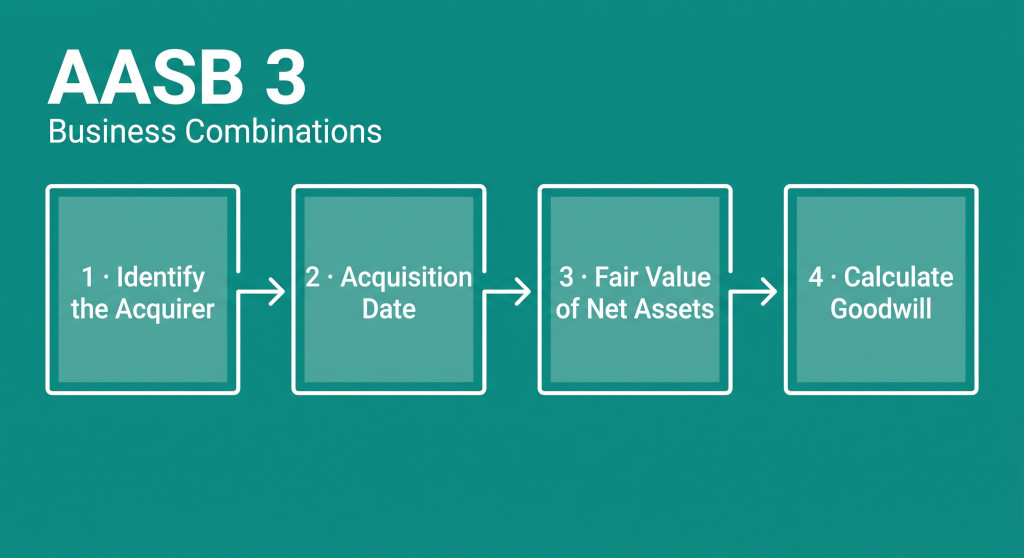
AASB 3 requires the acquirer to apply the acquisition method, which involves four steps applied as at the acquisition date.
Step 1: Identify the acquirer
The acquirer is the entity that obtains control of the acquiree. In most transactions this is obvious — the entity that pays the consideration and whose shareholders end up controlling the combined group. In reverse acquisitions (where the legal subsidiary is the accounting acquirer) and in some merger structures, the identification requires more care. The AASB 3 guidance points to the AASB 10 control definition as the basis for identifying the acquirer.
Step 2: Determine the acquisition date
The acquisition date is the date on which the acquirer obtains control. This is normally the date of completion — when legal title transfers and the acquirer can direct the acquiree’s activities. It is not necessarily the date of exchange of contracts, the date conditions are satisfied, or the date the board resolution approves the deal. Getting the acquisition date right matters because it is the reference point for measuring all assets, liabilities, NCI, and consideration.
Step 3: Recognise and measure the identifiable assets, liabilities, and NCI
This is the purchase price allocation step, and the one most likely to be done incorrectly. It is covered in detail below.
Step 4: Recognise and measure goodwill or a bargain purchase gain
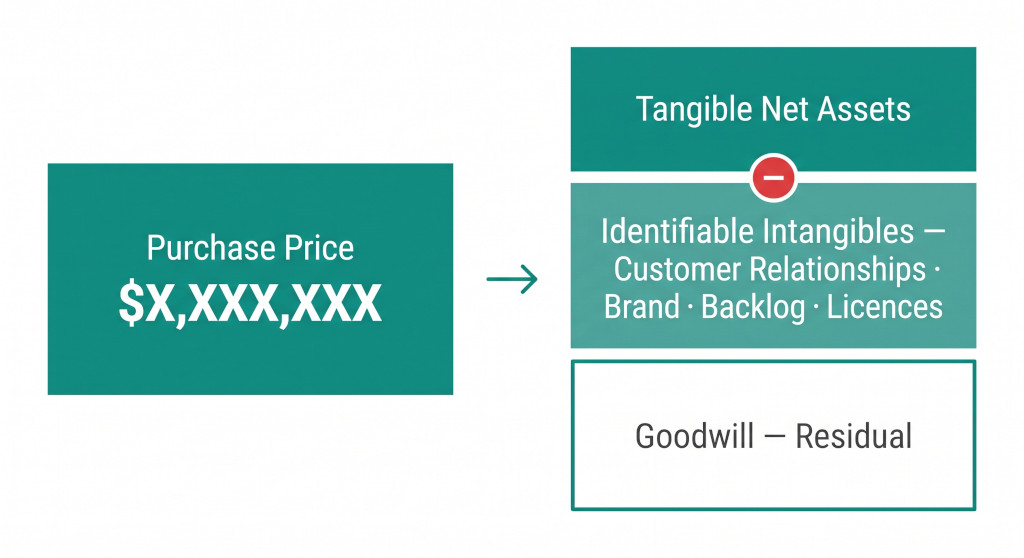
Goodwill is the residual: the excess of the consideration transferred (plus any NCI recognised, plus any previously-held interest remeasured to fair value) over the fair value of the identifiable net assets acquired. If the fair value of net assets exceeds the consideration, a bargain purchase gain arises and is recognised immediately in the consolidated income statement. Negative goodwill cannot be deferred or taken to equity — it goes to profit on acquisition day.
Step 3 in Detail: The Purchase Price Allocation
At the acquisition date, the acquirer must recognise every identifiable asset and liability of the acquiree at its fair value — regardless of whether it appeared in the acquiree’s pre-acquisition financial statements. This is the rule that trips up most Australian groups making their first acquisition.
The acquiree’s balance sheet shows assets and liabilities at their carrying values, which may reflect historical cost, depreciated cost, or book value under the acquiree’s accounting policies. None of those values carry across automatically. Everything must be remeasured to fair value at the acquisition date.
For tangible assets — property, equipment, inventory, receivables — this usually means confirming that the carrying value approximates fair value or making specific adjustments (write-downs to net realisable value for aged receivables, uplifts for property held below market value, and so on). The more significant work, almost always, is on intangible assets.
Which Intangible Assets Must Be Recognised Separately?
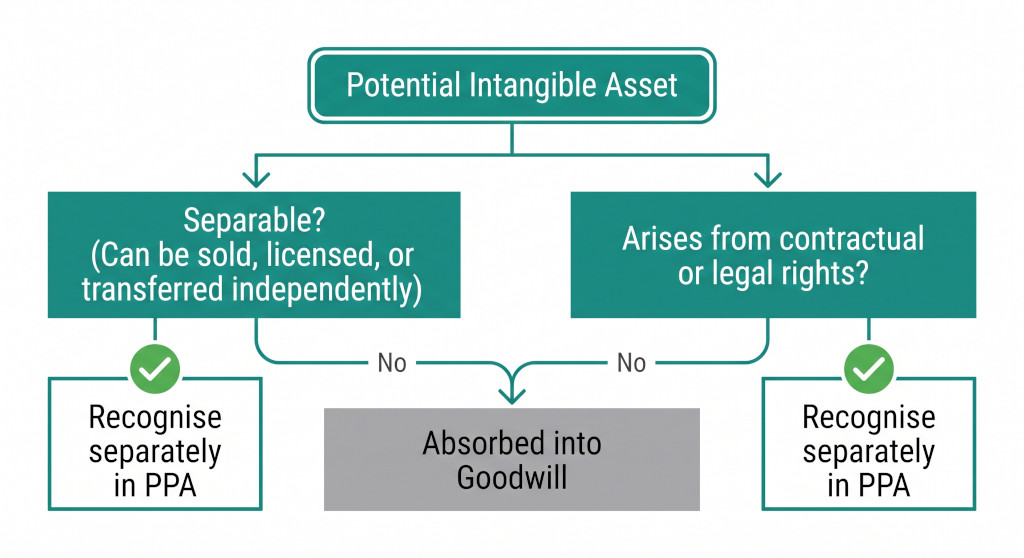
AASB 3 requires an intangible asset to be recognised separately from goodwill if it meets the identifiability criteria in AASB 138 Intangible Assets. An asset is identifiable if it is either:
- Separable — capable of being separated from the entity and sold, transferred, licensed, rented, or exchanged, either individually or together with a related contract, asset, or liability; or
- Arising from contractual or other legal rights — regardless of whether those rights are separable.
This is a much lower bar than many finance teams assume. An intangible asset does not need to be capable of being sold independently of the rest of the business to qualify — it only needs to be separable in principle, or to arise from a contract or legal right. In practice, this means that the following intangibles almost always require separate recognition in an Australian business combination:
| Intangible asset | Why it qualifies | Common valuation approach |
|---|---|---|
| Customer relationships / client lists | Separable — could be sold or licensed; often also contractual | Multi-period excess earnings method (MPEEM) |
| Brand names / trade names | Separable — can be licensed to a third party | Relief from royalty method |
| Order backlog / contracted revenue | Contractual — arises from signed contracts | Income approach (present value of contracted margins) |
| Non-compete agreements | Contractual — exists by virtue of a signed agreement | Income approach (with and without method) |
| Licences and permits | Contractual / legal right | Relief from royalty or replacement cost |
| Developed technology / software | Separable — can be licensed | Relief from royalty or replacement cost |
| Favourable lease terms | Contractual — below-market leases represent a right with value | Income approach (present value of rent savings) |
The assembled workforce — the value of having an experienced team in place — does not meet the identifiability criteria and cannot be recognised separately. It is absorbed into goodwill. Neither can customer goodwill in the broad sense (reputation, relationships not formalised in contracts). The distinction between separately identifiable intangibles and goodwill is one of the more judgemental areas in AASB 3 practice.
The Deferred Tax Effect of Recognising Intangibles
When intangible assets are recognised at fair value in the consolidated accounts but have a lower (often zero) tax base — which is common in Australian share acquisitions, where the acquiree’s tax values carry across unchanged — a temporary difference arises. Under AASB 112, the acquirer must recognise a deferred tax liability equal to the tax rate multiplied by the temporary difference.
This deferred tax liability is recognised as part of the acquisition accounting — it is a liability of the acquiree at the acquisition date for AASB 3 purposes, even though no such liability existed in the acquiree’s pre-acquisition accounts. And because it increases the recognised liabilities, it increases goodwill by the same amount. The recognition of intangibles therefore has a double effect: goodwill falls by the fair value of the intangibles, but rises by the deferred tax liability on those intangibles. The net reduction in goodwill is the intangible value less the related deferred tax.
Worked Example: PPA for an Australian Professional Services Acquisition
Apex Advisory Group Pty Ltd acquires Meridian Consulting Pty Ltd — a competitor consulting firm — for $2.8 million cash (100% acquisition, no NCI). The acquisition date is 1 July. Apex’s accountant initially posts: goodwill $2.2 million, cash ($2.8 million), net assets acquired $0.6 million. The auditors require a full purchase price allocation. A valuation specialist is engaged.
Net assets at book value versus fair value
| Asset / Liability | Book value $’000 | Fair value adjustment $’000 | Fair value $’000 |
|---|---|---|---|
| Cash | 50 | — | 50 |
| Trade receivables | 320 | (20) | 300 |
| Equipment | 180 | — | 180 |
| Customer relationships (3-yr life) | — | 450 | 450 |
| Brand name (10-yr life) | — | 180 | 180 |
| Trade payables | (150) | — | (150) |
| Deferred tax liability on intangibles (25% × $630k) | — | (157.5) | (157.5) |
| Net identifiable assets at fair value | 400 | 452.5 | 852.5 |
Goodwill calculation
| Consideration transferred | $2,800k |
| Less: fair value of identifiable net assets acquired | ($852.5k) |
| Goodwill recognised on acquisition | $1,947.5k |
Compare this to the original “price minus book value” approach: $2,800k − $400k = $2,400k of goodwill. The correct PPA reduces goodwill by $452.5k — the net impact of $630k of separately recognised intangibles offset by $157.5k of deferred tax on those intangibles. The difference is material and would have been identified by the auditors regardless.
The acquisition journal
| Account | Dr | Cr |
|---|---|---|
| Cash (acquired) | $50,000 | |
| Trade receivables | $300,000 | |
| Equipment | $180,000 | |
| Customer relationships (intangible asset) | $450,000 | |
| Brand name (intangible asset) | $180,000 | |
| Goodwill | $1,947,500 | |
| Trade payables | $150,000 | |
| Deferred tax liability | $157,500 | |
| Cash (consideration paid) | $2,800,000 |
Acquisition-date journal recognising Meridian Consulting’s identifiable assets and liabilities at fair value, with goodwill as the residual. Customer relationships ($450k, 3-year life) and brand name ($180k, 10-year life) are recognised as separately identifiable intangible assets. Deferred tax liability of $157.5k arises on the fair value uplift of intangibles (25% × $630k) where the tax base is nil in a share acquisition structure.
Post-acquisition: amortisation of recognised intangibles
From the acquisition date, the separately recognised intangibles are amortised over their useful lives. This amortisation appears in the consolidated income statement only — it does not appear in Meridian’s own entity accounts, which continue to carry no intangible assets.
| Customer relationships — annual amortisation ($450k ÷ 3 years) | $150k |
| Brand name — annual amortisation ($180k ÷ 10 years) | $18k |
| Total annual intangibles amortisation in consolidated accounts | $168k |
This amortisation reduces consolidated profit relative to what the sum of entity profits would show — a consolidation-only difference that will need to be explained to management and the board every year until the intangibles are fully amortised. Goodwill, by contrast, is not amortised under AASB standards. It is tested annually for impairment under AASB 136.
Preparing consolidated accounts after an acquisition?
BrizoConsol lets you post acquisition journals, carry forward goodwill and intangibles, and automatically include the acquired subsidiary in every subsequent consolidation — without rebuilding the workings from scratch each period. See It In Action
The Measurement Period
AASB 3 allows a measurement period of up to twelve months from the acquisition date during which the acquirer can revise the provisional fair values assigned in the initial acquisition accounting. This is important in practice because the information needed to measure certain assets or liabilities at fair value may not be available immediately — valuation reports take time, legal disputes may be unresolved, and earn-out arrangements may have uncertain outcomes.
During the measurement period, the acquirer recognises the acquisition using provisional values and adjusts them retrospectively once the final measurements are determined. The adjustment is made as if the corrected fair value had been recognised on the acquisition date — which means restating the comparative balance sheet and recalculating goodwill.
Common mistake: Treating a measurement period adjustment as a current-period accounting change rather than a retrospective restatement. If the final valuation of customer relationships comes in $80k higher than the provisional figure, goodwill reduces by $80k (net of deferred tax) and the prior period balance sheet is restated — not the current period income statement.
Contingent Consideration
Many Australian acquisitions — particularly in professional services, technology, and healthcare — include earn-out provisions where additional consideration is payable if the acquiree meets post-acquisition performance targets. Under AASB 3, contingent consideration is included in the acquisition-date measurement of total consideration at its fair value on that date, regardless of whether it is probable that it will be paid.
After the acquisition date, contingent consideration classified as a financial liability is remeasured to fair value at each reporting date, with changes recognised in the consolidated income statement. This means that if post-acquisition performance is stronger than expected and the earn-out becomes more likely to vest, the liability increases and a loss is recognised in consolidated profit — even though the business is performing well. This counterintuitive result surprises many Australian CFOs who have structured earn-outs precisely to manage their acquisition risk.
Contingent consideration classified as equity (where settlement is in a fixed number of the acquirer’s own shares) is not remeasured after the acquisition date.
AASB 3 vs IFRS 3: What Is Actually Different for Australian Groups?
The practical differences are minimal. AASB 3 was issued as a near-verbatim adoption of IFRS 3 and the acquisition method is identical. Australian groups should be aware of two procedural differences:
First, AASB 3 includes additional guidance on not-for-profit entities and public sector entities, which is irrelevant for commercial groups but explains some of the structural differences between the AASB and IASB documents. Second, where a Tier 2 entity applies Reduced Disclosure Requirements under AASB 1053, certain note disclosures required by IFRS 3 are simplified — but the recognition and measurement requirements for goodwill, intangibles, NCI, and contingent consideration are unchanged. The consolidated balance sheet and income statement look the same regardless of which disclosure tier applies.
NCI in a Partial Acquisition: Full or Partial Goodwill?
When the acquisition is less than 100%, the acquirer must also measure and recognise the non-controlling interest at the acquisition date. AASB 3 allows a choice between two methods for each individual acquisition:
- Partial goodwill method: NCI is measured at the NCI’s proportionate share of the acquiree’s identifiable net assets. Only the parent’s share of goodwill is recognised.
- Full goodwill method: NCI is measured at fair value. Both the parent’s and NCI’s share of goodwill are recognised, resulting in a higher goodwill balance and a higher NCI balance on the consolidated balance sheet.
The full vs partial goodwill post explains the balance sheet consequences and the impairment test differences between the two methods. For most Australian SME groups the partial goodwill method is simpler and more commonly applied, as it avoids the need to value the NCI stake separately. The NCI at acquisition guide works through both methods with numbers.
Practical Checklist: AASB 3 for Australian Groups
- Determine whether you have acquired a business or a group of assets. Apply the AASB 3 concentration test. If substantially all value is in a single asset, it may be an asset acquisition — different accounting applies.
- Identify the acquirer using the AASB 10 control criteria, not just the legal form of the transaction.
- Fix the acquisition date precisely — the date control transfers, not the exchange date or signing date.
- Obtain the acquiree’s trial balance at the acquisition date and begin the PPA process promptly. Do not file provisional values and forget to finalise them.
- Systematically identify all intangible assets using the separability and contractual/legal rights tests. Do not default to treating the entire excess purchase price as goodwill without this analysis.
- Engage a valuation specialist for significant intangibles. Customer relationships and brand names require disciplined methodology (MPEEM, relief from royalty) that most finance teams are not equipped to apply independently.
- Calculate and recognise deferred tax on all fair value uplifts — including intangibles — where the tax base differs from the accounting fair value. The DTL increases goodwill by the same amount, so the net reduction in goodwill is the intangible fair value minus the DTL.
- For partial acquisitions, choose and document the NCI measurement method (full or partial goodwill) for each acquisition. The election is per acquisition, not a blanket policy.
- Identify any contingent consideration included in the deal and measure it at fair value on the acquisition date. Classify it as financial liability or equity and establish the remeasurement process going forward.
- Set up the measurement period timeline. You have twelve months from the acquisition date to finalise all fair values. Track which provisional values remain open and ensure the valuation workings are available before the measurement period closes.
- Establish amortisation schedules for each separately recognised intangible. These amortisation charges appear in the consolidated income statement every period and must be explained to management alongside the entity-level results.
- Schedule the annual goodwill impairment review under AASB 136 as a standard year-end procedure. Goodwill does not amortise — it must be tested every year, even if there are no indicators of impairment.
Bring your acquisition into the group consolidation cleanly
BrizoConsol handles the full post-acquisition consolidation — elimination journals, goodwill, intangibles amortisation, NCI movements, and all subsequent intercompany eliminations — without spreadsheets. Start free and consolidate your first acquisition today. Start Free Trial