Goodwill Allocated to a Cash-Generating Unit That Includes a Foreign Subsidiary: How to Retranslate, Test, and Record the Impairment at Consolidation

When a group acquires a foreign subsidiary, goodwill is recognised at the acquisition date in the subsidiary’s functional currency. From that point forward, the goodwill must be retranslated at every subsequent closing rate, tested for impairment annually under IAS 36, and — if an impairment loss arises — recorded correctly in the consolidated financial statements. This is one of the more technically demanding tasks in group reporting, yet it lands routinely on the desks of controllers and finance managers who may be juggling consolidations across several entities simultaneously. This article walks through the mechanics in a practical, step-by-step way.
Why Goodwill in a Foreign CGU Is Different
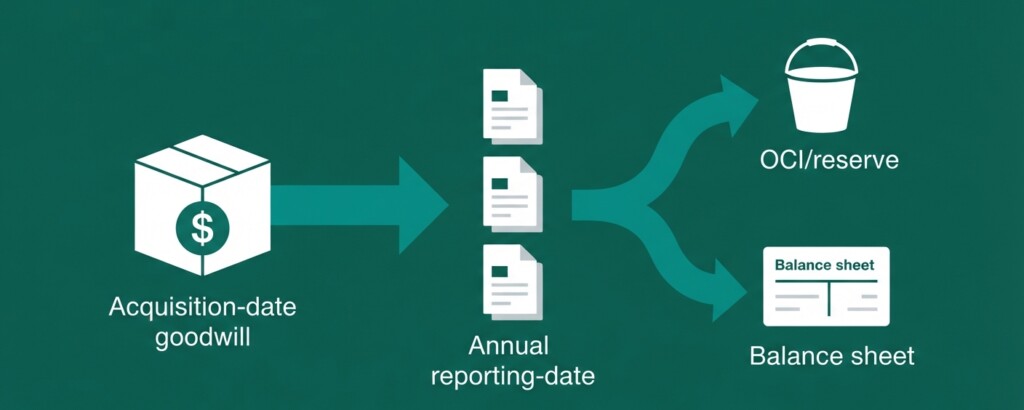
Under IAS 21, goodwill arising on the acquisition of a foreign operation is treated as an asset of that foreign operation. That means it is expressed in the subsidiary’s functional currency and retranslated to the group’s presentation currency at the closing rate at each reporting date. The resulting exchange difference goes to other comprehensive income (OCI) — specifically the foreign currency translation reserve (FCTR) — not to the income statement.
Separately, IAS 36 requires goodwill to be allocated to cash-generating units (CGUs) or groups of CGUs and tested for impairment at least annually. When the CGU contains a foreign subsidiary, the impairment test must be performed in the functional currency of that subsidiary before the result is translated back to the presentation currency. Mixing up the order — running the test in the presentation currency and then asking whether an impairment exists — is one of the most common errors seen in practice.
Stop building consolidations in spreadsheets.
BrizoConsol automates multi-entity consolidation — setup in minutes, reports the same day.
Key principle: the IAS 36 impairment test for a foreign CGU is conducted in the subsidiary’s functional currency. The impairment loss, once determined, is then translated to the presentation currency at the rate on the date of the test (usually the closing rate at the reporting date). Do not test in the presentation currency and back into functional currency.
Step 1 — Retranslating Goodwill at the Closing Rate
Suppose a UK group (presentation currency: GBP) acquired a Polish subsidiary three years ago. At the acquisition date, goodwill was measured at PLN 4,800,000. The spot rate at acquisition was 0.20 (PLN/GBP), so goodwill appeared in the consolidated balance sheet at £960,000.
At the current year-end, the closing rate has moved to 0.19 (PLN/GBP). The goodwill in the consolidated balance sheet must be restated to reflect this new rate. The retranslation calculation is straightforward:
| Goodwill in functional currency (PLN) | PLN 4,800,000 |
| Closing rate (PLN to GBP) | 0.19 |
| Goodwill at closing rate (GBP) | £912,000 |
| Goodwill at prior year closing rate (0.20) | £960,000 |
| Exchange loss on retranslation (OCI) | –£48,000 |
The £48,000 movement is a translation loss that goes to OCI and accumulates in the FCTR. It does not pass through the consolidated income statement. In a manual Excel consolidation, this movement is easy to miss or to accidentally route through profit or loss, particularly when multiple currencies and multiple CGUs are involved.
Step 2 — Running the Impairment Test in Functional Currency
The impairment test compares the carrying amount of the CGU (including goodwill) with its recoverable amount. Recoverable amount is the higher of fair value less costs of disposal and value in use (VIU). For most SME groups, VIU — based on discounted cash flow projections — is the practical route.
Continuing the example: for consolidated impairment testing purposes, the carrying amount of the Polish CGU in functional currency stands at PLN 9,600,000 (including the PLN 4,800,000 goodwill). Management has prepared a VIU calculation in PLN that yields a recoverable amount of PLN 8,200,000. There is an impairment of PLN 1,400,000.
| Item | PLN | GBP (at 0.19 closing rate) |
|---|---|---|
| Carrying amount of CGU (incl. goodwill) | 9,600,000 | £1,824,000 |
| Recoverable amount (VIU) | 8,200,000 | £1,558,000 |
| Impairment loss | 1,400,000 | £266,000 |
| Of which: allocated first to goodwill | 1,400,000 | £266,000 |
| Remaining impairment to other assets | — | — |
Under IAS 36, impairment losses are allocated first to reduce goodwill to zero before any reduction is applied to other assets in the CGU. In this case, the full PLN 1,400,000 falls within the goodwill balance of PLN 4,800,000, so no other asset is written down. The impairment loss is then translated to GBP at the closing rate of 0.19, giving £266,000.
Once goodwill is impaired, the write-down cannot be reversed in a subsequent period even if recoverable amount recovers. This is an explicit prohibition in IAS 36.124. Controllers should ensure that the impairment is recorded permanently and that prior-period comparative disclosures are not inadvertently restated to show a recovery.
Step 3 — Recording the Impairment in the Consolidation Journal
The impairment loss of £266,000 is recognised in the consolidated income statement as an operating expense. The credit reduces the carrying amount of goodwill on the consolidated balance sheet. Because the goodwill sits at the group level (it arose on consolidation, not in the subsidiary’s own books), the journal is a consolidation adjustment, not an entry in the subsidiary’s statutory accounts.
| Account | Dr | Cr |
|---|---|---|
| Impairment loss — goodwill (P&L) | 266,000 | |
| Goodwill (consolidated balance sheet) | 266,000 |
To record impairment of goodwill allocated to the Polish CGU, translated at the closing rate of 0.19 PLN/GBP. Loss recognised in consolidated income statement. Goodwill carrying amount reduced from £912,000 to £646,000.
After this entry, goodwill on the consolidated balance sheet is £646,000 (PLN 3,400,000 at 0.19). In subsequent periods, this reduced PLN balance will continue to be retranslated at each new closing rate, and future translation differences will continue to flow through OCI.
The Interaction Between Impairment and the FCTR
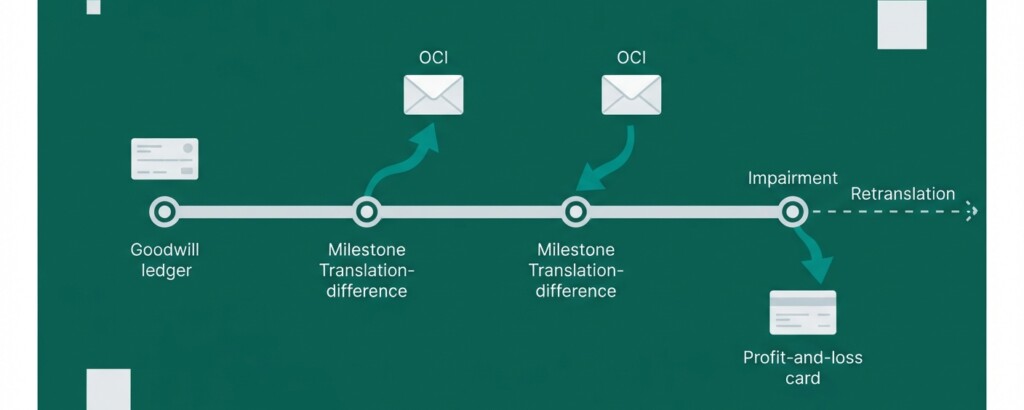
A subtlety that catches many finance teams is the relationship between the impairment loss and the cumulative FCTR balance. The impairment loss goes to the income statement. The FCTR continues to accumulate translation differences on the remaining goodwill balance. Under IAS 21.49, an impairment write-down is not a partial disposal and does not trigger any reclassification of accumulated FCTR to profit or loss. When the subsidiary is eventually disposed of, the cumulative FCTR associated with the foreign operation — including any amounts that accrued before and after the impairment — is recycled in full to the income statement as part of the disposal gain or loss.
In the meantime, the FCTR balance needs to be tracked separately for each foreign operation. Groups that consolidate in Excel often mistakenly attempt to reclassify FCTR at the date of impairment or lose track of entity-level reserves, creating reconciliation problems at disposal. A dedicated consolidation tool that tracks FCTR movements by entity and by asset is significantly more reliable for this purpose.
Non-Controlling Interests and Goodwill Impairment
Where the group has used the full goodwill method (under IFRS 3, recognising NCI at fair value at acquisition), the goodwill on the balance sheet includes a portion attributable to the NCI. In that case, the impairment loss must also be allocated between the owners of the parent and the NCI on the same basis as that on which profit or loss is allocated.
If the group has used the partial goodwill method (NCI measured at the proportionate share of net identifiable assets), only the parent’s share of goodwill is on the balance sheet. The IAS 36 impairment test must then be ‘grossed up’ to include the notional NCI goodwill before the test is run, and any impairment loss is only recognised to the extent of the parent’s share. This grossing-up step is explicitly required by IAS 36.C4 and is frequently omitted in practice.
Partial goodwill method — impairment gross-up example: if the parent owns 80% of the subsidiary and partial goodwill on the balance sheet is PLN 4,800,000, the notional 100% goodwill is PLN 6,000,000 (PLN 4,800,000 ÷ 0.80). The impairment test runs using PLN 6,000,000. If the impairment on the grossed-up basis is PLN 1,750,000, only PLN 1,400,000 (80%) is recognised. The NCI’s share of PLN 350,000 is not recorded.
Common Errors and How to Avoid Them
- Running the IAS 36 test in the presentation currency rather than the functional currency of the CGU — this understates or overstates the impairment depending on currency direction.
- Routing the retranslation exchange difference on goodwill through profit or loss instead of OCI — this inflates or deflates reported earnings.
- Forgetting to gross up goodwill for the NCI when using the partial goodwill method — this leads to under-recognition of impairment.
- Reversing goodwill impairment in a later period when recoverable amount improves — this is prohibited under IAS 36.
- Losing track of the FCTR balance attributable to goodwill, making disposal accounting unreliable.
- Applying the closing rate to both the opening goodwill balance and the impairment charge without checking whether the impairment date differs from the year-end date — if material, the impairment should be translated at the rate on the date it occurred.
The Financial Close Workflow in Practice
For an SME group with two or three foreign subsidiaries, goodwill impairment testing at consolidation typically involves the following steps during the financial close cycle: collecting subsidiary trial balances in local currency; loading closing and average rates; retranslating each entity’s balance sheet and income statement; running goodwill retranslation as a separate consolidation adjustment; preparing and reviewing VIU models in each functional currency; comparing carrying amounts to recoverable amounts in functional currency; posting any impairment as a consolidation journal; and allocating impairment between parent and NCI.
In a manual Excel environment, each of these steps involves a separate worksheet or file, and the exchange rate inputs need to be consistent across all of them. Rate mismatches between the VIU model and the retranslation schedule are a common source of errors. A consolidation platform that centralises FX rates, links the retranslation to the impairment test inputs, and posts consolidation journals automatically eliminates most of these failure points.
Disclosure Requirements
IAS 36 requires extensive disclosure when goodwill is material. For each CGU to which significant goodwill is allocated, groups must disclose: the carrying amount of goodwill; the basis of recoverable amount (VIU or FVLCTD); key assumptions underlying the VIU model (growth rates, discount rate, terminal value assumptions); the period covered by management’s projections; and a sensitivity analysis showing the change in a key assumption that would cause the carrying amount to equal the recoverable amount.
Where an impairment has been recognised, the notes must describe the events and circumstances that led to it, the amount of the loss, and how recoverable amount was determined. These disclosures are often drafted by the finance team and need to be consistent with the numbers in the financial statements — a consistency that is easier to maintain when the impairment calculation flows directly from the consolidation model rather than sitting in a disconnected spreadsheet.
Summary: The Key Numbers to Reconcile
| Balance Sheet Line | Opening GBP | Retranslation (OCI) | Impairment (P&L) | Closing GBP |
|---|---|---|---|---|
| Goodwill — Polish CGU | £960,000 | –£48,000 | –£266,000 | £646,000 |
| FCTR (cumulative, goodwill portion) | £0 | –£48,000 | — | –£48,000 |
| Retained earnings (impairment charge) | — | — | –£266,000 | –£266,000 |
This three-column movement analysis — retranslation, impairment, closing balance — is the core reconciliation that auditors will expect to see. It proves that the exchange difference on goodwill has gone to OCI (not P&L) and that the impairment has gone to P&L (not OCI). Getting this split right in a multi-entity, multi-currency consolidation is where rigorous process and the right tools make a material difference to both the quality of the financial statements and the time taken to produce them.
Consolidate Across Multiple Entities Without the Spreadsheet Risk
BrizoConsol helps finance teams manage multi-entity consolidations, FX retranslation, intercompany eliminations, and group reporting in one connected platform — reducing the manual effort and reconciliation risk that comes with Excel-based close processes.