How Finance Teams Cut Consolidation Time from Days to Hours
Mark is the CFO of a UK professional services group with six entities spread across three countries. Every month, consolidation started on day one of the new period and finished — on a good month — nine working days later. He had a group controller, two management accountants, and an Excel workbook that had grown to 47 tabs over six years. The workbook had broken twice, once so badly that the group missed its bank reporting deadline. The process was not unusual. It was, as he later described it, “entirely normal and completely unsustainable.”
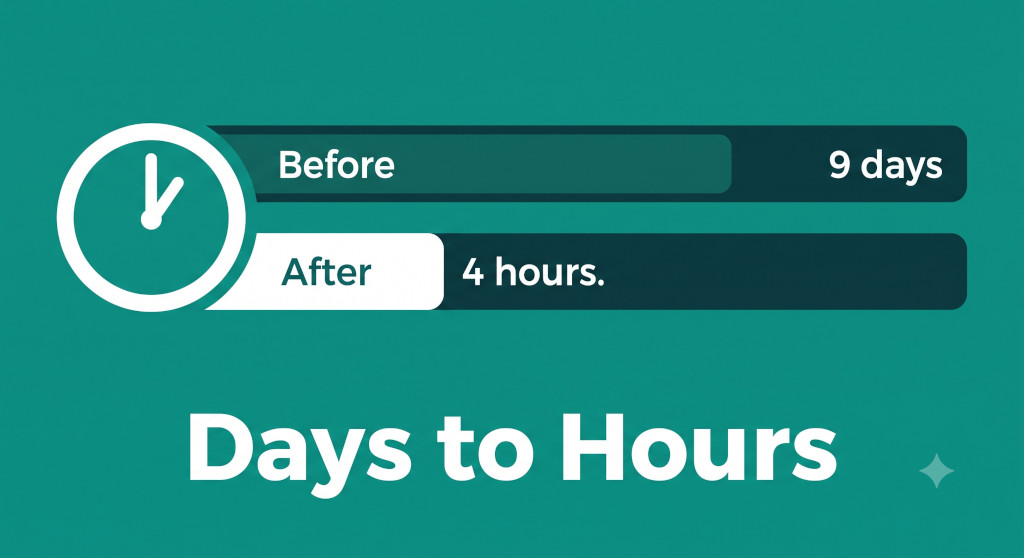
Eighteen months after implementing a structured overhaul — combining process changes, standardisation, and purpose-built consolidation software — the same six-entity group closes in under four hours. The group controller runs it herself on day two. Nobody is chasing entity accountants at 9 pm. The board pack goes out on day five instead of day fourteen.
The transformation wasn’t the result of one big change. It was six specific interventions, each of which removed a distinct category of wasted time. This post explains what those interventions are, why each one matters, and how to sequence them when you’re starting from scratch. If you want to benchmark where your process stands today, the 10 signs you’ve outgrown Excel for financial consolidation is a useful starting point before reading on.
Stop building consolidations in spreadsheets.
BrizoConsol automates multi-entity consolidation — setup in minutes, reports the same day.
Where the Time Actually Goes
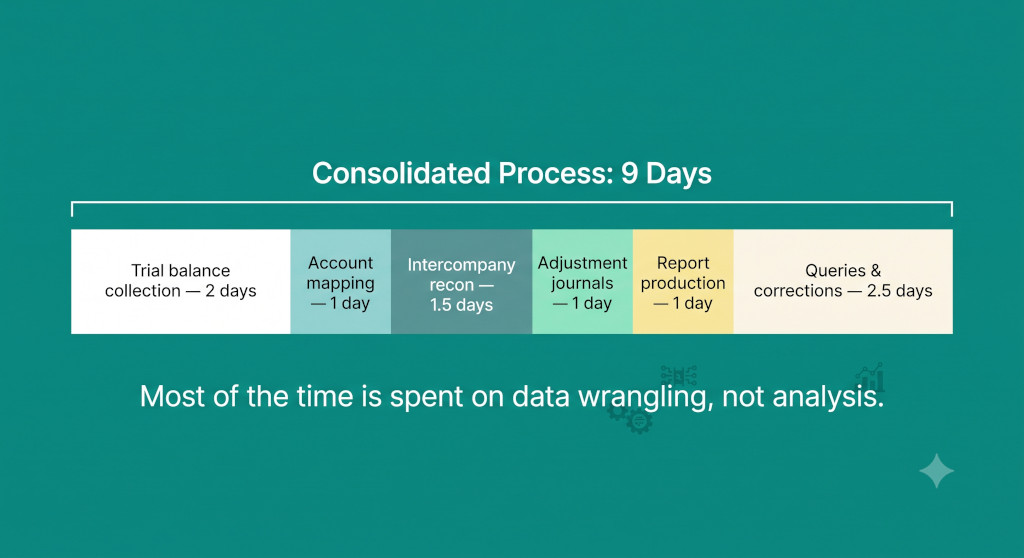
Before you can cut consolidation time, you need to know precisely where it’s being spent. Most finance leaders instinctively blame the volume of entities or the complexity of their intercompany structure. Those are real factors — but they are rarely the primary cause of a slow close. The time typically disappears in six places:
| Activity | Typical time consumed | Root cause |
|---|---|---|
| Collecting trial balances from entities | 1.5 – 2 days | Manual extraction, inconsistent formats, chasing late submissions |
| Remapping accounts to group chart | 0.5 – 1 day | Entities use different account codes; mapping is rebuilt each month |
| Intercompany reconciliation | 1 – 2 days | Differences discovered late; bilateral confirmation done manually |
| Posting consolidation adjustment journals | 0.5 – 1 day | Recurring journals re-entered manually; no audit trail from prior months |
| Producing consolidated reports | 0.5 – 1 day | Reports rebuilt in Excel from scratch each month |
| Queries, corrections, and re-runs | 2 – 3 days | Errors discovered downstream; entire process re-run to fix |
| Total | 6 – 10 days |
The insight this breakdown reveals is that the majority of close time is spent on data wrangling, not on accounting judgement. The work of deciding how to treat an acquisition, or calculating a goodwill impairment, or translating a foreign subsidiary’s equity — that work is genuinely complex and cannot be shortcut. But collecting a trial balance, remapping accounts, and re-entering the same depreciation elimination journal every month: none of that requires a qualified accountant’s time. It just requires the right system.
A useful diagnostic: if your group controller spends more than 20% of their close time on data collection and formatting, your process has a structural problem that no amount of effort will sustainably fix. The solution is structural, not behavioural.
Intervention 1: Build a Common Chart of Accounts and Keep It
The single highest-leverage change most multi-entity groups can make is standardising the chart of accounts across all entities. When every entity uses the same account codes — or at minimum maps to the same group codes — account remapping drops to zero. The trial balance arrives ready to consolidate. No spreadsheet gymnastics. No risk that account 4100 means revenue in one entity and intercompany income in another.
Many finance leaders resist this because they believe their entities are too operationally different to share a chart of accounts. In practice, entities need to agree only on the group-level account structure — typically 80 to 120 codes covering all material line items. Each entity can maintain as many local sub-codes as it likes underneath, provided they roll up to the agreed group code. This approach preserves local reporting flexibility without creating a remapping problem at group close.
The implementation work is front-loaded. Designing the group chart, mapping each entity’s existing accounts to it, and training local bookkeepers typically takes four to eight weeks. After that, the benefit is permanent: every month’s consolidation starts with properly structured data. The step-by-step guide to designing a common chart of accounts covers the design decisions in detail, including how to handle entities that use different accounting software with incompatible default codes.
Common mistake: Designing the group chart of accounts without consulting entity-level accountants. Local teams often have legitimate reasons for their account structure — tax reporting, regulatory requirements, or operational reporting — that will resurface as problems if not factored in upfront. Run a brief review with each entity before finalising the group structure.
Intervention 2: Lock Intercompany Reconciliations Before Close Starts
In most groups, intercompany reconciliation happens at the end of close — after the trial balances are collected, after the accounts are remapped, after the preliminary consolidation is run. A difference surfaces on the consolidated balance sheet, and then the investigation begins. This sequencing is the single biggest reason close runs long: intercompany problems are discovered when there is no time left to fix them properly.
The structural fix is to move intercompany reconciliation to day minus-three — three working days before the period end. Entity accountants confirm their intercompany balances at that point, while there is still time to post corrections in the same period. Differences discovered on day minus-three take twenty minutes to fix. The same difference discovered after the consolidation is run takes two days: investigation, correction, re-extraction, re-run.
Implementing this requires a small but firm cultural shift: the group must treat the intercompany reconciliation deadline as a hard close date, not an aspiration. Entity accountants who miss it create rework for the whole group. The intercompany reconciliation guide for multi-entity groups covers how to structure the bilateral confirmation process, and the multi-entity month-end close checklist provides a sequencing framework that puts reconciliation in the right place in the close timeline.
Intervention 3: Automate Recurring Adjustment Journals
Most groups have a set of consolidation adjustments that repeat every month with minor variations: goodwill amortisation (or impairment review), intercompany management fee eliminations, depreciation eliminations on intercompany asset sales, and minority interest calculations. These adjustments are often re-entered manually from a prior-period template, reviewed, corrected for small errors, and then posted. The entire process takes anywhere from two hours to a full day.
Recurring journals — journals that are set up once and repeat automatically each period, with values that either hold constant or are updated from a formula — eliminate this time almost entirely. The group controller reviews a pre-populated journal rather than building one. Any value that has changed (an updated loan balance, a revised minority percentage) is updated in one field, and the rest of the journal recalculates. For groups still entering these manually, automated intercompany journals explain how the automation works in practice, including how to handle adjustments that need monthly review rather than straight repetition.
The audit benefit is as important as the time saving. When journals are automated, there is a complete system-generated audit trail: who set it up, when it was last modified, what value was used each month. When journals are entered manually from a template, that trail is a folder of spreadsheet files that nobody can confidently date or version.
Intervention 4: Set Hard Entity Submission Deadlines — and Enforce Them
This is the intervention that requires the least technical work and the most organisational will. Most groups have a nominal entity submission deadline — trial balances due by noon on day two of close, for example — that is routinely breached by one or two entities without consequence. The group controller waits, chases, waits again, and eventually starts the consolidation on day four or five instead of day two.
The fix is not to make the deadline stricter. It is to make the consequence of missing it clear and consistent. The most effective policy is this: if an entity’s trial balance is not submitted by the deadline, the consolidation runs without it, and the entity is flagged as missing in the board pack. This happens once. It does not happen twice.
Alongside the deadline, the submission format must be standardised. If the group controller receives eight trial balances in eight different Excel layouts — different column orders, different account code formats, different currency labelling conventions — even on-time submissions create several hours of reformatting work. The guide to stopping the trial balance reformatting cycle addresses this specifically.
A well-run group close should have the group controller in control of the timeline, not held hostage to it. Hard deadlines with real consequences are the mechanism that makes this possible.
Intervention 5: Replace the Consolidation Spreadsheet with Purpose-Built Software
This is the intervention that generates the most visible time saving — but it only delivers its full value after the first four interventions are in place. Consolidation software that receives inconsistently formatted trial balances from entities with different account codes and unreconciled intercompany balances will surface problems faster than Excel, but won’t eliminate the underlying work. The process has to be clean before the software can accelerate it.
Once those foundations are in place, the time saving from purpose-built consolidation software is substantial. Trial balance extraction becomes a direct connection rather than a file collection exercise. Account mapping is saved and applied automatically each month. Intercompany eliminations are generated from the posted intercompany balances rather than built as manual journals. Currency translation is calculated automatically from the closing rate. Reports are generated from the live consolidated data rather than rebuilt in a separate spreadsheet.
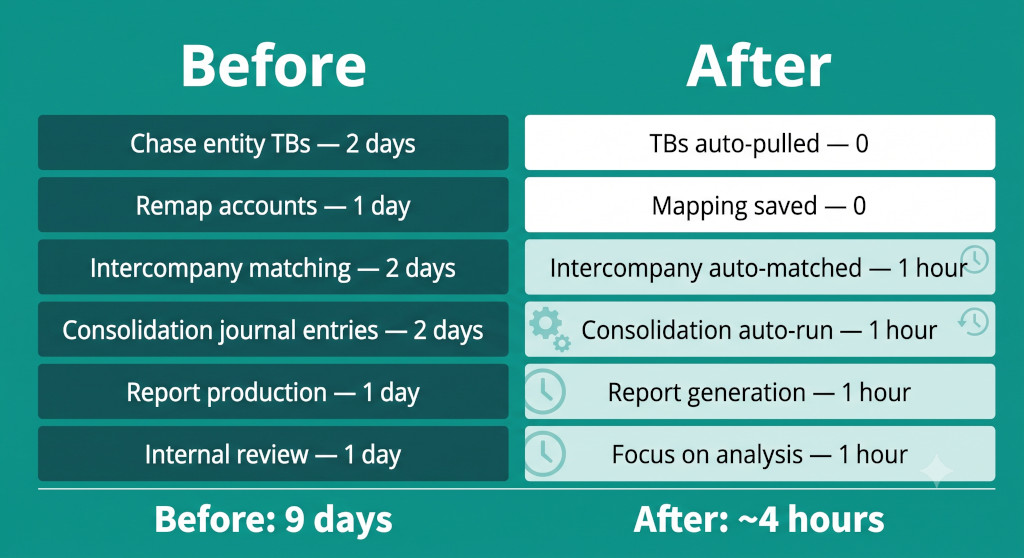
The combined effect of these automations — applied to a process that has already been cleaned up — is what produces the shift from nine days to four hours. For a detailed look at what consolidation software actually does and which capabilities matter most, the consolidation software guide covers the full feature set. For a side-by-side comparison of the Excel approach and a software approach on the same group, how consolidation software cuts your month-end close works through the time comparison in detail.
Intervention 6: Run Entity Processes in Parallel, Not in Series
Many finance teams run their consolidation process sequentially: collect all trial balances, then remap all accounts, then reconcile all intercompany balances, then post all journals, then produce reports. If any entity is late or any step takes longer than expected, the entire timeline shifts right.
A parallel process structure removes most of these dependencies. Intercompany reconciliation runs from day minus-three, in parallel with the entities’ own month-end processes. Trial balance collection and account mapping begin as soon as the first entity submits — not when all entities have submitted. Adjustment journals that don’t depend on all entities being in (goodwill, NCI calculations for completed entities) are posted as soon as the relevant entity’s data is available.
This requires the group controller to shift from a sequential checklist to a dependency map: a clear view of which steps can run in parallel and which steps genuinely depend on prior steps being complete. The practical framework for month-end group consolidation in under 30 minutes provides a worked dependency map for a six-entity group.
See What Fast Consolidation Looks Like in Practice
BrizoConsol connects to your accounting software, applies your account mapping automatically, eliminates intercompany balances in seconds, and produces your consolidated reports — without rebuilding the same workbook every month. See It In Action
What the Timeline Looks Like After All Six Interventions
Here is what the before and after looks like for a representative six-entity group — not a best-case scenario, but a realistic one based on a clean implementation of all six changes:
| Close Step | Before | After | What Changed |
|---|---|---|---|
| Collect entity trial balances | 2 days | ~15 min | Direct software connection; no manual file collection |
| Remap accounts to group COA | 1 day | 0 | Saved mapping applied automatically on import |
| Intercompany reconciliation | 1.5 days | ~30 min | Reconciled at day −3; only exceptions need day-of attention |
| Post intercompany eliminations | 0.5 days | ~5 min | Auto-generated from matched intercompany balances |
| Post consolidation adj. journals | 1 day | ~20 min | Recurring journals pre-populated; group controller reviews and posts |
| Currency translation | 0.5 days | ~5 min | Software applies closing/average rates; CTA calculated automatically |
| Produce consolidated reports | 1 day | ~10 min | Reports generated from live data; no separate rebuild |
| Queries, corrections, re-runs | 2.5 days | ~1 hour | Fewer errors upstream; corrections applied and re-run in minutes |
| Total | ~9 days | ~2.5–4 hours |
The time saving in “queries and corrections” is worth highlighting separately, because it is where most of the unpredictable variation in close time comes from. In an Excel-based process, a single data error — a transposed digit, a formula referencing the wrong cell — can cascade through the workbook invisibly and only surface when a director asks why the consolidated revenue has dropped by £800,000. Finding and correcting that error requires understanding a spreadsheet built over six years by multiple people. In a purpose-built system, the error is either prevented by validation rules or traced directly to the source transaction in seconds.
The Implementation Sequence That Works
All six interventions are worth implementing. But they are not equally urgent, and attempting all six simultaneously is a reliable way to implement none of them properly. The sequence that works in practice:
- Start with the common chart of accounts. This is the foundation that makes every other change easier. Until accounts are standardised, every process improvement runs into the same account-mapping bottleneck.
- Move intercompany reconciliation to day minus-three. This is a process change, not a technology change. It can be implemented in the current month by simply issuing a new deadline and communicating the consequence of missing it.
- Set hard entity submission deadlines. Again, a process change. Standardise the submission format at the same time: agree on one Excel template or direct extraction method and stop accepting variations.
- Implement recurring journals for all standard adjustments. With a clean chart of accounts and known entity submission timing, you can now systematically identify all recurring adjustments and set them up as templates or automated journals.
- Switch to consolidation software. With clean data, standardised accounts, reconciled intercompany balances, and automated journals, the software is receiving what it was designed to process. The migration is faster, the setup is cleaner, and the time saving is immediate.
- Restructure to a parallel close process. Once the software is running and the team is comfortable with the new workflow, redraw the close dependency map and identify which steps can run concurrently. This typically removes the last one to two days from the timeline.
Each step builds on the one before it. Groups that attempt step five before step one — implementing software while the account mapping and intercompany reconciliation problems are still unresolved — typically find that the software surfaces all of those problems at once, creating a painful first close cycle and an unfair impression that the software hasn’t helped. Fix the inputs first.
A realistic timeline: Most groups complete steps one through four within two to three months. Software implementation (step five) typically takes two to six weeks, depending on the number of entities and accounting systems. The full benefit of step six — the parallel close — is usually visible within the first two or three close cycles after go-live. Total time from “starting the project” to “closing in under a day” is typically three to six months.
The Practical Transformation Checklist
Use this as a working checklist to track progress across all six interventions:
- Audit your current close timeline — log where hours are spent across three consecutive close cycles to identify the biggest time sinks.
- Design and implement a group chart of accounts, agreed with all entity accountants before rollout.
- Set a group-wide intercompany reconciliation deadline at day minus-three and communicate the escalation process for breaches.
- Establish a single trial balance submission format and a hard submission deadline with a clear consequence for lateness.
- Identify all recurring consolidation adjustment journals and convert them to templates or automated recurring journals.
- Evaluate and select consolidation software, prioritising direct connectivity to your entities’ accounting systems and automated intercompany elimination.
- Run a parallel close pilot: identify three steps in your current process that can start before all entities have submitted and run them concurrently in the next close cycle.
- After three close cycles on the new process, re-measure the timeline and identify the remaining bottleneck — there will be one — and address it specifically.
The goal is not to find a single magic solution. Consolidation efficiency comes from removing layers of unnecessary manual work one layer at a time. The guide to why month-end close keeps slipping covers the organisational dynamics that tend to pull close timelines back out, and how to prevent them from undoing process improvements after they’ve been made.
For groups ready to go further than process changes alone — and to see what a fully automated consolidation looks like in practice — the resources below will help.
Start Closing in Hours, Not Days
BrizoConsol is built for multi-entity groups who are done rebuilding the same consolidation workbook every month. Connect your entities, apply your account mapping once, and close faster from month one. Start Free Trial