How to Consolidate a Hotel Group Where Each Property Operates Through a Separate OpCo and a Shared PropCo Holds the Real Estate
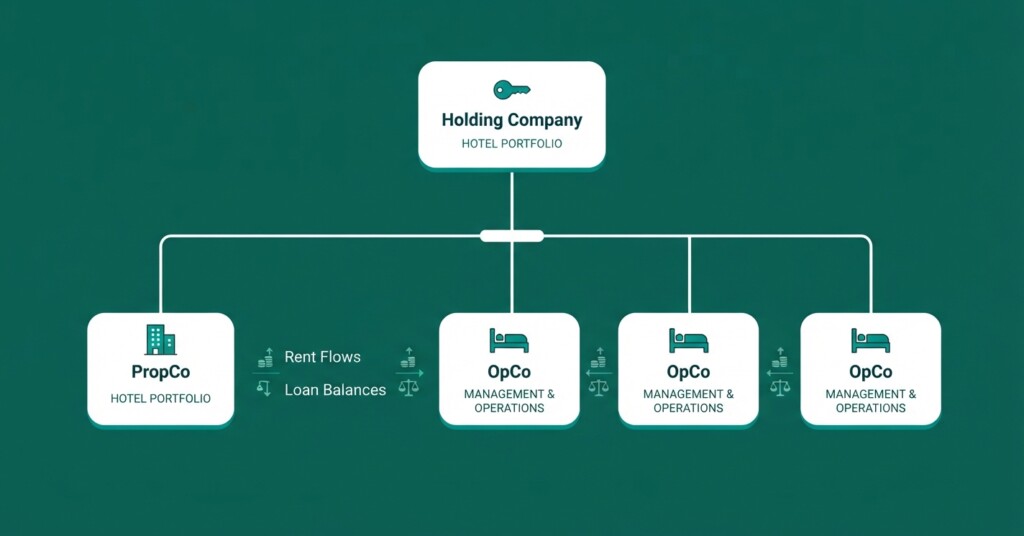
Hotel groups with multiple properties frequently adopt a structure where each property trades through its own operating company — the OpCo — while a single holding entity, the PropCo, owns the underlying real estate and leases it back to each OpCo. This is a sensible commercial and tax structure, but it creates a consolidation puzzle that trips up many finance teams at month-end. You have intercompany rent, intercompany loans, potentially different functional currencies if any properties are overseas, minority shareholders in some OpCos, and a PropCo whose real estate must be reclassified from investment property to owner-occupied property and depreciated under group accounting policies. This article walks through how to approach the consolidation properly.
Understanding the Group Structure Before You Consolidate
Before opening a spreadsheet, map the legal structure clearly. A typical hotel group might look like this: a parent HoldCo owns 100% of PropCo and varying stakes in three or four OpCos. PropCo holds the freehold or long-leasehold interests in each hotel property and charges each OpCo a market-rate or intra-group rent. Each OpCo runs the hotel operation — employing staff, taking guest revenue, paying suppliers, and servicing the lease obligation to PropCo.
The consolidation scope covers every entity where the parent has control under IFRS 10 or FRS 102 Section 9, which generally means ownership above 50% of voting rights or de facto control. If HoldCo owns 70% of one OpCo and a third-party investor holds 30%, that OpCo is still consolidated in full, with the 30% reflected as a non-controlling interest (NCI). PropCo is typically 100%-owned, so there is no NCI complication there.
Stop building consolidations in spreadsheets.
BrizoConsol automates multi-entity consolidation — setup in minutes, reports the same day.
Intercompany Eliminations: Rent and Management Fees
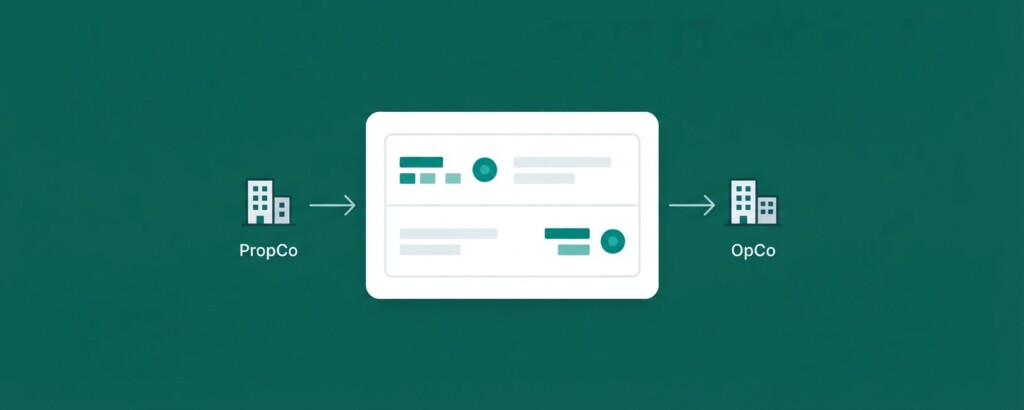
The most significant intercompany item in this structure is the rent that each OpCo pays to PropCo. Where intra-group leases are accounted for on an operating basis (such as in entity accounts prior to the full implementation of on-balance-sheet lease standards), PropCo records rental income and each OpCo records a rent expense. At the group level, these cancel out — one entity’s income is another’s cost, and both relate to the same asset sitting inside the consolidated boundary. The elimination entry is straightforward in principle.
| Account | Dr | Cr |
|---|---|---|
| Rental Income (PropCo) | 120,000 | |
| Rent Expense (OpCo) | 120,000 |
Elimination of intercompany rent for the period. PropCo recognised £120,000 rental income from OpCo 1; OpCo 1 recognised the same amount as rent expense. Both sides cancel on consolidation, leaving only external revenues and costs in the group P&L.
Where groups also charge management fees from HoldCo down to the OpCos — for central finance, HR, or brand services — the same logic applies. The fee income in HoldCo and the management charge in each OpCo are eliminated against each other. One common error is eliminating only one side of the entry, leaving an unexplained surplus or deficit in the consolidated P&L.
If your group charges management fees between entities, confirm that the fee income and the corresponding expense are recorded in the same period across both entities. Timing mismatches — where one entity accrues and the other does not — are among the most common causes of intercompany reconciliation breaks at month-end.
Intercompany Loan Balances and Interest
PropCo may have been funded partly by loans from HoldCo, or HoldCo may have on-lent external bank debt down to the OpCos. Each of these creates an intercompany receivable in one entity and a corresponding payable in another. At the group level, both sides eliminate. The same applies to interest: if HoldCo charges interest to an OpCo on a loan, the interest income in HoldCo and the interest expense in the OpCo both disappear in the consolidated accounts.
Intercompany loan balances frequently disagree at period-end. The borrowing entity may have recorded a payment that the lending entity has not yet received, or interest may have been accrued in one entity but not the other. Before eliminating, reconcile each intercompany balance pair to a single agreed figure. Eliminating mismatched amounts leaves unexplained differences in the consolidated balance sheet that can take hours to find.
Eliminating Unrealised Profit on the PropCo Asset
This is where the structure becomes genuinely complex. In PropCo’s standalone accounts, the real estate let to OpCos is typically accounted for as investment property under IAS 40 or FRS 102 Section 16, often carried at fair value with revaluation gains taken to P&L. However, under IAS 40 paragraph 15 and FRS 102 Section 16, from the group’s consolidated perspective the property is owner-occupied because it is operated by group subsidiaries. It must be reclassified on consolidation to Property, Plant and Equipment (PPE) under IAS 16 or FRS 102 Section 17, any standalone fair value gains through P&L must be reversed or realigned with group revaluation policies, and the building portion must be systematically depreciated.
A related issue is the treatment of the right-of-use asset and lease liability that each OpCo recognises under IFRS 16 or FRS 102 (2026 revised). On consolidation, the lease between PropCo and each OpCo is an intra-group lease. The right-of-use asset and lease liability in the OpCo, along with OpCo’s lease depreciation and interest expense and PropCo’s rental income, must all be eliminated. The group owns the underlying physical asset outright through PropCo, so no lease exists from the consolidated perspective.
| Account | Dr | Cr |
|---|---|---|
| Lease Liability (OpCo — intra-group) | 2,400,000 | |
| Right-of-Use Asset (OpCo — intra-group) | 2,400,000 |
Elimination of OpCo right-of-use asset and corresponding lease liability arising from the intra-group lease with PropCo. On consolidation, the lease does not exist from the group perspective. The underlying freehold land and buildings remain on the consolidated balance sheet, reclassified from investment property to Property, Plant and Equipment and measured under group PPE policies.
FX Translation When One or More OpCos Operates in a Different Currency
Suppose one of the OpCos operates a hotel in Portugal and its functional currency is euros, while the group presents its consolidated accounts in sterling. The translation process follows IAS 21 (or FRS 102 Section 30): assets and liabilities of the euro OpCo are translated at the closing rate, and income and expenses are translated at the transaction rate or a period average rate. The difference between opening net assets translated at the prior closing rate and the current closing rate — along with the difference between the average rate used for the P&L and the closing rate — goes to a foreign currency translation reserve (FCTR) in equity, not through profit or loss.
| Euro OpCo net assets at 31 December (€1,820,000 at closing rate 1.15) | £1,582,609 |
| Euro OpCo net assets at 1 January (€1,600,000 at prior closing rate 1.18) | £1,355,932 |
| Retained profit for the year translated at average rate (€220,000 at 1.165) | £188,841 |
| Foreign Currency Translation Reserve movement (balancing figure) | £37,836 |
| Consolidated equity — FCTR cumulative movement | £37,836 |
Under IAS 21, the cumulative FCTR is recognised in other comprehensive income and is not recycled through profit or loss unless the group disposes of the foreign operation (under FRS 102 Section 30, recycling to profit or loss is prohibited even on disposal). Where the foreign entity has an NCI, the translation movement is allocated between the parent’s FCTR and NCI equity. This means a group with overseas hotel properties can show a consistently profitable P&L while balance sheet equity fluctuates with exchange rate movements — something that can alarm non-finance stakeholders if it is not explained clearly in the management accounts.
Non-Controlling Interests in the OpCos
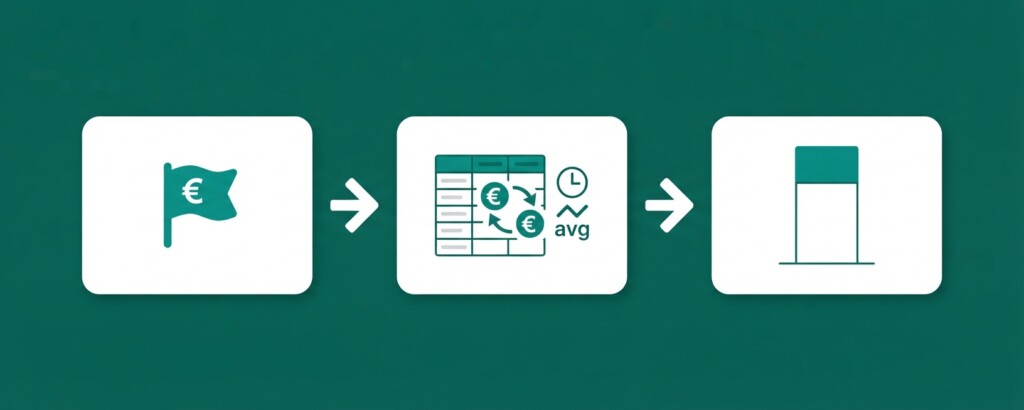
Where a third-party investor holds a minority stake in one or more OpCos, the consolidation must present the NCI separately. Under IFRS 3 and IFRS 10, the full assets and liabilities of the OpCo are consolidated (100%), and then the NCI’s share of net assets is shown as a separate component of equity. In the P&L, profit is split between the amount attributable to the parent and the amount attributable to NCI.
| Entity | Group Ownership | NCI % | Entity PAT (£) | Attributable to Group (£) | Attributable to NCI (£) |
|---|---|---|---|---|---|
| OpCo 1 — London | 100% | 0% | 340,000 | 340,000 | 0 |
| OpCo 2 — Edinburgh | 80% | 20% | 210,000 | 168,000 | 42,000 |
| OpCo 3 — Lisbon (€) | 75% | 25% | 188,841 | 141,631 | 47,210 |
| PropCo | 100% | 0% | 480,000 | 480,000 | 0 |
| Total Group | — | — | 1,218,841 | 1,129,631 | 89,210 |
NCI equity on the balance sheet is calculated as the NCI percentage applied to the subsidiary’s net assets at the reporting date, adjusted for any goodwill allocated to NCI at acquisition if the full goodwill method was adopted. For hotel OpCos acquired at a premium, this can be material and should be tracked carefully each period as the OpCo retains earnings or pays dividends.
The PropCo Dividend and Intercompany Cash Flows
Groups often use PropCo as a cash-holding and distribution vehicle. PropCo collects rent, services any external property debt, and distributes surplus cash as a dividend to HoldCo. On consolidation, the dividend from PropCo to HoldCo eliminates — it is a transfer within the group boundary. However, any dividend paid by an OpCo to NCI shareholders is a real cash outflow from the group’s perspective and is not eliminated; it reduces both cash and NCI equity.
Structuring the Monthly Close for a Hotel Group
The practical challenge for most hotel group finance teams is doing all of the above reliably every month, not just at year-end. A sensible monthly close sequence for this structure typically runs as follows.
- Each entity closes its own books and produces a trial balance in its local currency.
- Intercompany balances are confirmed between each pair of entities before any consolidation work begins — this is the single biggest time-saver at month-end.
- Any intra-group transactions recorded at different amounts (timing differences, accrual mismatches) are agreed and corrected at entity level where possible, or a consolidation adjustment is made and documented.
- Foreign currency trial balances are translated into the presentation currency using closing rates for balance sheet items and average rates for P&L items.
- Consolidation eliminations are posted: rent, management fees, interest, loan balances, the PropCo lease elimination, and any intra-group dividends.
- NCI is calculated and split from group equity and profit.
- The FCTR movement is calculated and posted to equity.
- Group P&L, balance sheet, and cash flow are assembled and sense-checked against prior periods and budget.
When this process runs across four or more entities with an overseas property and an NCI investor, the manual effort in Excel is substantial. Keeping elimination schedules, FX translation workings, and NCI calculations in sync — and ensuring they tie to the underlying trial balances — typically occupies a significant portion of the finance team’s month-end time. Consolidation tools that connect directly to entity-level accounting data and automate the translation, elimination, and NCI steps reduce this workload considerably and make it easier to rerun the numbers if an entity restates a period.
Common Errors to Avoid in Hotel Group Consolidations
One of the most frequently missed items in PropCo/OpCo structures is the classification and depreciation of the underlying property on the consolidated balance sheet. In standalone accounts, PropCo often classifies the property as investment property at fair value (under IAS 40 or FRS 102 Section 16) and therefore does not record depreciation. On consolidation, however, the property is owner-occupied from the group perspective and must be reclassified to Property, Plant and Equipment (IAS 16 or FRS 102 Section 17), with the building element depreciated and any fair value gains through standalone P&L reversed or aligned with group policy. Confirm that the consolidated balance sheet reflects the underlying property net of accumulated depreciation, rather than retaining PropCo’s standalone investment property treatment or OpCo’s eliminated right-of-use asset.
Other errors to watch for include: applying the wrong exchange rate to PropCo assets when PropCo is denominated in sterling but holds a euro-denominated property; failing to allocate the translation difference of a foreign OpCo between group FCTR and NCI; and omitting to reclassify certain costs between the OpCo and group level where the group accounting policy differs from the entity policy (for example, where an OpCo capitalises a cost that the group expenses under its policy).
Reporting the Consolidated Group to Stakeholders
Once the consolidated numbers are prepared, hotel groups typically want segmental reporting — showing each property’s contribution alongside the consolidated group totals. This means the consolidation output needs to preserve entity-level detail, not just aggregated figures. A management pack that shows revenue, EBITDA, and net profit by property, with PropCo costs allocated or shown separately, gives the board and any external investors the operational view they need alongside the statutory consolidated position.
For groups with bank covenant requirements — which are common where PropCo carries external property finance — the consolidated reporting pack often needs to present specific ratios such as interest cover or loan-to-value against the consolidated figures. Getting these consistently right each quarter requires the consolidation to be both accurate and repeatable, which is precisely where a structured process — whether in a dedicated consolidation tool or a rigorously maintained model — pays dividends over ad hoc spreadsheet approaches.
See How Automated Consolidation Handles PropCo/OpCo Structures
If your hotel group spends significant month-end time on intercompany eliminations, FX translation, and NCI calculations across multiple entities, see how BrizoConsol approaches multi-entity consolidation for groups like yours.