The Five Accounts That Only Exist in Your Consolidated Financial Statements
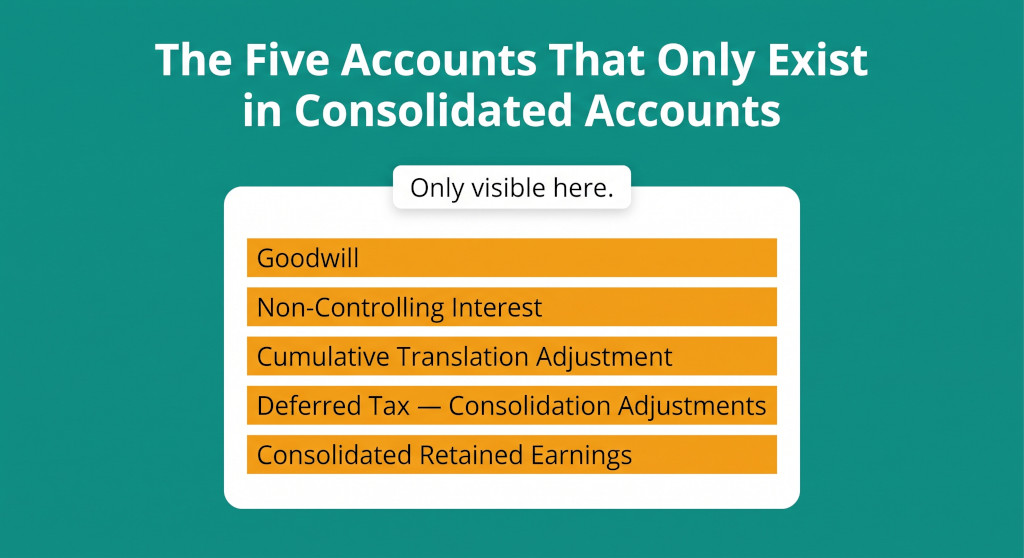
Tom has just been appointed CFO of an Australian professional services group with four entities. He’s a strong finance leader — he has spent years reading entity management accounts, reviewing entity P&Ls, and signing off entity tax returns. But the consolidated financial statements, which he’s reviewing for the first time in this role, contain five line items he’s never seen in any entity’s accounts.
On the balance sheet: a goodwill line of $2.1 million. A non-controlling interest figure sitting inside equity at $340,000. A cumulative translation adjustment reserve of negative $87,000. A deferred tax liability labelled “consolidation adjustments — $44,000”. And a retained earnings figure that doesn’t match any individual entity and can’t be reconciled by simply adding the four entities’ retained earnings together.
“Where do these come from?” he asks his reporting accountant. “They don’t appear anywhere in the entity accounts I’ve been reviewing.”
Automate NCI calculations across all your entities.
BrizoConsol handles non-controlling interest automatically — no manual adjustments required.
“They’re consolidation entries,” she explains. “They don’t exist in any of the entity files. They only appear when you combine the group.”
Tom is not alone in finding this puzzling. These five accounts are genuinely different from everything else on the consolidated balance sheet — they arise not from transactions the entities have entered into with the outside world, but from the mechanics of bringing the entities together. Understanding each one is the difference between reading a consolidated balance sheet with confidence and reading it with vague uncertainty about where half the numbers came from.
1. Goodwill — The Premium That Has No Home in Entity Accounts
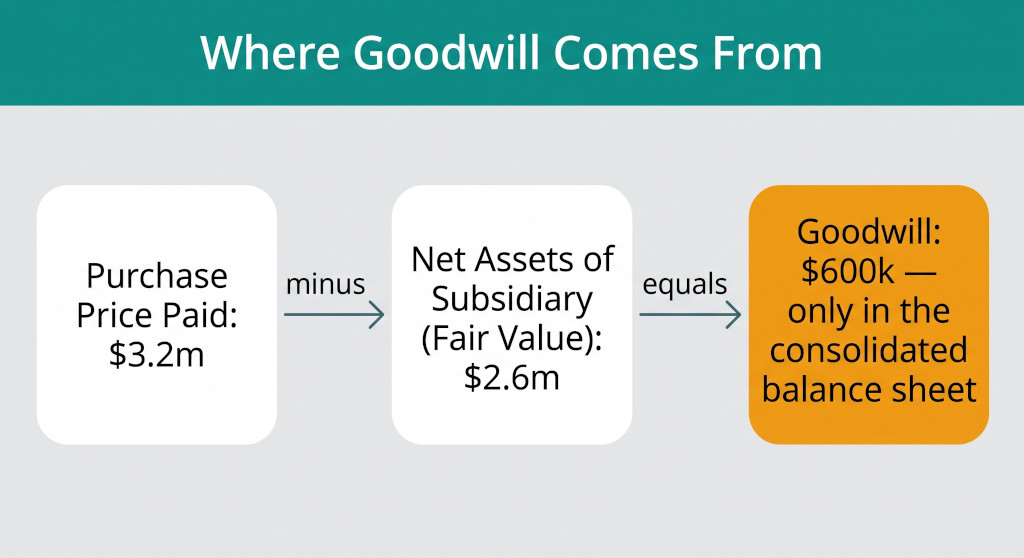
When Tom’s group acquired one of its subsidiaries, the parent entity paid $3.2 million for it. In the parent entity’s own Xero or MYOB file, that $3.2 million sits as “Investment in Subsidiary” — a single asset on the parent’s balance sheet, measured at cost. The subsidiary’s own accounts show no reference to the acquisition price at all; the subsidiary simply continues recording its own assets and liabilities as before.
At consolidation, both of those treatments disappear. The investment in the parent’s entity accounts is cancelled against the subsidiary’s net assets. What’s left — the difference between the $3.2 million purchase price and the $2.6 million fair value of what was acquired — is goodwill: $600,000. This figure doesn’t exist in the parent’s entity accounts (which just showed an investment at cost) and it doesn’t exist in the subsidiary’s accounts (which know nothing of the acquisition price). It exists only in the consolidation working papers that eliminate the investment and replace it with the subsidiary’s underlying net assets.
Goodwill must be tested for impairment every year — not amortised under IFRS and Australian AASB standards, but reviewed to check whether its carrying value is still supported by the cash flows of the business it represents. When an impairment write-down occurs, it reduces goodwill and hits the consolidated P&L — but again, only at the consolidated level. Neither the parent entity nor the subsidiary entity records the impairment. It lives entirely in the consolidation journals. For a full walkthrough of how the acquisition calculation works, see IFRS 3 Business Combinations: A Practical Guide for Multi-Entity Groups.
Goodwill is the most visible consolidation-only account because it appears as a large, named line item near the top of every consolidated balance sheet that has involved an acquisition. But it is entirely invisible in every entity’s own accounts — the parent sees an investment, the subsidiary sees nothing.
2. Non-Controlling Interest — The Minority’s Share Sits in Group Equity
Tom’s group owns 75% of one subsidiary. The remaining 25% belongs to an external investor — a minority shareholder who is not part of the group but whose 25% stake means the subsidiary’s full net assets must still be consolidated (because the group controls the subsidiary). At the entity level, the subsidiary records its own equity and retained earnings in full — it has no way to split its own equity between “group share” and “minority share.” The parent entity’s accounts show the investment at cost and ignore the minority entirely.
At consolidation, the full 100% of the subsidiary’s assets and liabilities are brought in, which means 25% of those net assets and 25% of the subsidiary’s profit for the year effectively belong to someone outside the group. Non-controlling interest is the mechanism that keeps the consolidated accounts honest about this: it separates the 25% minority’s claim from the 75% parent’s claim within the consolidated equity section, and shows the minority’s share of profit as a separate allocation on the consolidated income statement.
NCI changes every period as the subsidiary earns or loses money, pays dividends, and as the group’s ownership percentage moves. It must be rolled forward carefully in every consolidation, and it has its own column in the consolidated statement of changes in equity. For a detailed breakdown of where NCI appears across all four consolidated statements, see Non-Controlling Interest on the Balance Sheet and Income Statement.
3. Cumulative Translation Adjustment — Where Currency Movements Live in Group Equity
Tom’s group has one foreign subsidiary — a New Zealand entity whose accounts are prepared in NZD. When consolidating, the group must translate the New Zealand subsidiary’s accounts into AUD. Under AASB 121, assets and liabilities translate at the closing rate; income and expenses translate at the average rate for the period; equity items translate at historical rates. These three different rates produce a difference — a translation gain or loss — that cannot logically go through profit or loss (it’s a mathematical consequence of using different rates, not a real economic event), so it sits in other comprehensive income as the cumulative translation adjustment.
The CTA accumulates year by year as the exchange rate moves. In a year where the AUD strengthens against the NZD, translating the New Zealand subsidiary’s net assets at a lower closing rate produces a negative CTA movement (the translated value of the net assets falls). In a year where the AUD weakens, the opposite occurs. The CTA builds up across the life of the group’s ownership of the foreign subsidiary — and when the subsidiary is eventually disposed of, the accumulated CTA is recycled through profit or loss as part of the disposal gain or loss calculation.
No entity produces a CTA in its own accounts. The CTA is a pure product of the translation mathematics at consolidation. If the group has no foreign subsidiaries, it will have no CTA. The more foreign subsidiaries, the more complex the CTA becomes to track and reconcile. For a practical guide to diagnosing CTA differences, see Why Does My CTA Not Reconcile?
Building Consolidated Accounts With All Five of These Moving Parts?
BrizoConsol calculates goodwill at acquisition, tracks NCI period by period, translates foreign subsidiaries and builds your CTA automatically, handles deferred tax on consolidation adjustments, and reconciles your consolidated retained earnings — so you can review the output rather than build it manually. See It In Action
4. Deferred Tax on Consolidation Adjustments — The Tax Consequence of Journals That Don’t Exist in Entity Accounts
When the group acquired one of its subsidiaries, the purchase price allocation identified that a piece of equipment had a fair value of $800,000 — higher than its carrying value in the subsidiary’s own accounts of $500,000. At consolidation, the equipment is stepped up by $300,000 to reflect its fair value. But the tax base of the equipment — what the tax authority allows to be depreciated — remains at $500,000. There is now a $300,000 difference between the consolidated book value and the tax base.
Under AASB 112, this temporary difference creates a deferred tax liability of $300,000 × 30% = $90,000. This DTL exists only at the consolidation level — the subsidiary’s entity accounts still show the asset at $500,000, with no step-up and no DTL. The DTL reverses gradually as the stepped-up value is depreciated in the consolidated accounts over the asset’s remaining useful life.
The same logic applies to intercompany profit eliminations. When one entity sells an asset to another at a profit, and the profit is eliminated at consolidation, a deferred tax asset is created at the consolidation level (the tax was paid on a profit the group hasn’t yet realised). Neither the selling entity nor the buying entity records this DTA. It exists only in the consolidation working papers. For the full mechanics of how these arise and how to calculate them, see Deferred Tax in Group Consolidation: How Consolidation Adjustments Create Tax Differences.
5. Consolidated Retained Earnings — The Number That Can’t Be Found Anywhere Else
This is often the most confusing of the five, because consolidated retained earnings looks like a number that should be straightforwardly derivable from the entities. It isn’t. Consolidated retained earnings is not the parent’s retained earnings. It is not the sum of all entities’ retained earnings. It is something more specific: the parent’s own retained earnings, plus the group’s share of each subsidiary’s post-acquisition profits, minus intercompany dividends that have been eliminated, minus goodwill impairment losses, and adjusted for any CTA recycled through P&L on disposal.
Each of those adjustments changes the number relative to any simple sum of entity accounts:
- The parent’s entity retained earnings includes dividends received from subsidiaries — but those dividends are intercompany income that gets eliminated at consolidation. The consolidated number removes them.
- The subsidiary’s entity retained earnings includes its full accumulated profit — but the group only has a claim on post-acquisition profits. Pre-acquisition retained earnings were part of the net assets used to calculate goodwill at acquisition; they don’t belong in consolidated retained earnings a second time.
- Goodwill impairment losses reduce consolidated retained earnings but don’t appear in any entity’s accounts.
- Deferred tax movements on consolidation adjustments flow through consolidated P&L and therefore through consolidated retained earnings, without any entity recording the same entry.
The practical result is that consolidated retained earnings must be reconciled independently, line by line, from a retained earnings roll-forward. It cannot be read from any entity’s trial balance. For a step-by-step walkthrough of this reconciliation, see How to Reconcile Consolidated Retained Earnings.
A common error: Finance teams that prepare or review consolidated accounts sometimes accept the consolidated retained earnings figure without reconciling it, assuming it has been derived correctly by the consolidation software or spreadsheet. Because consolidated retained earnings accumulates all consolidation adjustments since the first acquisition in the group, an error in any prior period compounds forward indefinitely. It is worth reconciling from first principles at least annually.
What These Five Accounts Have in Common
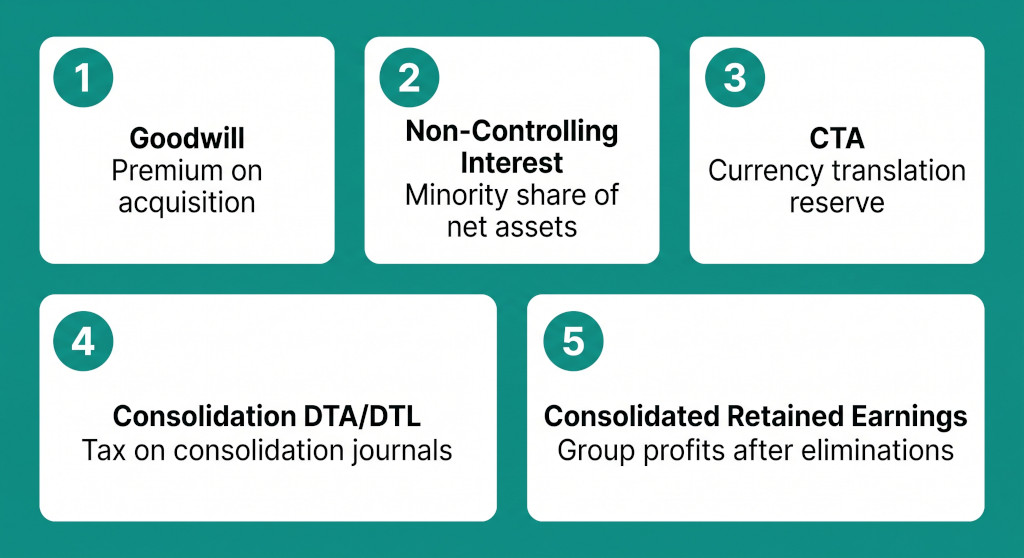
Looking across all five, a pattern emerges. Each of these accounts exists because the consolidation process requires the group to be treated as a single economic entity — even though the underlying legal entities are separate, each with their own accounts, their own tax returns, and their own balance sheets. The act of combining those separate entities, eliminating the transactions between them, and presenting the result as a unified group creates accounting balances that simply have no equivalent at the entity level.
| Account | Why It Only Exists at Consolidation | Where to Dig Deeper |
|---|---|---|
| Goodwill | Arises from cancelling the parent’s investment against the subsidiary’s fair-value net assets at acquisition. Neither entity records it. | IFRS 3 Business Combinations |
| Non-Controlling Interest | The minority’s share of net assets — a concept that only has meaning when the group is presented as a whole, including a subsidiary the group doesn’t own 100%. | NCI on the Balance Sheet and Income Statement |
| Cumulative Translation Adjustment | The mathematical result of translating foreign subsidiary accounts at different rates for different items. No entity translates its own accounts into a different currency. | Why Does My CTA Not Reconcile? |
| Deferred Tax — Consolidation Adjustments | Temporary differences arise between consolidated book values (after step-ups and elimination adjustments) and the tax base, which follows entity-level accounting. | Deferred Tax in Group Consolidation |
| Consolidated Retained Earnings | A rolling accumulation of post-acquisition group profits, after intercompany eliminations, goodwill impairments, and consolidation tax adjustments — none of which exist in any entity’s accounts. | How to Reconcile Consolidated Retained Earnings |
Tom, by the end of his review, has a clear mental model. Every line item on a consolidated balance sheet is either carried across from an entity’s accounts (assets, liabilities, revenues, expenses that relate to transactions with the outside world) or it is one of these five — a number that exists solely because the group has been assembled from parts. The five consolidation-only accounts are not accounting fiction; they are the honest accounting consequence of owning subsidiaries, operating across currencies, and sharing assets and liabilities across a group. Understanding them is the starting point for reading consolidated accounts with real confidence. For a complete end-to-end example of how all these elements come together, see A Complete Consolidation Worked Example: From Entity Trial Balances to Consolidated Financial Statements.
Preparing Consolidated Accounts for Your Group?
BrizoConsol handles all five of these consolidation-only accounts automatically — calculating goodwill at acquisition, rolling NCI forward each period, building the CTA from FX rates, posting deferred tax on consolidation adjustments, and reconciling consolidated retained earnings from first principles. Start Free Trial