When a Partly-Owned Subsidiary Has Accumulated Losses That Exceed Its Equity: How to Handle Negative NCI at Consolidation
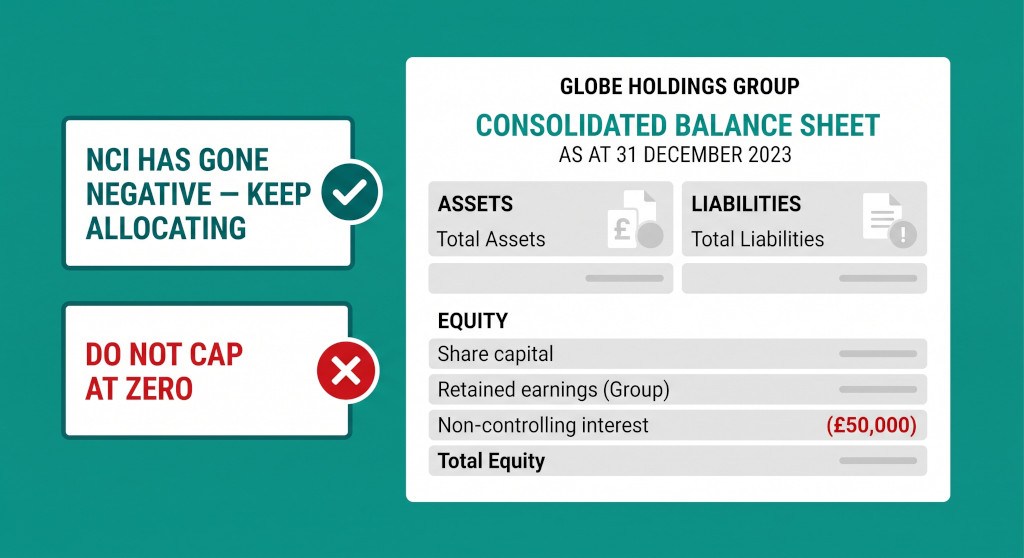
Marcus had been finance director at the wellness group for two years when his management accountant flagged something unusual in the draft consolidation. FitnessCo, the 80%-owned gym chain subsidiary they had acquired three years earlier, had lost money every year since the pandemic. The NCI column in the group’s consolidation model had turned negative — sitting at £(50,000) — and the accountant wanted to know whether she should zero it out before the accounts were signed.
Marcus’s instinct was to cap it at zero. That felt right: if the minority shareholders owned 20% of FitnessCo and FitnessCo was loss-making, surely the minority shareholders could not be allocated more losses than they had originally invested. Once their share of equity was gone, the remaining losses should fall entirely on the parent. It seemed logical. It was also wrong.
Under IFRS 10, the rule is explicit and counterintuitive to anyone trained on the old IAS 27: total comprehensive income — including losses — is allocated between the parent and NCI in proportion to their ownership interests, even if the result is a negative (deficit) NCI balance on the consolidated balance sheet. The NCI is not protected from losses beyond its initial investment. The group cannot absorb losses that economically belong to the minority shareholders simply because those shareholders would be unhappy about it.
Automate NCI calculations across all your entities.
BrizoConsol handles non-controlling interest automatically — no manual adjustments required.
Why the Old Rule Was Different — and Why It Changed
Under IAS 27 (the predecessor to IFRS 10), losses in excess of the NCI’s interest were allocated to the parent. The NCI balance was floored at zero. The rationale was that minority shareholders could not usually be compelled to fund subsidiary losses, so it was inappropriate to show them as bearing losses beyond their equity stake.
IFRS 10 changed this on the basis that the consolidated accounts should reflect economic reality, not legal enforceability. If FitnessCo loses £350,000 in a year and NCI holds 20%, then 20% of that loss — £70,000 — economically belongs to the minority shareholders. The consolidated accounts should say so, regardless of whether the minority shareholders are actually being asked to write a cheque. The deficit NCI balance represents a claim the group theoretically has against the minority shareholders, even if it will never be enforced.
IFRS 10.B94 states: “A parent shall attribute the profit or loss and each component of other comprehensive income to the owners of the parent and to the non-controlling interests. The parent shall also attribute total comprehensive income to the owners of the parent and to the non-controlling interests even if this results in the non-controlling interests having a deficit balance.”
The Worked Example: FitnessCo
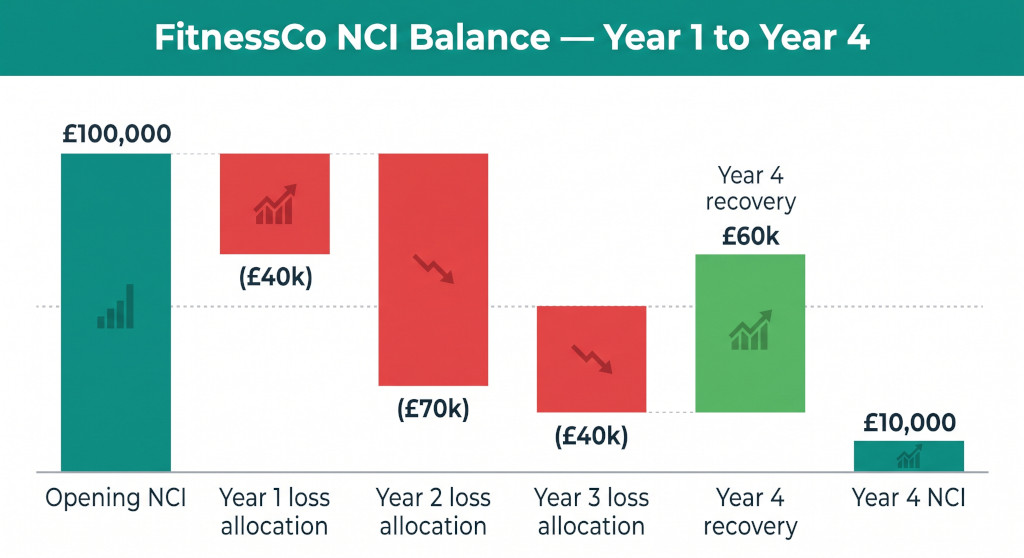
The group acquired FitnessCo on 1 January Year 1. The fair value of FitnessCo’s net assets at acquisition was £500,000. The group holds 80%; the minority shareholders hold 20%. For the NCI at acquisition, the group uses the proportionate share method:
| FitnessCo net assets at fair value | £500,000 |
| NCI percentage | 20% |
| NCI at acquisition date | £100,000 |
FitnessCo then posts losses in each of the next three years. Year 4 sees a recovery:
| Period | FitnessCo P&L | Group share (80%) | NCI share (20%) | NCI closing balance |
|---|---|---|---|---|
| At acquisition | — | — | — | £100,000 |
| Year 1 loss | £(200,000) | £(160,000) | £(40,000) | £60,000 |
| Year 2 loss | £(350,000) | £(280,000) | £(70,000) | £(10,000) |
| Year 3 loss | £(200,000) | £(160,000) | £(40,000) | £(50,000) |
| Year 4 profit | £300,000 | £240,000 | £60,000 | £10,000 |
The NCI crosses into negative territory during Year 2, when the NCI’s share of the Year 2 loss (£70,000) exceeds the opening NCI balance of £60,000. Under IFRS 10, the full £70,000 is still allocated to NCI. There is no cap. The NCI balance at the end of Year 2 is £(10,000) — a debit balance.
By the end of Year 3, NCI stands at £(50,000). This is reported as a negative figure within the equity section of the consolidated balance sheet — not reclassified to liabilities, not zeroed out, not absorbed by the parent.
The Consolidation Journal in the Loss Years
The mechanics of allocating the loss to NCI are unchanged from the standard NCI allocation. The only difference is that the cumulative NCI balance ends up negative. In Year 2, the journal in the consolidation working papers is:
| Account | Dr | Cr |
|---|---|---|
| NCI — share of FitnessCo loss (P&L / SOCE) | £70,000 | |
| Non-controlling interest (equity — balance sheet) | £70,000 |
This entry takes the NCI balance from £60,000 to £(10,000). The credit to the NCI equity account is correct — the NCI is being allocated its share of loss, which reduces (and in this case reverses) the NCI balance. No special treatment is required when the balance crosses zero.
In Year 3, the same structure applies:
| Account | Dr | Cr |
|---|---|---|
| NCI — share of FitnessCo loss (P&L / SOCE) | £40,000 | |
| Non-controlling interest (equity — balance sheet) | £40,000 |
NCI balance moves from £(10,000) to £(50,000). The entry is identical in form to every prior year. Nothing changes mechanically when NCI is already in deficit.
The error that persists in many group models: an IF statement or manual override that prevents the NCI balance from going below zero. If your consolidation model or software caps NCI at nil, it is misstating the consolidated accounts under IFRS 10 and misattributing losses to the parent that belong to the minority shareholders. Check your model now if you have a loss-making partly-owned subsidiary.
Presenting Negative NCI on the Balance Sheet and in the SOCE
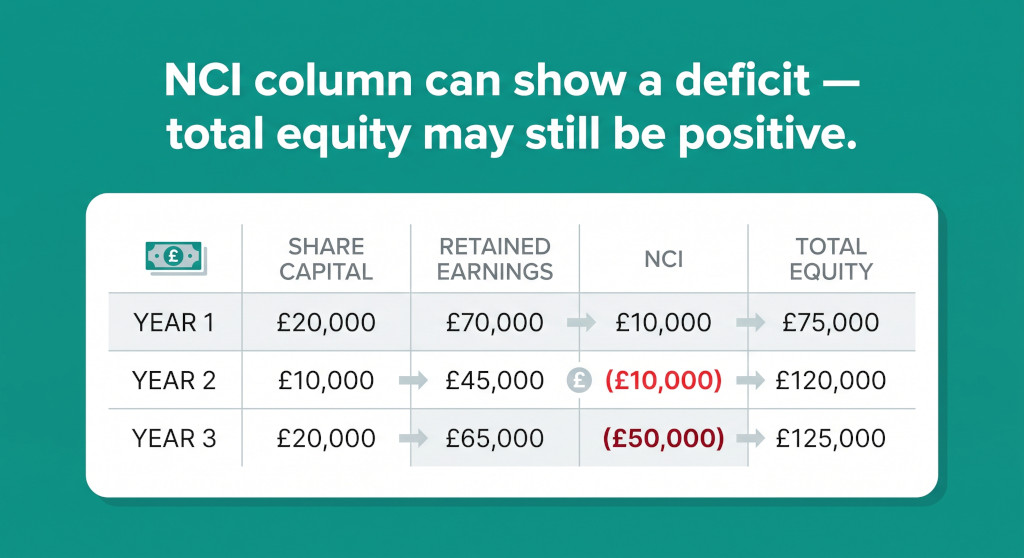
A negative NCI balance sits within equity on the consolidated balance sheet, presented as a negative figure. It is not reclassified to liabilities. The consolidated equity section might look like this at the end of Year 3:
| Equity component | £ |
|---|---|
| Share capital | 500,000 |
| Retained earnings (attributable to parent) | 350,000 |
| Non-controlling interest | (50,000) |
| Total equity | 800,000 |
Total equity remains positive because the parent’s retained earnings absorb the group’s share of FitnessCo’s losses. The negative NCI simply reflects that the minority shareholders have, in economic terms, been allocated more losses than they originally invested. For a full picture of how NCI is shown across the primary statements, see the guide to NCI on the balance sheet and income statement.
In the consolidated statement of changes in equity, the NCI column will show cumulative negative movements. The NCI column in the SOCE must be built correctly — showing the opening balance, the share of loss for the period, and any dividends paid to minority shareholders (if applicable, though uncommon in a loss-making subsidiary). No special presentation adjustments are made when the NCI column goes negative. Readers of the accounts will understand the position from the notes.
What Happens When the Subsidiary Returns to Profit
In Year 4, FitnessCo generates a profit of £300,000. The NCI’s 20% share is £60,000. This is credited to the NCI balance in the normal way:
| Account | Dr | Cr |
|---|---|---|
| Non-controlling interest (equity — balance sheet) | £60,000 | |
| NCI — share of FitnessCo profit (P&L / SOCE) | £60,000 |
NCI balance moves from £(50,000) to £10,000. There is no “recovery” mechanism, catch-up rule, or priority reallocation. Profits are attributed proportionally from the first period of recovery, regardless of the prior deficit.
This is an important point. Some finance teams assume that once NCI has been in deficit, the parent should recoup the “excess losses” that were absorbed on the minority shareholders’ behalf before NCI starts accumulating again. There is no such mechanism under IFRS 10. Profits in Year 4 are allocated 80:20 from day one. The deficit simply unwinds through proportional profit allocation over time.
NCI tracking that handles the full range of scenarios
BrizoConsol allocates NCI correctly across all ownership structures — including partly-owned subsidiaries with deficit balances. See how it builds the NCI column for your group automatically. See It In Action
The Goodwill Impairment Connection
A subsidiary accumulating losses large enough to push NCI into deficit is almost certainly an impairment indicator for any goodwill allocated to it. Under IAS 36, impairment indicators include significant decline in the asset’s market value, significant underperformance against plan, and deterioration in the economic environment affecting the CGU. A loss-making subsidiary three years after acquisition qualifies on at least the first two grounds.
The impairment test compares the recoverable amount of the cash-generating unit (FitnessCo and its allocated goodwill) with its carrying amount. If the carrying amount — which includes the goodwill balance — exceeds the recoverable amount, impairment is recognised. The impairment charge reduces goodwill first, then other assets of the CGU in proportion.
Critically, if the group used the full goodwill method at acquisition, both the parent’s and NCI’s share of goodwill is on the balance sheet and both are potentially impaired. If partial goodwill was recognised, only the parent’s share sits on the balance sheet. For a comparison of how this affects the impairment calculation, see the guide to full goodwill vs partial goodwill. For the mechanics of the goodwill impairment test itself, see the goodwill in group consolidation guide.
When the Parent Has Obligations Beyond Its Equity Stake
IFRS 10’s allocation rule is about how losses are attributed in the consolidated accounts. It is a separate question from whether the parent has any legal or contractual obligation to fund the subsidiary’s losses on behalf of the minority shareholders.
If the parent has guaranteed the minority shareholders’ investment — for example, in a joint venture or co-investment structure where the parent has agreed to make the minority shareholders whole — that guarantee is a separate financial instrument that may need to be recognised as a financial liability. The redeemable NCI guide covers the related scenario of put options and guaranteed returns on minority stakes.
Similarly, if the subsidiary has external creditors who the parent has guaranteed, the parent may face provisions or contingent liabilities beyond the NCI deficit. These are presented separately from the NCI balance — the NCI deficit does not convert to a liability simply because the parent is practically exposed.
The NCI deficit tells you how losses have been allocated in the accounts. It does not tell you anything about who will actually absorb those losses economically — that depends on the group’s financing arrangements, guarantees, and legal structure. Keep the two questions separate.
Checklist: Handling Negative NCI Correctly
- Do not cap NCI at zero. Under IFRS 10.B94, losses are allocated to NCI proportionally regardless of whether the result is a deficit balance. If your model has a floor at nil, remove it.
- Check your consolidation software. Some older systems and Excel-based models implement the old IAS 27 cap as a default. Verify that your tool allocates losses to NCI without restriction.
- Present the negative NCI balance within equity on the consolidated balance sheet — not as a liability, not as a deduction from assets. The heading may need a note explaining the deficit.
- Build the NCI column in the SOCE correctly from the opening negative balance. The cumulative movements should reconcile to the balance sheet position.
- Do not apply a catch-up rule on recovery. When the subsidiary returns to profit, allocate proportionally from the first profitable period. There is no mechanism to repay the “excess” losses to the parent before NCI begins accruing again.
- Trigger a goodwill impairment review as soon as the subsidiary posts material losses — certainly before the NCI turns negative. By the time the NCI is in deficit, the impairment case is likely already strong.
- Review any guarantees or contractual obligations the parent has to minority shareholders. Assess these separately from the NCI allocation — they may give rise to financial liabilities that sit outside equity entirely.
- Disclose the deficit NCI in the notes if it is material. Readers of the accounts will expect an explanation of why a component of equity is negative and what it represents.
Consolidation that keeps up with every NCI scenario
BrizoConsol handles NCI across all ownership structures, including deficit balances, partial disposals, and step acquisitions — without manual adjustments. Start a free trial and run your first consolidation today. Start Free Trial