How to Build a Group Reporting Pack That Separates Statutory Consolidation from Management View Without Running Two Separate Closes

Most finance teams managing multiple entities face a version of the same problem: the statutory consolidation and the management reporting pack tell different stories, and keeping them both accurate requires either two separate month-end processes or a messy set of Excel adjustments bolted on after the fact. Neither approach scales well, and both create reconciliation headaches that grow every time you add an entity, change a reporting currency, or acquire a new subsidiary.
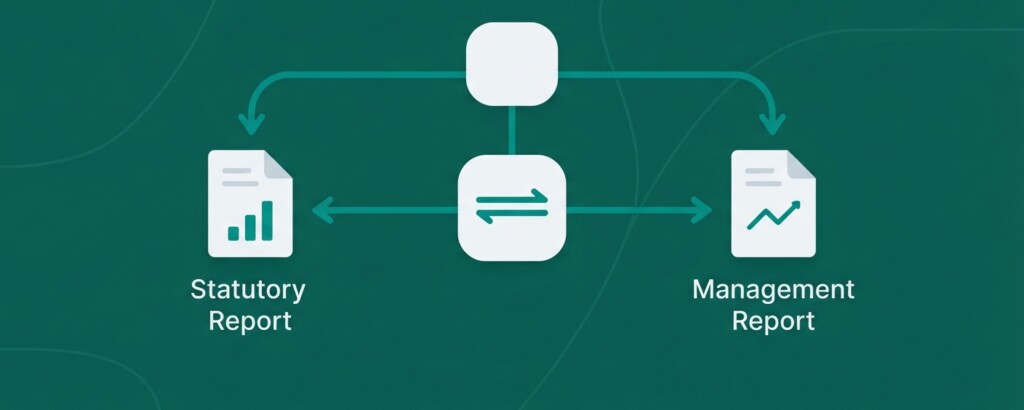
This article explains how to architect a group reporting pack that produces both a statutory consolidation and a management view from a single data set and a single close — without doubling the workload or maintaining parallel ledgers.
Why the Two Views Diverge in the First Place
Statutory consolidation follows specific accounting standards — IFRS 10, FRS 102, or equivalent local GAAP — and must comply with rules around control, non-controlling interests (NCI), goodwill, and the treatment of intragroup transactions. The output is a set of consolidated financial statements that an auditor can sign off on.
Stop building consolidations in spreadsheets.
BrizoConsol automates multi-entity consolidation — setup in minutes, reports the same day.
Management reporting, by contrast, is built around how a business is actually run. It might exclude certain IFRS adjustments, include proportional views of joint ventures, split results by business line rather than legal entity, or present currency results in a way that strips out the noise of FX translation. Neither view is wrong — they serve different purposes — but if your process treats them as separate exercises, you end up closing twice.
The root cause of most dual-close problems is that intercompany eliminations, FX translation, and NCI adjustments are applied as a single batch at the end of the month, making it impossible to reuse the same workings for both statutory and management purposes. Separating these adjustment layers cleanly is the fix.
The Adjustment Layer Architecture
The practical solution is to treat the consolidation process as a series of discrete, stackable adjustment layers rather than a single consolidation journal. Each layer can be included or excluded depending on which view you are building. At the base is the trial balance of each individual entity. On top of that you apply intercompany eliminations, then FX translation, then statutory adjustments (goodwill, NCI, acquisition accounting), and finally management-only adjustments (segment reallocations, budgeted rates, proportional JV inclusion).
When those layers are documented and applied separately, a management report simply switches off the statutory-only layers and switches on any management-only layers. You have run the close once. You are just selecting which layers to render.

Intercompany Eliminations: Getting the Foundation Right
Before you can separate statutory from management views, intercompany eliminations need to be handled systematically. The most common mistake is to eliminate intercompany balances as a net journal at consolidation level without first confirming that both sides of each intercompany transaction agree at entity level. When they do not agree — which is most of the time in practice — you end up with a residual difference that distorts both views.
Consider a straightforward intercompany loan: Entity A has recorded a loan receivable of £500,000, and Entity B has recorded the corresponding loan payable. At consolidation, both sides are eliminated. But if Entity B has accrued interest that Entity A has not yet recognised in the same period, the balances do not match, and the elimination leaves an unexplained difference.
| Account | Dr | Cr |
|---|---|---|
| Intercompany Loan Payable — Entity B | 500000 | |
| Intercompany Loan Receivable — Entity A | 500000 |
Standard intercompany loan elimination at consolidation. Both sides confirmed as agreed before posting. Any timing differences in interest accruals are resolved at entity level prior to close.
The discipline here is to run an intercompany agreement process before the elimination journals are posted, not after. Every entity should confirm its intercompany balances against its counterparties, and mismatches should be resolved at entity level. That way the elimination journal is clean, and the same elimination can be reused in both the statutory pack and the management pack.
FX Translation: Separating Transaction Exposure from Translation Exposure
FX translation is where statutory and management views most commonly diverge. The statutory requirement under IAS 21 is to translate foreign operation results at the average rate for the period and the closing balance sheet at the closing rate, with the resulting translation differences taken to other comprehensive income (OCI) through the foreign currency translation reserve.
Management reporting often wants something different: results translated at a budgeted rate so that operational performance is not distorted by exchange rate movements that the business unit has no control over. This is legitimate and useful, but it means the FX layer needs to be split into two components: the translation at actual rates (statutory) and the variance between actual and budget rates (management adjustment).
| Revenue of EU subsidiary at actual average EUR/GBP rate of 0.86 | £2,320,000 |
| Revenue of EU subsidiary at budgeted EUR/GBP rate of 0.88 | £2,374,400 |
| Management FX variance (excluded from statutory, included in management commentary) | £54,400 |
| Statutory consolidated revenue (actual rate) | £2,320,000 |
By keeping the management FX adjustment as a named, documented layer, you can reconcile from the management figure back to the statutory figure at any time. The two packs are no longer disconnected — they are the same data set with different layers applied.
Non-Controlling Interests: Where Statutory Complexity Lives
NCI is almost exclusively a statutory requirement. Under IFRS 10, where a parent controls a subsidiary but does not own 100% of it, the portion of net assets and profit attributable to minority shareholders must be presented separately in the consolidated statements. For management reporting, most groups choose to present either a 100% view of the controlled entities or a proportional view based on economic ownership — neither of which matches the statutory NCI presentation exactly.
The key is to calculate NCI as a discrete adjustment layer. The consolidated profit and net assets are determined first on a 100% basis, and then the NCI allocation is applied as a separate step. The management pack simply omits that final NCI allocation step or replaces it with an economic ownership view.
| Entity | Group Ownership | PAT (100% Basis) £ | NCI Share % | NCI Allocation £ | Attributable to Group £ |
|---|---|---|---|---|---|
| Subsidiary A | 80% | 320,000 | 20% | 64,000 | 256,000 |
| Subsidiary B | 75% | 180,000 | 25% | 45,000 | 135,000 |
| Subsidiary C | 100% | 540,000 | 0% | 0 | 540,000 |
| Group Total | 1,040,000 | 109,000 | 931,000 |
In the statutory pack, the NCI column populates the consolidated statement of changes in equity. In the management pack, the same underlying profit figures are used but the NCI layer is suppressed or replaced with a simpler economic attribution. You have not done two closes — you have done one close with two rendering options.
The Single Close Process in Practice
Running a single close that feeds both packs requires a specific sequencing of steps. The order matters because some adjustments depend on others being complete first.
- Each entity submits its trial balance and a completed intercompany confirmation schedule by a fixed cut-off date.
- Intercompany mismatches are identified and resolved at entity level with correcting journals posted in the source ledger.
- FX translation is applied to all foreign entity balances at actual average and closing rates to produce statutory translated figures.
- Management rate variances are calculated as a separate overlay and documented in the reporting pack.
- Intercompany elimination journals are posted at group level against the translated, agreed balances.
- NCI is calculated as a discrete layer applied to the 100% consolidated figures.
- Statutory adjustments (goodwill amortisation where applicable, acquisition accounting adjustments, deferred tax on consolidation) are posted as a named layer.
- Management adjustments (segment reallocations, cost recharges that are eliminated statutorily but shown in management, proportional JV inclusion) are posted as a separate named layer.
- Statutory pack is produced by rendering the shared and statutory layers (steps 1, 2, 3, 5, 6, and 7, excluding management overlays).
- Management pack is produced by rendering the shared and management layers (steps 1, 2, 3, 4, 5, and 8, omitting statutory-only adjustments and suppressing or replacing the statutory NCI allocation), with a reconciliation bridge to the statutory figures.
The most common failure point in this approach is allowing ad hoc adjustments to be posted directly to the consolidation without being tagged to a layer. Every journal posted at group level must be classified as statutory, management, or shared. If it is not classified, it is impossible to know which pack it should appear in, and both packs become unreliable.
Building the Reconciliation Bridge
A well-constructed group reporting pack always includes a reconciliation bridge between the statutory profit attributable to the group and the management reported profit. This is not just good practice — it is essential for audit readiness and for CFO confidence when presenting to a board that will see both sets of numbers.
The bridge is simply a structured list of the named adjustment layers, showing what each layer adds or removes between the two views. It makes the relationship between the packs transparent and auditable without requiring either pack to be rebuilt from scratch.
| Statutory consolidated profit after tax attributable to the group | £931,000 |
| Add back: NCI allocation (management shows 100% view) | £109,000 |
| Add: Management FX variance (budget vs actual rate) | £54,400 |
| Less: Segment reallocation adjustment (not in statutory) | -£28,000 |
| Management reported profit after tax | £1,066,400 |
Where Manual Processes Break Down
In Excel-based group reporting, the layered approach described above is theoretically possible but practically fragile. Each layer tends to become a separate tab or workbook, version control is difficult, and when an entity resubmits a corrected trial balance after the close has started, the cascade of updates required across all layers is prone to error. The intercompany confirmation step in particular is a significant manual burden when it requires email-based matching of balances across multiple counterparties and currencies.
Consolidation software addresses this by holding the entity trial balances and all adjustment layers in a connected data model. When a trial balance changes, the FX translation, eliminations, and NCI calculations update automatically. The statutory pack and management pack are rendered from the same underlying data set without manual rekeying. The reconciliation bridge is maintained automatically because the layer classification is built into every journal.
The practical benefit for a finance team running a six-entity group is not just speed — it is the ability to reforecast the group position mid-month, run sensitivities on FX rates, or model the impact of an acquisition on consolidated NCI without rebuilding the entire workbook from scratch.
Governance and Documentation Standards
A group reporting pack that separates statutory from management views only delivers its full value if it is accompanied by clear governance documentation. This means a written consolidation policy that defines which entities are in scope for full consolidation versus equity accounting, how intercompany transactions are classified, what the management rate methodology is, and how NCI is calculated for each subsidiary. It also means a close calendar that specifies cut-off dates for each step in the layered process.
Without that documentation, the pack is dependent on the knowledge of one or two individuals who built it, and it becomes difficult to review, audit, or hand over. Good governance transforms the pack from a one-person exercise into a repeatable institutional process.
A Note on Statutory Compliance
This article has focused on process architecture rather than accounting standards, but it is worth noting that the statutory layer must comply with whichever GAAP applies to the group. For IFRS reporters, IFRS 10 on consolidation, IAS 21 on FX translation, IFRS 3 on business combinations, and IAS 27 on separate financial statements are the primary references. For UK GAAP reporters, FRS 102 Section 9 covers consolidated financial statements and Section 30 covers foreign currency. The management layer has no external compliance requirement but should be consistently applied and clearly described in the pack so that users understand what they are looking at.
How BrizoConsol handles this
BrizoConsol is built around the layered adjustment model this article describes. Each entity connects directly — via Xero or QuickBooks Online integration, or through Excel import — so trial balance data flows into a single consolidated data set without rekeying. Intercompany eliminations are organised by type with configurable difference treatment, meaning the elimination layer is discrete and reusable across both packs. Currency translation applies actual average and closing rates with CTA calculated automatically, and a separate management rate overlay can be maintained alongside the statutory figures without overwriting them.
NCI is calculated as a named layer that the management reporting view can suppress or replace, while the statutory consolidated statements carry the full IFRS 10 presentation. Group reporting and board packs are produced from the same underlying data set by selecting which layers to render. Every journal posted at group level carries a classification, so the reconciliation bridge between statutory and management profit is maintained automatically rather than rebuilt each period.
Stop building consolidations in spreadsheets.
BrizoConsol automates multi-entity consolidation — setup in minutes, reports the same day.